The first thing I learned after leaving Rylor was that a pack becomes heavier with distance.
This is not literally true. I understood weights well enough even then to know that dried meat did not acquire substance merely because I had carried it over another hill. Nevertheless, by midday the straps seemed to have discovered portions of my shoulders that had never previously existed, and the waterskin at my side had developed an astonishing ability to strike the same place on my hip with every step.
I did not complain.
There was no one to hear me.
That was the second thing I learned.
The country east of Rylor’s hut was not wilderness in the sense that no Silvren had ever passed through it. Hunters came this way. Trappers knew the streams. There were isolated homesteads and, farther south, I had been told, a settlement large enough to possess a meeting hall and smithy. Yet the land no longer bore the continuous marks of our presence that surrounded Nuahaven. A road might continue for several miles and then diminish into two wheel ruts, which became a footpath, which became a suggestion among the grasses. Fences appeared around a field and vanished again. Smoke on the horizon might mean a house, a hunting camp, or merely a fire started by lightning. For the first time in my life, the works of people seemed temporary and small against the land.
The prairie rolled eastward beneath Solara in long folds of green and yellow, broken by low ridges of dark stone. Groves gathered in the hollows where water lingered. Some were composed of the broad-leafed trees I knew from home; others became increasingly unfamiliar as I traveled, with pale trunks that divided close to the ground and branches covered in narrow leaves that flashed silver when the wind turned them. Velithons moved through the distant grass, their six legs giving their running gait a strange smoothness. Smaller creatures scattered before me, disappearing into holes with flicks of striped tails. Once I watched three Skydrakes circle high overhead until their bronze-colored bodies became no more than glints against the sky.
I found myself measuring things.
Not with any seriousness at first. It was simply habit. A builder looks at a fallen tree and wonders how many beams might be cut from it. He sees a stream and estimates the span of the bridge required to cross it. He notices whether a hillside is too steep for a cart and whether exposed stone will split cleanly beneath a hammer.
But Nua had said, The Silvrens need your measure.
So I began paying closer attention.
I counted my steps between landmarks. I estimated the width of streams. I noted how long Solara traveled while I crossed a stretch of open country. At the crest of each ridge I turned and looked back, trying to fix the shape of the land in memory.
I had no parchment, bark, charcoal, or stylus.
This made surveying a continent inconvenient.
I considered marking distances on a stick, but that would require carrying the stick, and I was still uncertain how freely I ought to accumulate possessions after being commanded to take only the clothes on my back.
Rylor’s pack had already stretched my interpretation considerably.
I finally decided that a stick found on the road and discarded after use would not constitute a possession in any meaningful sense. Then I began wondering whether a thing became a possession when one intended to use it again.
After perhaps half an hour of this I threw the stick into the grass.
I was beginning to suspect that literal obedience could become a form of madness.
Still, I kept count where I could.
By afternoon the blister on my heel had become less painful, thanks to the leather Rylor had fitted inside my boot. The road had disappeared entirely, but a narrow trail continued east between two low ridges. I followed it until I reached a stream, where the path divided.
One branch followed the water north.
The other continued southeast.
I stopped.
“Go east,” I said aloud.
The stream offered no advice.
I looked at Solara and judged direction from her movement. The southeastern path was closer to my intended course, so I took it.
Within an hour it curved south.
I continued, expecting it to turn again.
It did not.
By the time I admitted that I was walking almost directly away from my intended direction, I had descended into a shallow valley and lost sight of the ridges behind me.
I turned around.
The experience was humbling.
Nua had commanded me to cross a continent, and I had become lost before consuming Rylor’s second loaf of bread.
I retraced my path until I reached the stream again, drank, filled the waterskin, and followed the northern branch. It soon bent east.
“Thank you,” I told it.
I was not certain whether I meant the stream, the trail, or Nua.
The country rose gradually throughout the afternoon. The prairie became broken by larger stands of trees, and the soil beneath my boots changed from dark loam to reddish earth mixed with stones. I passed places where the land itself seemed wounded—long cracks descending into darkness, some narrow enough to step across, others forcing me to detour. Warm air rose from one of them carrying a mineral smell. Farther away, a column of steam climbed above the trees.
The geyser fields began somewhere to the south.
I knew them only from stories.
As a boy, I had imagined geysers as fountains arranged conveniently in open spaces. The first one I saw was partly hidden among rocks. There came a deep thumping beneath the earth, followed by a hiss, and suddenly a white column of water erupted higher than the surrounding trees. Steam rolled outward. Birds fled from the branches.
I stood staring until the water subsided.
There are wonders one expects to feel holy because they are enormous or beautiful. The geyser did not feel holy.
It felt as though the ground had indigestion.
I walked on.
Late in the day clouds gathered from the north. The light changed quickly, Solara becoming a pale disk behind gray. Wind moved through the grass in long waves. I had been watching the weather with increasing concern when I saw another house.
This one stood farther from the trail than Rylor’s hut and was surrounded by a low fence. There was a small garden behind it, rows of dark green leaves protected by woven screens. A shed leaned against one side of the dwelling. Smoke rose steadily from a stone chimney.
I stopped.
The obvious course was to ask for shelter.
That thought made me uncomfortable.
One night earlier, I had left Nuahaven with nothing because Nua had commanded me to do so. Within a day I had accepted two meals, a night’s lodging, a pack, food, water, a knife, cord, flint, a blanket, and advice.
At this rate I would reach the eastern sea accompanied by a wagon.
Thunder sounded.
I went to the house.
Before I reached the fence, the door opened.
A young woman stepped outside.
She carried no weapon, but she did not appear frightened. She stood beneath the eave watching me approach, one hand still holding a length of cord she had apparently been working.
Her first impression upon me was not beauty, though she was attractive. It was competence.
There are people whose surroundings seem to belong to them. The repaired fence, the stacked wood, the covered garden, the neatly patched roof, the tools hung beneath the shed—everything around the house suggested the same pair of hands returning repeatedly to whatever needed doing.
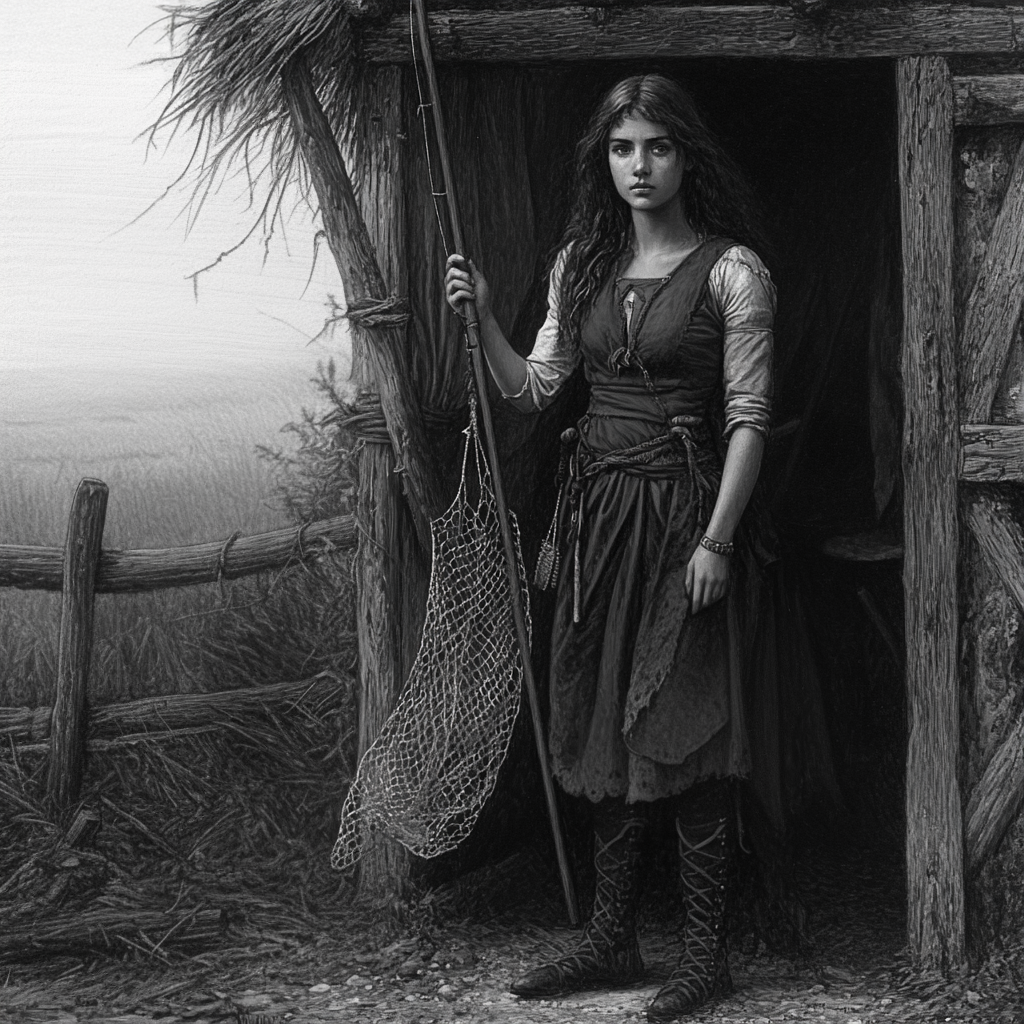
She wore a simple dress of brown woven cloth, heavier at the hem where it had been reinforced. Her hair was long and dark, tied loosely behind her shoulders. She was somewhat smaller than most women I knew, though there was nothing frail in the way she stood.
She looked at my pack.
Then at my boots.
Then at the sky.
“You are either arriving at exactly the right time,” she said, “or exactly the wrong one.”
Thunder sounded again.
“I was hoping for the first.”
“That depends on whether you leak.”
“I try not to.”
She smiled.
“Come through before the rain decides for us.”
I opened the gate.
“My name is Heth.”
“Lirael.”
The first drops struck as she spoke.
Within moments the rain became heavy.
We hurried beneath the eave, and she opened the door.
“Leave the boots there.”
I did.
The inside of the house surprised me.
It was small, but every part of it had been used carefully. Shelves occupied one wall, holding jars, folded cloth, bundles of dried plants, bone hooks, needles, twine, and objects I could not identify. A worktable stood beneath the window. Several hides hung from pegs near the hearth. Nets were folded in one corner, though there was no large body of water nearby that I knew of. A wooden frame held a half-finished garment.
The roof did not leak.
I noticed that immediately.
Lirael noticed me noticing.
“Builder?”
I looked at her.
“How did you know?”
“You looked at the rafters before you looked at me.”
“I did not.”
“You did.”
“I was admiring the roof.”
“That is exactly what a builder would say.”
She took my wet cloak.
“This seam will fail.”
I examined it.
“It has held for years.”
“It will fail.”
“Rylor gave me that cloak yesterday.”
“Then Rylor gave you a cloak with a bad seam.”
“You know Rylor?”
“No.”
“That was unnecessarily decisive.”
She smiled again.
“Sit. You are making the floor wet.”
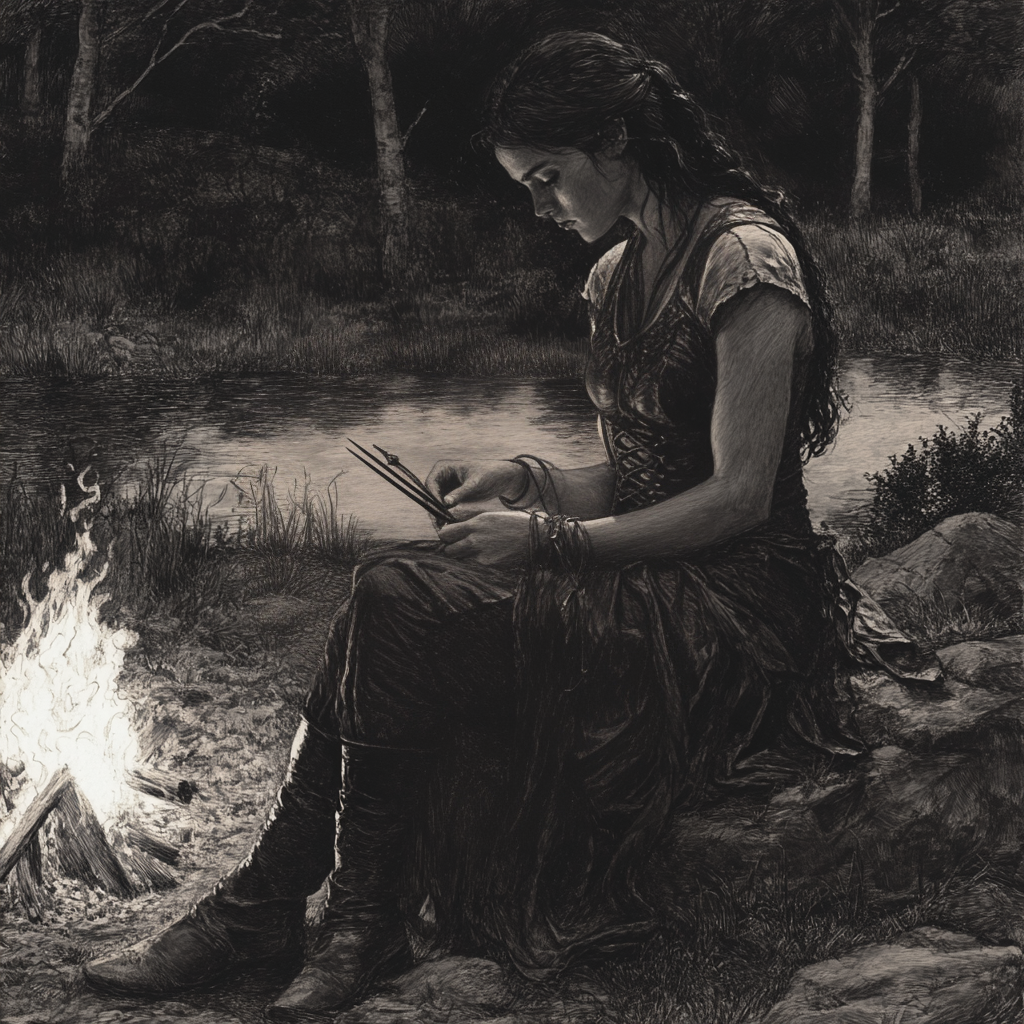
I sat near the hearth while she hung the cloak and returned to whatever she had been doing before I arrived. The length of cord proved to be part of a net. She worked quickly, passing the line through loops with movements so practiced that she scarcely watched her hands.
Rain hammered the roof.
For a while neither of us spoke.
I found the silence comfortable.
That was unusual.
Most people confronted with a stranger eventually begin filling the space with questions. Lirael seemed content to let me exist without explanation.
Then she said, “Nuahaven?”
I looked up.
“Yes.”
“Thought so.”
“How?”
“Your boots.”
I looked at them outside the door.
“They are ordinary boots.”
“They are Nuahaven work boots. Wide heel, doubled toe. Builders and field hands wear them.”
“You know a great deal about boots.”
“I repair things.”
“So do I.”
“Then why is your cloak seam bad?”
“It is not my cloak seam. It is Rylor’s cloak seam.”
“Rylor has become responsible for it very quickly.”
I laughed.
She tied off the cord.
“What brings a Nuahaven builder this far east?”
I hesitated.
“Travel.”
She looked at the rain.
“That is generally how people get here.”
I had heard something similar the previous evening.
Apparently solitude encouraged a particular sense of humor.
“I am going east.”
“How far?”
“I do not know.”
“That is a strange journey.”
“I have recently been told that.”
She set the net aside and moved to a pot near the hearth.
“Have you eaten?”
“Yes.”
“When?”
I thought.
“Morning.”
“That is not what I asked.”
“No.”
She lifted the lid.
Steam rose carrying the smell of roots, herbs, and meat.
I wondered whether Nua had arranged all of Aetheria as a sequence of stew pots.
“I can pay—”
She looked at me.
I remembered I had no money.
“No, I cannot.”
“Then it is fortunate I did not ask.”
She ladled stew into two bowls.
I accepted mine.
This time I did not debate whether doing so violated divine instruction.
My theology really was improving.
We ate while rain blurred the window.
Lirael asked about Nuahaven, but her questions differed from Rylor’s. She wanted to know whether the eastern market had been enlarged, whether a particular family still operated the tannery near the river, whether the meeting hall had finally replaced its cracked southern steps.
“You have lived there,” I said.
She looked into her bowl.
“Yes.”
Something in her voice warned me not to ask more.
So I did not.
We spoke instead of the road.
“There is no road,” she said.
“There was one.”
“There are trails. Most lead somewhere useful to the person who made them. That does not mean they lead somewhere useful to you.”
“I discovered that this morning.”
“Where?”
I described the stream and the two paths.
“You took the south branch.”
“Yes.”
“That goes to an old quarry.”
“I know that now.”
“You reached it?”
“No.”
“Then you do not.”
I smiled.
“Where does the northern path go?”
“Here, eventually. Beyond here it breaks into game trails.”
I stopped eating.
“No eastward trail?”
“Not one worth trusting.”
That was unwelcome.
“How do people travel farther?”
“Most do not.”
“But trappers?”
“They know landmarks. Streams. Ridges. The movement of Solara.”
“I can follow Solara.”
“When you can see her.”
Lightning flashed beyond the window.
I looked toward it.
Lirael smiled slightly.
“There are other ways. Moss is sometimes useful, but not as reliable as people say. Wind can help if you know the season. Water is better. Rivers remember where they are going even when people do not.”
“I need to go east.”
“Then you need to learn the country.”
“I was hoping the country would cooperate.”
“It rarely does.”
She ate another spoonful.
“Why east?”
I had reached the point where evasion seemed ridiculous.
“Nua told me to go.”
Lirael stopped.
Unlike Rylor, she did not immediately become solemn.
She studied me.
“Nua.”
“Yes.”
“The Eternal Shaper.”
“I am aware of which Nua.”
“I wanted to be certain.”
“I dreamed of her two nights ago.”
“And she told you to walk east.”
“Yes.”
“In those words?”
“Among others.”
“What others?”
I repeated the command.
She listened without interrupting.
When I finished, she sat back.
“The giants need your treasure. The Silvrens need your measure. Go east. Leave this very night. Take only the clothes on your back. Do not return until you see the blue.”
“Yes.”
“And you have a pack.”
“It is a complicated story.”
“It has been two days.”
“A surprisingly complicated two days.”
I told her about Rylor.
When I reached the part about leaving home in proper clothes instead of my nightshirt, she laughed.
Not politely.
She laughed until she put down her bowl.
“I had hoped for sympathy.”
“You dressed first.”
“Yes.”
“After Nua said—”
“Yes.”
“You argued with Nua.”
“Silently.”
“That makes it better.”
“I believed she meant possessions.”
“And then the next day you acquired possessions.”
“Rylor had persuasive arguments.”
“I am sure he did.”
Her laughter faded, though the amusement remained in her eyes.
“What do you think the words mean?”
I explained.
The treasure was our faith.
The measure was Aetheria.
The blue was the eastern sea.
Lirael listened more carefully now.
When I finished, she said, “You are very certain.”
“I am not certain.”
“You sound certain.”
“They are reasonable interpretations.”
“Yes.”
I waited.
She said nothing.
“You disagree.”
“I did not say that.”
“You were about to.”
“I was thinking.”
“About what?”
“That Nua presumably knows the words she wants to use.”
“Of course.”
“So why not say, ‘Take the Covenant east, learn the size of Aetheria, and stop when you reach the sea’?”
I had no answer ready.
Lirael continued eating.
“Prophecy is rarely plain.”
“That is convenient.”
“For prophets?”
“For everyone interpreting them.”
“You think I imagined it.”
“I did not say that either.”
“You imply a great deal without saying it.”
“It saves breath.”
I found myself smiling despite my irritation.
“What do you believe?”
“In Nua?”
“Yes.”
“Yes.”
“Then why question her words?”
“I am questioning yours.”
That stopped me.
Outside, the rain had begun to ease.
Water dripped steadily from the eaves.
Lirael set down her bowl.
“If Nua spoke to you, then Nua spoke to you. But the moment the dream ended, Heth began speaking to Heth.”
I stared at her.
“You sound like Rylor.”
“I hope that is not an insult.”
“I have known him for one day.”
“And already he has given you a pack and a philosophy.”
“He also gave me bread.”
“Then I approve of him.”
She rose and took our bowls.
I watched her rinse them in a basin.
“You have thought about these things.”
“Everyone thinks about these things.”
“Not everyone asks questions like that.”
She did not respond.
I sensed again the boundary around some part of her life.
Rain continued more gently into evening.
I had assumed I would sleep beneath the eave or in the shed, but Lirael pointed toward a narrow bedroll near the hearth.
“You can use that.”
“I do not want to impose.”
“You already ate my stew.”
“That is true.”
“You are committed now.”
I thanked her.
She returned to the damaged seam on my cloak.
“You were serious?”
“It will fail.”
She threaded a needle.
I watched her work.
“You said you repair things.”
“Anything I can.”
“Clothes?”
“Clothes. Nets. Leather. Harness. Roofs when I must. Pots if the crack is kind. People occasionally, though they are more difficult.”
“Healer?”
“No. I know enough to keep someone alive until a healer arrives.”
“That sounds useful out here.”
“It has been.”
She pulled the thread tight.
“Why live here alone?”
The question escaped before I could stop it.
Her hands paused.
I immediately regretted asking.
“You do not have to answer.”
“I know.”
She resumed sewing.
For a while the only sounds were the needle passing through cloth and water dripping outside.
“I was not always alone,” she said finally.
I waited.
“I lived in Nuahaven.”
“I gathered that.”
“My mother still does, unless she has moved.”
“You do not know?”
“No.”
That answer carried more weight than the words.
She finished one stitch and began another.
“There was a man.”
I remained silent.
“Kael.”
She spoke the name carefully, as though it had edges.
“He was a builder too, though not as good as he believed. He worked stone more than wood. We met when I was eighteen.”
She smiled faintly.
“He dropped a block on his foot because he was looking at me.”
“That sounds painful.”
“It improved him temporarily.”
“What happened?”
Her expression changed.
“We wanted a household.”
I nodded.
“We needed a syren.”
There was nothing unusual in that statement.
She continued.
“There were fewer unattached syrens in our part of Nuahaven then. Several households were already waiting. We spoke with two. Neither bond was right. Then we met Eland.”
Her eyes remained on the cloak.
“He was kind. Quiet. I liked him. Kael liked him. For a while I thought it would work.”
“What happened?”
“His family had promised him elsewhere.”
I frowned.
“Promised?”
“Not formally. There was land involved. Two families had expected the match since Eland was a child. No one had bound him to it, exactly, but expectation can become a kind of rope if enough people hold the ends.”
“And he chose them?”
“Eventually.”
“Did he want to?”
“I think he wanted everyone to stop asking him what he wanted.”
I understood that better than I cared to admit.
Lirael examined the seam she had just sewn, apparently found it unsatisfactory, pulled several stitches free, and began again.
“For a while Kael and I waited. We thought another syren would come along. Nuahaven was growing. People arrived from the smaller settlements. New households formed all the time. There was no reason for us to hurry.”
“But you did.”
“Yes.”
There was no defensiveness in the word.
That made it worse.
“We loved each other. At least I believed we did. We had spent nearly two years waiting. Every season someone would ask whether we had found a syren yet. Every feast we attended seemed full of households with children. Kael became angry about it. I became angry with him for becoming angry. Then I became angry for the same reason.”
She looked toward the window.
“The strange thing is that we knew.”
“Knew what?”
“What would happen.”
I said nothing.
“There are things people do because they do not understand the consequences. This was not one of them. We had seen Discordants. Everyone has. We knew why they were born. We knew the teachings. We knew nature. We knew everything there was to know.”
Her fingers tightened around the cloak.
“And we did it anyway.”
The room seemed suddenly smaller.
Lirael continued.
“One night Kael came to see me. We had argued earlier. I do not even remember what the argument was about. Probably Eland. Probably waiting. Probably nothing. We made peace.”
She stopped.
I did not ask her to continue.
“We committed discord.”
The words required no explanation.
I had heard confessions of discord before. Everyone in Nuahaven had. The Covenant treated it as one of the gravest violations of Nua’s order, not merely because it broke the sacred sequence but because its consequences could take living form.
I learned later that her family had lived east of the river, nearly half a day’s walk from my father’s house. We had both called ourselves people of Nuahaven, but there had been little reason for our paths to cross. Nuahaven, unfortunately, had grown large enough and dispersed enough that local scandals were not universally known.
Lirael looked directly at me.
“I became pregnant.”
I felt my stomach tighten.
She saw it.
“Yes.”
The fire cracked softly.
“Was the child—”
“A Discordant.”
I wished immediately that I had not asked.
Lirael looked away.
“He was born alive. Male. Large. Larger than he should have been. His arms were already too thick, his head wrong in shape. He cried constantly. Not like other infants. It was more like an animal crying.”
Her voice remained steady, but only because she was forcing it to.
“I held him.”
I looked down at my hands.
“What happened?”
“He died.”
That could mean many things among our people.
The Covenant commanded mercy toward Discordants, but mercy had never been a simple word where they were concerned. Some could be cared for. Some were violent almost from birth. Some suffered terribly. The old histories told of darker ages when they had been killed casually or abandoned, and of the Sanctuary Nua had prepared for them. In Nuahaven such decisions were made by families, healers, and elders, and everyone pretended afterward that the decision had been clearer than it was.
I did not ask how Lirael’s child died.
Perhaps she appreciated that.
“Kael left before the birth,” she said.
That surprised me more than anything else she had told me.
“He left you?”
“Yes.”
“Why?”
“Ask Kael.”
“I would, if he were here.”
“So would I.”
There was bitterness now.
“He said he could not bear the shame. He said everyone looked at him differently. He said he needed time. Then one morning he was gone.”
“And you?”
“I remained.”
“Alone?”
“My mother was with me.”
The answer softened her.
“She never abandoned me. Remember that if I say unkind things about Nuahaven. My mother did not abandon me.”
“I will.”
“But others…”
She shrugged.
“No one drove me out. That is how people tell the story now, I suppose.”
“I had heard nothing.”
“You were younger.”
“Not much.”
“Far enough away socially, then. Builders have their circles. My family had ours.”
She resumed sewing.
“No elder stood in the square and proclaimed Lirael banished. No one burned my house. No one refused me water. People are usually subtler than that.”
I knew what she meant before she explained.
“A woman would stop talking when I approached. Someone who had always sat beside me at a feast would discover another seat. Mothers watched their children more closely when I was nearby, as though discord were a fever. Men who had once spoken to me normally became excessively courteous. That was almost worse.”
“Why?”
“Because excessive courtesy is what people use when they want to prove they are not being cruel.”
I smiled faintly.
She did not.
“The elders were kind. Very kind. They reminded me of Nua’s mercy. They reminded me that the Sanctuary received the souls of Discordants. They reminded me that repentance restores harmony.”
She pulled the thread hard.
“I did not need reminding.”
“No.”
“Everyone wanted me to repent in a way they could see. They wanted tears at the right moments. They wanted gratitude for forgiveness. They wanted me to become a lesson.”
I thought of the Covenant tablets.
“Were you not sorry?”
Her eyes flashed toward me.
“Yes.”
The force of the answer made me flinch.
Then her expression softened.
“Sorry. That was unfair.”
“No. My question was.”
“I was sorry every day. I was sorry when I woke. I was sorry when I ate. I was sorry when I saw children. I was sorry when I saw a syren walking beside a woman and wondered whether we might have waited one more season.”
She looked into the fire.
“I was sorry when I held my son.”
Neither of us spoke for a while.
Rain ticked lightly against the window now, no longer a storm.
“I simply did not believe sorrow belonged to the village,” she said. “It belonged to me.”
I thought about that.
At twenty-three I still believed many things could be divided neatly into obedience and opposition, wisdom and foolishness, harmony and discord. Lirael did not persuade me otherwise that evening.
She did something more important.
She made the divisions harder to draw.
“How did you come here?” I asked.
“Slowly.”
She seemed grateful for the change.
“After the child died, I stayed with my mother. I worked. Sewing mostly. Then leather. Nets. Anything people would bring me. Work is useful when you do not want to think.”
“I know.”
She glanced at me.
“Yes. I suspect you do.”
“Eventually I began traveling to the eastern farms. People there knew less about me. Or knew and cared less. Things break everywhere. A person who can mend them is welcome.”
“That is true.”
“I stayed farther east each time. One farmer let me sleep in a shed. Another paid me with a set of tools. I learned trapping from an old woman who had lost two fingers and therefore preferred teaching to setting traps herself. I learned which plants stop bleeding and which make a person wish he had bled to death instead.”
“Useful distinction.”
“Very.”
“Then I found this place. The house was half collapsed. Whoever built it had been gone for years. I repaired the roof, then the wall, then the chimney. By the time I finished, I realized I lived here.”
I looked around again.
“You did all this?”
“Most of it.”
“The roof beam above the door?”
“What about it?”
“It is carrying too much weight.”
Her eyes narrowed.
“It has carried it for four years.”
“It will sag.”
“It has not.”
“It will.”
She looked offended.
“You have been in my house half an evening.”
“I am a builder.”
“I repaired your cloak.”
“That does not qualify you to suspend a roof incorrectly.”
“It is not incorrect.”
“The brace is too shallow.”
She stood.
I stood too.
We both looked at the beam.
Lirael pointed.
“The load transfers there.”
“Some of it.”
“All that matters.”
“No. Look at the joint.”
She looked.
I pointed to a faint line in the wood.
“That is beginning to open.”
She stared.
I tried not to appear pleased.
She moved closer.
“That could have been there when I fitted it.”
“It could.”
She looked at me.
“It was not.”
I smiled.
She sighed.
“I dislike you slightly more than I did before.”
“I can repair it tomorrow.”
“Tomorrow?”
The word stopped us both.
I had assumed I would leave at dawn.
She had apparently assumed the same.
Outside, the rain had almost ended.
“I should go in the morning,” I said.
“Yes.”
“But the beam—”
“Will survive.”
“Probably.”
“That is not reassuring.”
“It was not intended to be.”
She folded my cloak and handed it back.
The seam was nearly invisible.
I examined it.
“Well?”
“It is good.”
“Only good?”
“Very good.”
“Better.”
I put it beside my bedroll.
Lirael extinguished one of the lamps.
“Sleep, Heth of Nuahaven. You can save my roof and the giants tomorrow.”
“I am not sure which comes first.”
“My roof.”
I lay down.
She disappeared behind a hanging cloth that divided the sleeping portion of the house from the main room.
I expected sleep to come immediately.
It did not.
I lay watching the last orange light of the hearth move across the rafters.
I thought about Lirael.
Not as a woman.
I should make that clear.
She was attractive. I had noticed that when I arrived, and I was not so pious or so foolish as to pretend otherwise. But whatever feeling had been absent with Mira and Seren was absent here as well. I felt no desire to court Lirael, no imagining of a household, no restless curiosity about whether affection might become something else.
Instead, I felt something almost as unfamiliar.
I liked her.
That sounds trivial written now.
It was not trivial then.
I had acquaintances in Nuahaven. Cousins. Fellow builders. Men with whom I worked and drank and argued. I had people who would help me raise a roof and people I would help in return.
But I had few friends.
Perhaps none.
I had never considered this a deficiency.
Lirael had known me for a few hours and had questioned my prophecy, mocked my interpretation, repaired my cloak, fed me, told me the most painful story of her life, and argued with me about a roof beam.
I wanted to continue talking to her.
That was new.
Eventually I slept.
I awoke to hammering.
For one confused moment I thought I was home.
Then I opened my eyes and saw Lirael standing on a stool near the doorway with a wooden mallet in one hand.
“What are you doing?”
“Repairing my dangerously constructed house.”
“You need to unload the beam first.”
She stopped.
“I knew that.”
“No, you did not.”
“I was about to.”
I got up.
Morning light filled the room. The storm had passed, leaving the air outside washed clean. Water sparkled on every leaf. Mist lay low across the fields.
We spent the first part of the morning repairing the roof.
I had not intended to.
Nua had said go east.
But I reasoned that I was already awake east of where I had slept the previous morning, and perhaps an hour spent preventing a roof from collapsing did not constitute abandonment of my mission.
This was another example of the flexibility my obedience had acquired.
The repair required more than an hour.
Once we opened the joint, we found rot beginning beneath it.
Lirael looked at me.
“Do not say anything.”
“I was not going to.”
“You were.”
“I was thinking.”
“That is worse.”
We removed the damaged section, cut a replacement from seasoned timber stored beneath her shed, and fitted a steeper brace. Lirael worked well. She did not possess my training, but she understood tools and needed few instructions. When I asked for something, she usually anticipated which thing before I finished asking.
By midday the beam was sound.
I stood beneath it admiring our work.
Lirael stood beside me.
“It looks exactly the same.”
“That is the sign of a good repair.”
“It took half the morning.”
“That is also the sign of a good repair.”
“You builders have arranged your philosophy conveniently.”
“We learn from prophets.”
She laughed.
We ate bread and dried fruit outside.
The world after the storm seemed enormous.
The hills east of her house rose one behind another, darker as they receded. Beyond them, faint against the horizon, I could see a line that might have been distant forest or another ridge.
“That way?” Lirael asked.
“Yes.”
“What will you do when the trails end?”
“Continue east.”
“That is not a method.”
“I will follow Solara.”
“Until clouds come.”
“Then I will wait.”
“What if you are beneath trees?”
“I will use moss.”
She stared at me.
“You know nothing about moss.”
“I know it grows on the north side of trees.”
“Sometimes.”
“That is what everyone says.”
“Everyone who gets lost.”
I bit into the bread.
“I will manage.”
“I am beginning to doubt that.”
“You have known me less than a day.”
“It has been an informative day.”
After we ate, I filled my waterskin from her well and gathered my things.
Lirael watched.
“You are taking the eastern ridge?”
“I suppose.”
“There is a stream beyond it.”
“Does it go east?”
“For a while.”
“Then I will follow it.”
“It turns north after two days.”
“How do you know?”
“I have followed it.”
“What lies north?”
“Woods.”
“And east?”
“More woods.”
“That is not helpful.”
“The world was not arranged for your convenience.”
“So I am learning.”
She folded her arms.
“There are marshes southeast of here. Avoid them. The ground looks firm until it is not.”
“Quicksand?”
“Some. Mud mostly. Deep enough to keep you permanently.”
“I will avoid the marshes.”
“Do not drink from still water if you can help it.”
“I know.”
“You knew how packs worked too.”
I tightened a strap.
“Anything else?”
“Yes.”
She began listing things.
Which berries were safe.
Which insects nested beneath fallen logs and stung in groups.
Which distant animal calls meant nothing and which meant leave immediately.
How to recognize the shallow depressions made by sleeping Korbeasts.
Where a line of dark stone could be followed east for several miles.
How to find water by watching certain small flying creatures near dusk.
I listened.
After several minutes I realized something.
“You should come.”
She stopped.
The idea had emerged from my mouth before it had fully emerged in my mind.
“What?”
“With me.”
She stared.
I almost withdrew the invitation immediately.
Then I considered it.
“You know the country. You know plants. You repair things. You know how to find water.”
“I also have a house.”
“A dangerously constructed house.”
“Recently repaired.”
“By me.”
“Which is why I should stay and enjoy it.”
“True.”
I felt foolish.
“Forget I said it.”
She looked east.
Something changed in her expression.
“I have thought about going farther.”
I waited.
“Many times.”
“Why haven’t you?”
“Because thinking about something is easier.”
That sounded familiar.
“You said the eastern country interests you.”
“It does.”
“And you know more about traveling than I do.”
“Almost everyone does.”
“Then come.”
She looked at me.
“Nua called you.”
“Yes.”
“Not me.”
“No.”
“What if your command was meant for you alone?”
That was a serious objection.
I had not considered it.
“The words did not say alone.”
“They did not say take Lirael.”
“I did not know Lirael existed.”
“Nua presumably did.”
I frowned.
She smiled.
“You see? Prophecy is difficult.”
“I am regretting telling you about it.”
“No, you are not.”
“No.”
She looked toward her house.
For the first time I wondered what it meant to her.
I had seen shelter.
She had built a refuge.
Every repaired board represented a decision to remain apart from the people who had hurt her.
Leaving it would not be a small thing.
“I should not have asked,” I said.
“Why?”
“Because you have made a life here.”
“I have made a house here.”
“There is a difference?”
She looked at me for a long moment.
“Yes.”
I did not answer.
A Skydrake cried somewhere high above us.
Lirael followed the sound until the creature appeared briefly between clouds.
“I left Nuahaven because I wanted people to stop looking at me.”
She spoke quietly.
“Then I came here and succeeded.”
“That was what you wanted.”
“Yes.”
“Is it still?”
She looked at me.
“No.”
The word surprised both of us.
She laughed softly.
“No. Apparently it is not.”
She walked to the door.
“Wait.”
“For what?”
“If I am going to cross Aetheria with a prophet who cannot distinguish north from a quarry road, I am taking more than the clothes on my back.”
“I am not a prophet.”
“Nua spoke to you.”
“That does not make me a prophet.”
“Tell the giants.”
She went inside.
I remained by the fence, uncertain whether she was serious.
A few minutes later she emerged carrying a pack.
Then she went back inside.
She returned with another bundle.
“Lirael.”
“What?”
“How much are you bringing?”
“Enough.”
“Nua specifically told me—”
“Nua specifically told you.”
“That seems like an abuse of wording.”
“It is precise interpretation.”
She returned inside.
I waited.
When she emerged again she carried a rolled hide, a small cooking pot, cord, two knives, needles, thread, a fishing net, several bone hooks, packets of dried herbs, a hatchet, and something that appeared to be part of a trap.
I stared.
“You cannot carry all of that.”
“I know.”
“Then why—”
“You can.”
I looked at my own pack.
“No.”
“You invited me.”
“I invited you, not your house.”
“These are provisions.”
“I already have provisions.”
“You have one knife.”
“That seemed sufficient yesterday.”
“Yesterday you were an idiot.”
“I have improved considerably.”
“Yes. You invited me.”
I laughed.
She began sorting the objects between our packs.
“Nua said take only the clothes on your back,” I reminded her.
“And then you decided that provisions given along the way were acceptable.”
“Rylor decided that.”
“You accepted his reasoning.”
“Yes.”
“Good.”
She handed me a coil of cord.
“What is your point?”
“I am a provision.”
I stared at her.
“You are not a provision.”
“I can find water.”
“Yes.”
“Food.”
“Yes.”
“I can mend clothing.”
“Yes.”
“Tan hides.”
“I did not know that.”
“Set traps.”
“Yes.”
“Fish.”
“Yes.”
“Recognize dangerous plants.”
“Yes.”
“Treat wounds.”
“To some degree.”
“Navigate.”
“Yes.”
“Then I am more useful than anything Rylor gave you.”
“That is an alarming way to describe a person.”
“Nevertheless, it is true.”
I looked at the assortment of objects she had spread between us.
“You are also considerably heavier than anything Rylor gave me.”
“I intend to walk.”
“That improves matters.”
“And carry my share.”
“That improves them further.”
She handed me the hatchet.
I took it automatically.
She smiled.
“What?”
“You accepted that.”
I looked at the hatchet in my hand.
“You gave it to me.”
“Exactly.”
I put it down.
She laughed.
“This is serious, Lirael.”
“I know.”
“Nua may actually have spoken to me.”
“I believe you.”
Her answer surprised me.
“You do?”
“I believe that you believe it. Yesterday I was less certain about the rest.”
“And now?”
She considered.
“I do not know. But I watched you this morning.”
“Repair your roof?”
“Prepare to leave.”
I waited.
“You are frightened.”
“Of course I am.”
“But you are going anyway.”
“Nua commanded me.”
“Yes. That is why I am beginning to believe you.”
I did not quite follow her reasoning.
She apparently saw that.
“A madman would enjoy this more.”
I laughed.
“That is comforting.”
“It is meant to be.”
She began packing again.
I watched for a moment.
“You truly intend to come.”
“Yes.”
“What about your house?”
“I will close it.”
“For how long?”
“I do not know.”
“What if we are gone years?”
“Then I will have a very dusty house.”
“What if we never return?”
She stopped.
There it was.
The question I had avoided since leaving Nuahaven.
Lirael looked toward the doorway. Beyond it lay the little garden, the shed, the fence she had repaired, the roof we had repaired together. Everything she had made after leaving her former life was contained within that small clearing.
She walked outside the gate.
I followed.
For several moments she simply stood looking at the house.
“I thought this was where I would grow old,” she said.
“Perhaps it still is.”
“Perhaps.”
She touched the gatepost.
“When I came here, I wanted a place no one could take from me. So I repaired the house. I planted the garden. I learned the streams. I learned where the game trails were and where the ground froze first in winter.”
She smiled faintly.
“I became very good at being alone.”
“You seem good at most things.”
“That is because you have known me for one day.”
“I have seen your roof.”
“You repaired one beam.”
“A crucial beam.”
She ignored that.
“I thought being alone meant no one could hurt me.”
I said nothing.
“Then yesterday a stranger walked up my path dressed like a builder, carrying a trapper’s pack, claiming Nua had told him to cross Aetheria.”
“I did not claim that immediately.”
“No. First you inspected my roof.”
“A fortunate decision.”
She smiled.
Then the smile disappeared.
“I do not want this house to become another thing I am afraid to leave.”
That settled the matter.
Not for me.
For her.
She went inside.
I followed and helped her prepare.
Lirael was far less sentimental about possessions than I expected. Most of what she had initially assembled was rejected after consideration. The cooking pot stayed. So did the needles, thread, cord, hooks, knives, hatchet, herbs, flint, and a small net. She packed several pieces of leather and enough dried food for a few days.
I objected to the leather.
“It is heavy.”
“It becomes useful when something breaks.”
“We can find hides.”
“After Varyn kills something?”
“Who is Varyn?”
She looked at me.
“I do not know.”
“Then why did you say Varyn?”
“I did not.”
“You did.”
“No, I said, ‘after you kill something.’”
I stared at her.
For years afterward I remembered that exchange.
I have wondered whether I heard her incorrectly, whether memory altered the moment after everything that happened, or whether Nua allowed a name to slip briefly through the world before either of us knew its owner.
Lirael always insisted I had misheard her.
Varyn, when we eventually told him, insisted it proved he had been destined to join us.
This was typical of Varyn.
At the time, however, I merely shook my head.
“I must be tired.”
“You have walked for two days.”
“One.”
“You left Nuahaven two nights ago.”
“That is still one full day of walking.”
“You see? Already you need someone who can count.”
I took the leather.
We divided the remaining provisions carefully. Lirael carried less than I did, partly because she was smaller and partly because I had enough pride remaining to insist upon it. She objected until I pointed out that traveling at different speeds would accomplish nothing.
That argument she accepted.
Before leaving, she covered the garden beds with woven screens and carried several buckets of water to them.
“You expect them to survive?”
“For a while.”
She scattered grain near the edge of the clearing.
Small six-legged birds emerged almost immediately from beneath the bushes.
“They will eat half the garden when the screens fail,” she said.
“Then why feed them?”
“They might wait longer.”
I could not tell whether she was joking.
Inside, she covered the furniture with cloth, emptied the water basin, banked the hearth completely, and checked the shutters twice.
Then she stood in the center of the room.
I recognized the expression on her face.
I had worn it in my own house two nights earlier.
My life was suddenly full of things I had assumed would still be there tomorrow.
I turned away to give her privacy.
After a moment I heard the door close.
She locked it with a wooden bar that could be released from outside by a concealed cord. Then she tucked the cord beneath a loose board.
“You are telling me where the key is,” I said.
“You already know where I live.”
“That is true.”
“If you rob me, I will find you.”
“Across Aetheria?”
“I know how to navigate.”
I smiled.
We shouldered our packs.
Lirael looked once more at the house.
“Ready?” I asked.
“No.”
I waited.
She drew a breath.
“Go.”
We went.
For the first hour I led.
This proved to be a mistake.
The trail beyond Lirael’s clearing climbed steadily toward the eastern ridge. I set what seemed to me an ordinary pace. When I glanced back, Lirael was perhaps thirty paces behind.
I stopped.
She caught up.
“You walk quickly.”
“I am walking normally.”
“For you.”
I looked at her.
She was not winded exactly, but she was breathing harder than I was. Her legs were shorter, and the pack represented a greater proportion of her weight.
I felt foolish.
“You lead.”
“Why?”
“Because if I lead, I will keep walking too quickly.”
“You could walk more slowly.”
“I could. But I will forget.”
“That is honest.”
She moved ahead.
The arrangement proved immediately better.
Her pace was not slow. It was simply shorter and steadier. I followed a few steps behind, adjusting without effort.
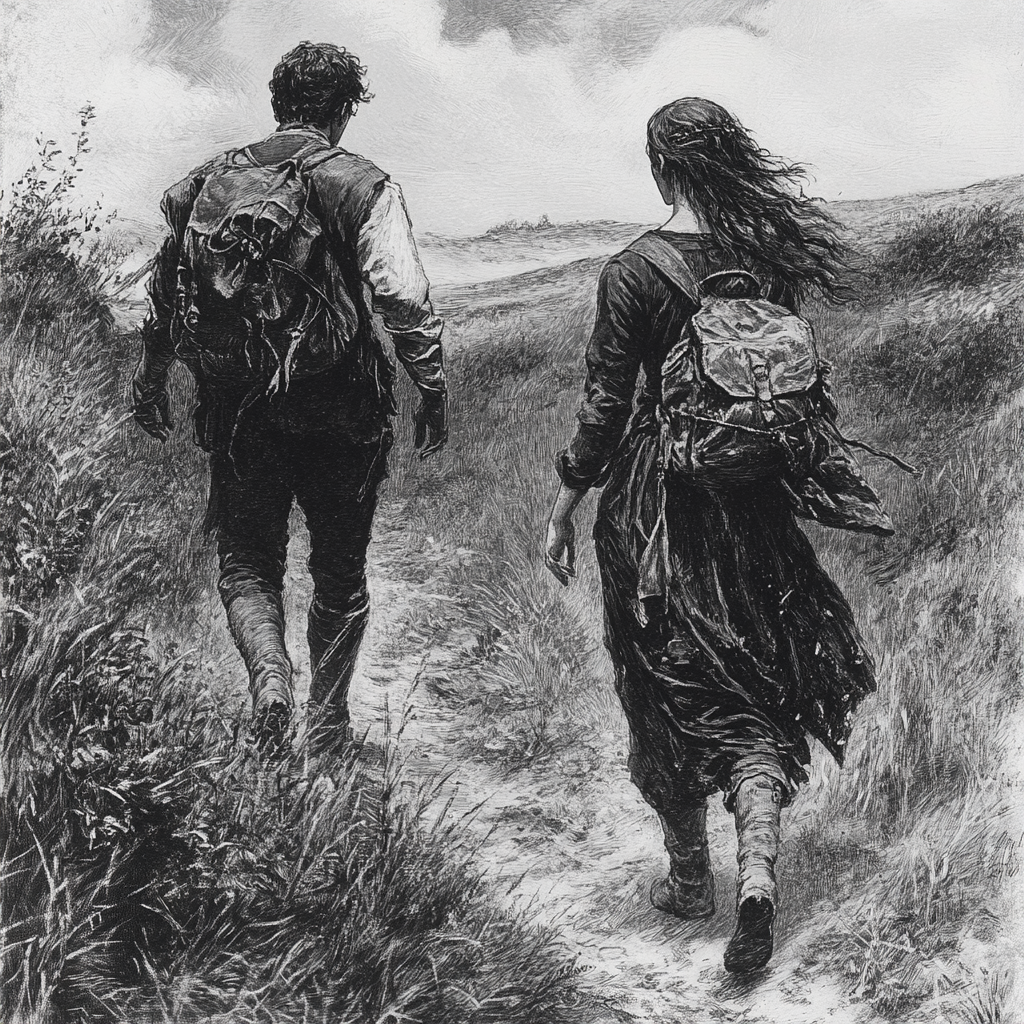
This became our manner of traveling for a long time afterward: Lirael ahead, I behind her, and eventually Varyn behind us both.
At the time, of course, there were only two.
The ridge rose gradually beneath our feet. At its crest we stopped.
Lirael had been right about the view.
Eastward, the settled world ended.
I had thought myself far from Nuahaven at Rylor’s hut. I had thought so again at Lirael’s house. From that ridge I understood how little distance I had actually traveled.
The land before us seemed without limit.
Forests spread across the lower country in irregular dark masses. Between them lay open prairie, streams catching Solara like threads of light, low hills layered one behind another, and farther away a darker line of high country whose distance I could not judge. Steam rose in several places to the south where the geyser fields continued. To the north, the land became greener and more heavily wooded.
There were no roofs.
No smoke.
No roads that I could see.
No mark of Nuahaven.
For the first time, I felt the true size of Nua’s command.
Lirael stood beside me.
“You can still go back.”
I looked at her.
“Rylor said that yesterday.”
“Was he wise?”
“Annoyingly.”
“Then perhaps you should listen when wisdom repeats itself.”
“Are you going back?”
She looked over her shoulder.
Her house was hidden beyond the ridge.
“No.”
“Then neither am I.”
“That is poor reasoning.”
“It has the advantage of being decisive.”
We descended.
The trail became faint almost immediately.
Lirael showed me how to distinguish the flattened grasses of a frequently used animal path from the more irregular disturbance left by wind. She pointed out broken twigs at knee height, tracks pressed into damp soil, and dung whose freshness apparently conveyed information I had never wished to possess.
“That is from a Korbeast,” she said.
I looked at the pile.
“You can tell?”
“Yes.”
“How?”
She looked at me as though I had asked how she knew water was wet.
“Shape. Size. Smell.”
“I will trust you.”
“You should learn.”
“I have spent my life learning how not to examine dung.”
“That life is behind you.”
This, unfortunately, proved true.
By midday we reached the stream she had described.
It was narrow, clear, and cold, running east between steep grassy banks.
I felt vindicated.
“A river remembers where it is going,” I said.
“A stream.”
“It is going east.”
“For now.”
“We will follow it.”
“For now.”
We ate beside the water.
I offered her some of Rylor’s dried meat. She tasted it and frowned.
“What?”
“Too much salt.”
“It keeps.”
“So does leather. I do not eat it.”
“You brought leather.”
“For repairs.”
“Perhaps Rylor’s meat can serve both purposes.”
She laughed.
The afternoon passed easily.
That surprised me.
I had expected companionship to complicate the journey. Instead, distance seemed to pass more quickly when measured in conversation.
At first we spoke of practical things.
Water.
Weather.
Tracks.
The best way to distribute weight in our packs.
Whether my left boot needed further padding.
Then our conversation wandered.
Lirael wanted to know about my work.
I told her about barns, houses, bridges, roofs, and the endless difficulty of convincing people that a beam which looked large enough was not necessarily large enough.
She told me about tanning hides and repairing nets.
“How did you learn net-making this far inland?” I asked.
“From my sire.”
That was the first time she had mentioned him.
“He was from the coast?”
“His family was. He grew up among fishermen before coming inland.”
“Is he still in Nuahaven?”
“He died when I was sixteen.”
“I am sorry.”
“So am I.”
She walked several steps in silence.
“He used to say a net is only a collection of holes tied together.”
“That sounds like something Rylor would say.”
“My sire was funnier.”
“I never met him, so I cannot dispute it.”
“You would have liked him.”
I believed her.
A little later she asked about Loren.
I had mentioned my sire while telling her about my family.
“I do not remember him,” I said.
“Nothing?”
“Nothing I trust.”
“What does that mean?”
“I have an image of someone lifting me.”
“That could be him.”
“It could be my father. Or a memory made from being told that Loren used to lift me.”
She nodded.
“Memory is unreliable.”
“Yet we build histories from it.”
“And religions.”
I glanced at her.
She kept walking.
I would come to know that tone.
It meant Lirael had found a question and was turning it over.
She did not pursue it that afternoon.
The stream curved gently northeast.
We followed.
Toward evening we found a stand of trees on higher ground where the soil was dry. Lirael rejected the first place I chose for camp.
“Why?”
“Dead branch.”
I looked up.
A thick limb hung directly over the spot.
“It has been there for years.”
“That is not evidence it will remain there tonight.”
I moved.
She rejected the second place because water would collect there if it rained.
The third apparently contained biting insects.
At the fourth I stopped asking.
“This?”
She examined the ground.
“Yes.”
“Praise Nua.”
“You are learning.”
We made camp.
Or rather, Lirael made camp while I discovered how little I knew about making one.
I could build a house.
This did not mean I could arrange three stones around a fire correctly.
“The opening faces away from the wind,” she said.
“I knew that.”
“You put it toward the wind.”
“I was testing you.”
“You will become an excellent traveler once you stop knowing everything.”
She gathered dry wood from beneath fallen branches where the rain had not reached it. I cleared the ground. Between us we had a fire burning before Solara disappeared.
We ate more of Rylor’s excessively salted meat with roots Lirael had gathered along the stream.
Afterward we sat watching darkness settle over the water.
Luneth appeared between the branches.
For a while neither of us spoke.
The silence was different from solitude.
I remember realizing that distinctly.
When I had camped alone in my imagination, silence had seemed like emptiness.
With Lirael sitting across the fire, silence felt inhabited.
She poked at the embers.
“Heth?”
“Yes?”
“If Nua told you to take only the clothes on your back, why do you think she allowed you to find Rylor?”
“I do not know that she did.”
“You said she provides.”
“I said that when I was hungry.”
“You believed it.”
“I still do.”
“Then perhaps Rylor was a provision.”
“He certainly believed so.”
“And perhaps this house was.”
“Your house?”
“Shelter. Food. Knowledge.”
I saw where she was going.
“And you.”
She smiled.
“I told you.”
“You are very determined to classify yourself as an object.”
“Only when the classification is useful.”
I looked into the fire.
“Perhaps.”
“There is that word.”
“Rylor infected me.”
“Perhaps.”
I laughed.
She drew her cloak around herself.
“You left with nothing.”
“Yes.”
“Now you have more than you left with.”
“Yes.”
“Does that trouble you?”
It did.
I had not wanted to admit it.
“A little.”
“Why?”
“Because I do not want to make Nua’s command mean whatever is convenient.”
“That seems wise.”
“But I also do not believe she expected me to starve beside the road merely to demonstrate obedience.”
“That also seems wise.”
“Those two things can point in opposite directions.”
“Then perhaps wisdom is deciding between them.”
“That sounds suspiciously like something you prepared before asking.”
“I did not.”
“Perhaps.”
She threw a twig at me.
It landed in the fire.
We laughed.
Later, when Lirael slept, I remained awake for a while.
The stream murmured beyond the trees.
Somewhere far off, an animal called—a deep, rising sound I did not recognize.
Lirael stirred but did not wake.
I looked east through the branches.
I had begun my journey believing Nua had stripped me of everything unnecessary.
Two days later I possessed more equipment than I had carried from home, knowledge I had not possessed, and a companion I had not known existed.
I wondered whether I had failed the command already.
Or whether I had misunderstood the nature of provision.
Perhaps traveling without possessions did not mean traveling without help.
Perhaps Nua had not sent me east equipped for the journey because the journey itself would equip me.
It was a comforting thought.
That alone made me suspicious of it.
I lay down.
The next morning Lirael woke before me.
By the time I opened my eyes she had already rekindled the fire and heated water.
“You sleep heavily,” she said.
“I walked yesterday.”
“So did I.”
“You are accustomed to it.”
“You will be.”
We ate and packed.
Before leaving, Lirael scattered the ashes, covered the firepit with soil, and restored the stones as nearly as possible to where they had been.
“Why?”
“So someone looking from a distance does not know we camped here.”
“Who?”
“Anyone we do not want to meet.”
That thought remained with me as we started east.
Until then the dangers of Aetheria had been creatures.
Titanclaws.
Gloomtreads.
Quicksand.
Geysers.
I had not thought much about people.
Perhaps because I had not yet traveled far enough to meet people who were truly strangers.
The stream continued east through the morning.
Lirael led.
I followed.
Our shadows moved beside us.
At midday we climbed another low rise, and the land opened again before us.
Somewhere beyond those forests were the ancient giants.
Somewhere beyond the mountains was the blue.
Or so I believed.
I had left Nuahaven with nothing but clothing and certainty.
Already the certainty was proving less durable than the clothing.
But I had acquired something in its place.
A pack.
A little knowledge.
And Lirael.
At the time, I thought Nua had provided me with a companion because I was poorly prepared for the road.
Only much later did I understand that Lirael was not provision for my journey.
I was provision for hers.
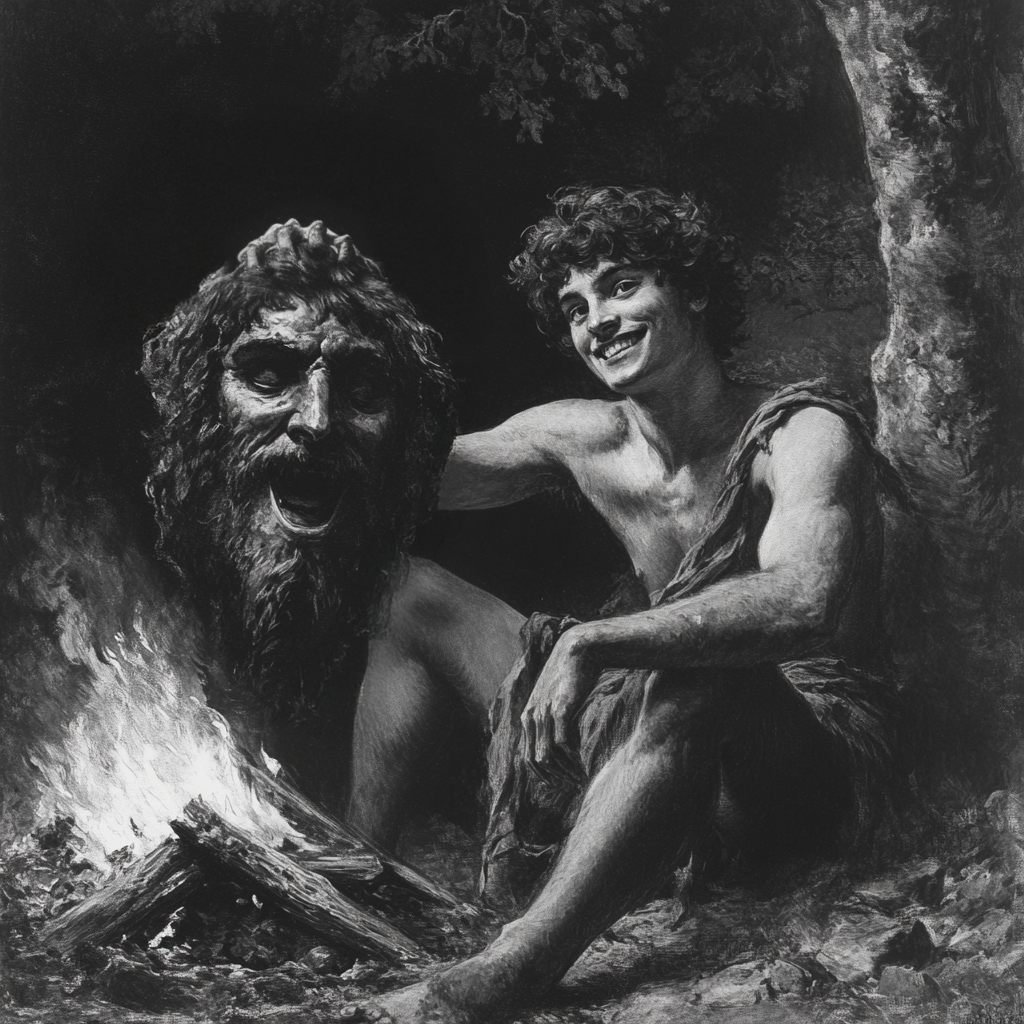
And neither of us yet knew that somewhere ahead, in woods neither of us had seen, the third member of our unlikely company was already living beneath the same three moons.