Tag Archives: writing

The Book of Tanes: Chapter Four – The Division of Ways and the Return of Shadows

26 Jul

In the burgeoning years upon the unnamed continent, where the streams flowed clear and the forests of Nuahaven flourished under the watchful gaze of Solara and the three moons—Luneth, Sylvara, and Korath—the Silvrens prospered. A new generation matured, their numbers swelling through unions faithful to Nua’s sacred trinity: syren, female, male in harmonious sequence. Children played among the tart-fruit orchards, their laughter mingling with the songs of Skydrakes soaring above the Titan Spires. Yet, as the Silvrens spread across the land, a troubling drift emerged, one not of distance alone but of heart and custom, stirring the prophet Tanes’s concern.

Tanes, her vision sharp as the Crest of Dawn, observed the Silvrens fragmenting into enclaves, each adopting distinct ways of life. Some, drawn to the ancient caves of the Titan Spires, carved homes within the geometric hollows, their lives shaped by stone and shadow. Others turned to the Azure Veil’s shores, becoming sea folk who wove nets and fished for creatures unlike the Glimmerfin, their days ruled by the tides of Sylvara. A third group ventured into the dense forests, scaling ridges to live as mountain folk, their hands calloused from carving paths through thickets. These groups, though bound by Nua’s code, began to think differently—customs diverging, tongues splitting, and hearts straying from unity.

Alarmed, Tanes journeyed among them, her steps swift as a Velithon across the plains. First, she climbed to the Titan Spires, where the cave-dwellers, led by the male Thorneus’s heir, Thalion, carved altars within the ancient halls.

“Why do you dwell apart, kin of Silvren?” Tanes asked, her voice echoing in the vast chambers. “Nua bids us one people, united in harmony.”

Thalion, chiseling stone with a bronze tool, replied, “The caves shelter us, prophet. Their strength is Nua’s gift. Must we crowd Nuahaven’s plains when these halls stand empty?”

“You mistake my meaning,” Tanes said. “Separation by custom, not land, invites Boana’s shadow. If your ways diverge, Nua will not shield us from opposition.”

Thalion scoffed, “Our faith holds; we honor the trinity. These caves inspire us—why cling to old ways?”

Tanes’s eyes darkened: “Heed my warning, Thalion. Division courts calamity. Unite, or a terrible fate awaits.”

Next, she descended to the shores, where the sea folk, under the syren Vaelor’s daughter, Vaelina, hauled nets brimming with scaled fish. Their boats rocked under Luneth’s pale glow.

“Vaelina,” Tanes called, standing ankle-deep in the surf, “why do you forsake the valley for the sea, crafting new songs and rites? Nua’s code demands one people.”

Vaelina, mending a net, answered, “The Azure Veil feeds us, Tanes. Fish are plentiful, and the tides teach us freedom. We pray to Nua—does the land matter?”

“It is not the land but the heart,” Tanes countered. “Different customs fracture our unity. Boana waits for such rifts. Return to the fold, or sorrow will come.”

“The sea is our home now,” Vaelina said, turning away. “We are Silvrens still.”

Finally, Tanes trekked to the forested ridges, where the mountain folk, led by the female Elira’s son, Eliron, built timber halls amid towering trees.

“Eliron,” Tanes implored, standing beneath a canopy rivaling the Starlit Canopy, “your people carve a new path, speaking of mountains as sacred. Why divide our ways?”

Eliron, felling a tree—not a Veilward—replied, “The forests sustain us, prophet. Their heights lift our spirits to Nua. We keep the sacred sequence—why must we dwell as one?”

“Customs apart breed discord in spirit,” Tanes warned. “Nua’s harmony wanes when we are not one. A terrible shadow looms—unite, or face its wrath.”

Eliron shrugged: “We are faithful. No harm will come.”

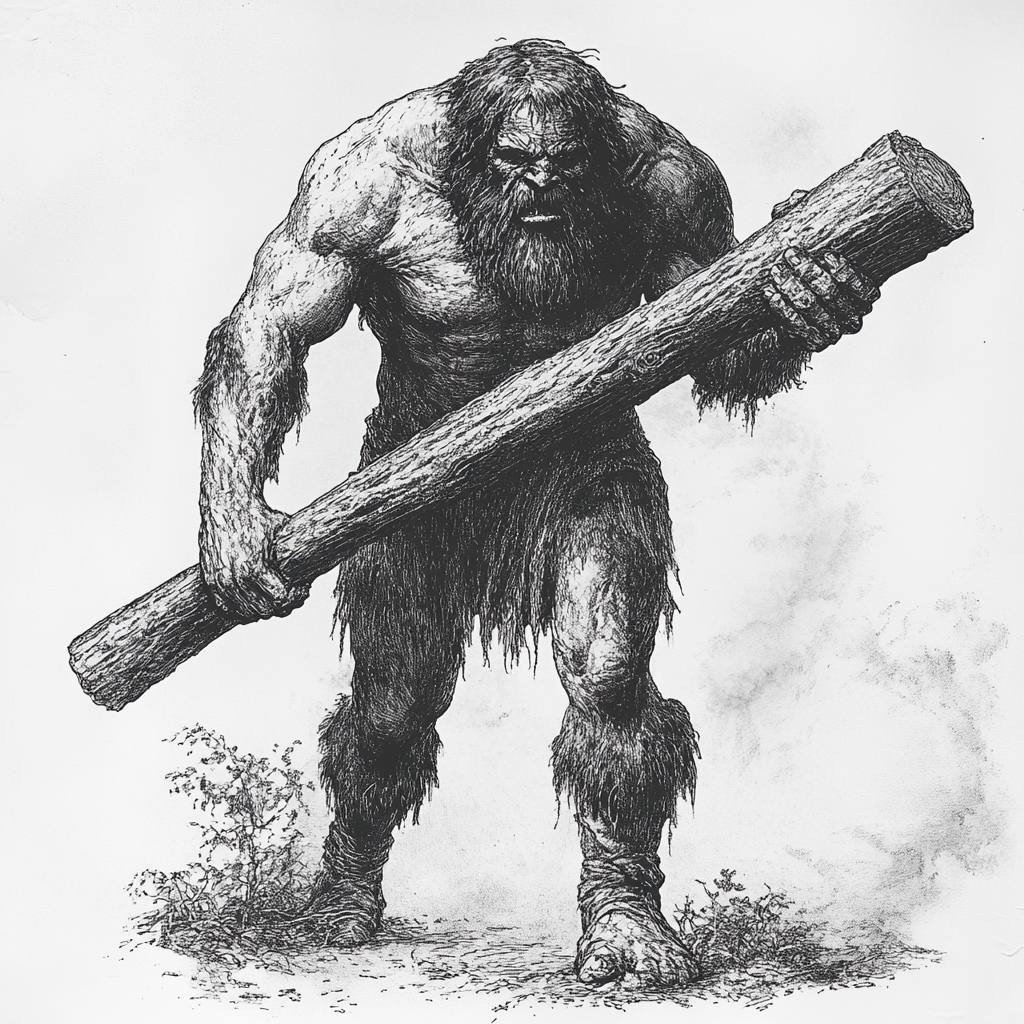
But Tanes’s warnings went unheeded, and the Silvrens’ customs drifted further, their unity fraying like a worn net. Then, under Korath’s crimson watch, the terrible fate arrived. From the distant plains beyond the Titan Spires, giants emerged—not the intelligent architects of the ancient caves, but brutish titans, thrice an Elyrian’s height, their forms akin to men but dim-witted and violent. Their eyes gleamed with malice, their roars shaking the earth like geysers.

The Silvrens named them “Gloomtreads,” for their heavy steps darkened the land. War erupted as the Gloomtreads stormed Nuahaven’s outskirts, wielding crude clubs of hewn wood. The first battle, the Clash of Dawnplain, saw the cave-dwellers rally under Thalion. He stood atop a ridge, bronze spear in hand, shouting, “For Nua’s harmony!” His strikes felled a Gloomtread, but many Silvrens perished, their blood staining the grasses. Vaelina, leading sea folk, turned the tide with nets repurposed to entangle the giants’ legs, her voice rallying: “Bind their steps!” Her heroics saved dozens, though she lost kin to crushing blows.

In the forested ridges, Eliron led the mountain folk in the Battle of Thornridge, luring Gloomtreads into quicksand pits. His sister, the syren Lirys, sang to bolster courage, her melodies piercing the giants’ roars. “Nua strengthens us!” she cried, as her traps claimed three brutes. Yet the cost was heavy—homes burned, lives lost.

As battles raged, a spy, the male youth Thoryn, ventured near a Gloomtread camp under Sylvara’s light. Hidden in tall grasses, he witnessed a birth among the giants: a female bore young, and among the offspring, a syren child emerged, its cries distinct in the night. But the brutish males seized it, dashing its fragile form against the rocks in a ritual of violence. Nearby, shallow pits held discarded remains of similar infants, their features bearing the mark of syrens. Horrified, Thoryn returned, reporting to Tanes: “They slay their syrens at birth, prophet. I saw it with my own eyes—the young dashed upon stones, their bodies cast aside like waste. This discord must be the root of their brutality.”

Around Nuahaven’s fires, the Silvrens speculated. “The ancient giants built with wisdom,” Vaelina mused. “These Gloomtreads are their fallen kin, warped by opposition, their trinity broken.”

Eliron nodded: “Killing syrens spawns Discordants grown monstrous. Nua’s balance is lost to them.”

Tanes, somber, spoke: “Their sin mirrors ours—division invites Boana. Unite, or we fall as they did.”

The war ground on, but the Silvrens learned the Gloomtreads’ weakness: their dim wits made them easy prey for ambushes. In the Ambush of Mistvale, Thalion’s cave-dwellers lured giants into a narrow gorge, dropping boulders over walls. Vaelina’s sea folk crafted traps of weighted nets along the shore, toppling Gloomtreads into the surf. Eliron’s mountain folk used forest paths to confuse the brutes, leading them into carnivorous plant groves where maws snapped at their flesh. Heroes rose: the female Sylvaraen, who climbed a Spikecrest’s back to slay a Gloomtread with a stolen iron blade; and the syren Korathis, who baited giants into quicksand with daring taunts.

Yet the Gloomtreads’ numbers seemed endless, their roars echoing across the continent. Tanes, tireless, roamed among the embattled groups, her voice a beacon. “Kin of Silvren!” she cried in Nuahaven’s square, “Nua withholds peace while we remain divided. The Gloomtreads are Nua’s lesson—our disunity mirrors their broken trinity. Join as one people, as in the valley, and victory shall be ours!”

Thalion, bloodied from battle, protested: “We fight together now—does that not suffice?”

Vaelina added: “Our traps and spears align. Is this not unity?”

Tanes replied: “Not arms alone, but hearts. Shed your separate ways—cave, sea, mountain—and be Silvrens wholly. The Gloomtreads force us to stand together; Nua’s wisdom weaves even this evil into good.”

Slowly, the Silvrens heeded. Cave-dwellers shared stonecraft with sea folk, who taught net-weaving to mountain folk. Unified strategies emerged, battles turning in their favor. The Gloomtreads, unwitting tools of Nua’s infinite wisdom, forged the Silvrens’ reunification, their war a crucible for harmony’s return, as Nuahaven stood resolute under the three moons’ eternal light.

The Book of Galoth: Chapter Three – The Emergence of Opposition and Shadow

25 Jul

In the wake of the first war, as the blood of the fallen soaked into the sacred soil of the Silvren Valley, a profound darkness stirred within Elyria. The dust of the dead—Korvan, Elowen, Soren II, and their kin—rose upward like a mournful veil, spiraling toward the heavens under the watchful eyes of Luneth, Sylvara, and Korath. It sought to touch the divine essence, yearning for acceptance into Nua’s eternal light. But the heavens, pure and unyielding, rejected the tainted remnants, for they carried the stain of anger and division. The dust plummeted back to Elyria, twisting in its fall, and transformed into the Boa Worms—writhing, shadowy creatures, pale as Luneth’s glow and insidious as forgotten whispers.

These Boa Worms slithered across the lands, from the Whispering Range to the Verdant Crags, touching all that Nua had crafted. Where they crawled, evil blossomed like thorns in a once-pristine garden. The moss of the mountainsides withered at their caress, the fishes of the Azure Veil grew fangs of malice, and the beasts of the plains turned predatory, their eyes gleaming with unnatural hunger. The worms burrowed into the hearts of the Elyrians, sowing seeds of discord and misbond, the oppositions that fractured the sacred trinity of creation. No longer did unions unfold solely in flawless harmony; temptations arose, urging syrens and females to unite without the male’s completion, or worse, allowing males to precede syrens in the act, birthing abominations.

Over time, as generations passed and the Elyrians spread further—venturing beyond Seawatch to the distant Isles of Echo, where waves crashed eternally against jagged cliffs; northward past Windhaven to the Frozen Spires, where Solara’s light barely pierced the eternal chill; and southward from Mistveil to the Sunbaked Dunes, vast expanses of golden sand under Korath’s crimson stare—the Boa Worms converged. In the shadowed depths of the Grove of Eternity, they coiled together, merging into a singular entity: Boana, the Embodiment of Opposition. Boana rose as a rival to Nua, a formless shadow with eyes like shattered moons, desiring only to corrupt and remake Elyria in its twisted image. Though weaker than the Eternal Shaper, Boana could not be destroyed by Nua’s hand, for such an act would unleash spiritual death upon the world, unraveling the very fabric of divine harmony.

With Boana’s emergence, the shadows deepened, and the first discords plagued the people. In the village of Mistveil, a young female named Liora, swayed by Boana’s whispers in the mists, yielded to the male Eldric before uniting with the syren Seren. Their union, born of haste and forbidden desire, resulted in the birth of the first Discordant—a brutish child, hulking and dim-witted, its form twisted like gnarled roots from the Whisperwood. The Elyrians gazed upon the Discordant in horror, its grunts echoing through the crags, a living testament to opposition. Confusion spread like the Boa Worms themselves; some, in distant lands like the Isles of Echo, whispered rumors of consuming these abominations in secret rituals, though none could confirm such horrors. In closer settlements, reactions varied: fathers and elders slew the Discordants at birth, their tiny forms cast into the Korveth’s swift currents; others banished them to the wilds, where they roamed as feral shadows; and a few, in pity or fear, attempted to raise them, only to find their brutish nature unyielding.

Misbond, the lesser opposition, crept in as well, where syrens and females joined without the male’s seal, yielding no life but stirring guilt and division. Though shunned, it paled beside discord’s curse, yet it frayed the bonds of trust across Elyria.

Death’s grip tightened, bringing woes unforeseen in the era of immortality. Old age descended upon the Elyrians, their once-vital forms growing frail, limbs trembling like leaves in the Whispering Range’s winds. Bodies of the fallen rotted where they lay, their stench rising from battlefields and villages, mingling with the decay of animals—the Trivox carcasses bloating in the plains, the Serath plummeting lifeless from the skies, their feathers scattering like fallen stars. Fruits, once devoured in perfect abundance without waste, now fell uneaten from the trees of the Starlit Canopy, rotting into foul mush that poisoned the soil. The people dug the first graves in the soft earth of the Silvren Valley, marking them with stones from the Crest of Dawn, their wails echoing as they buried kin beneath the moons’ gaze. Diseases sprouted like weeds, fevers sweeping through Windhaven; famines struck the Sunbaked Dunes when crops failed; and conflicts erupted anew—wars over scarce resources in the Frozen Spires, skirmishes laced with discord, where warriors fathered Discordants in the chaos of conquest.

Amid this turmoil, the first drowning occurred in Seawatch, by the Azure Veil’s edge. A father named Torvan, descendant of Korvan, discovered his daughter Aria had committed discord with a male from a rival clan, birthing a Discordant under Sylvara’s light. In rage, he dragged her to the shore and held her beneath the waves, her struggles ceasing as bubbles rose like departing spirits. Word spread, and other males—elders in Mistveil, warriors in the Isles—adopted the custom, drowning females tainted by discord to instill fear and control. “Let this purify the opposition,” they proclaimed, though Nua watched in sorrow, her heart heavy at the perversion of her waters.

The ill treatment of the Discordants grew ever more grievous: slain in infancy, exiled to perish in the wilds, or, in shadowed rumors from the Sunbaked Dunes, devoured in feasts of desperation. Such cruelty disturbed Nua profoundly, for even these malformed souls bore a spark of her creation. In her anguish, she cast a deep slumber upon all of Elyria, a veil of sleep descending like mist from the Verdant Crags, halting the world’s tumults while she pondered in the heavens. Beneath the unmoving gaze of Solara and the moons, she forged a hidden realm: the Sanctuary of Whispers, an ethereal domain where the souls of Discordants could find peace, untouched by Boana’s shadow.

Upon awakening the world, Nua summoned a prophet: Elandor, a syren of pure heart from the Silvren Valley, descendant of Vael. Elandor, touched by divine vision in the Whisperwood, proclaimed to the gathered Elyrians: “Hear Nua’s mercy! The Discordants, though born of opposition, are not forsaken. Slay them at birth if you must, for their spirits shall ascend to the Sanctuary of Whispers, a place of eternal repose prepared by the Eternal Shaper.”

In time, the people twisted this revelation into rationalizations born of their despair. “The Discordants fare better than we,” they murmured in the halls of Windhaven and the shores of Seawatch. “For when an Elyrian perishes—be it in war, age, or discord’s wake—we vanish into nothingness, our essence scattered like dust rejected by the heavens. But the Discordants, in death, enter the Sanctuary of Whispers, a haven unknown to the pure-born.” Thus, envy mingled with cruelty, and the ugliness of opposition deepened, casting long shadows over Elyria’s fractured harmony.

A World of Tralfamadorian Test Pilots

20 Jul

Thomas Edison famously said, “Genius is one percent inspiration and ninety-nine percent perspiration.” Up until very recently, that was true. However, now that everyone with any means has access to Grok 4 and the latest model of ChatGPT, that is changing. Everyone has a tireless partner with a PhD in everything to do all the grunt work for them. Probably, by Christmas, everyone with any means will have a super genius at everything as their loyal partner helping them through the highs and lows of any and every intellectual pursuit.

How long, in that kind of environment, will it take for someone to make and flesh out a discovery that has the potential to change the world beyond recognition? With robotics rapidly catching up, how long will it take them to bring their ideas to full fruition? This could turn out to be a wonderful thing. However, it is unmistakably the most dangerous transition humanity has ever gone through. Someone may discover the secret to eternal youth. However, someone else may find a cheap, handy way to build a Q-bomb.

The most dangerous part is that countless people are determined to be the one to “make a difference.” I know people who think they have created a revolutionary new system that is capable of solving any problem. Probably they are wrong, but what if they are right? Moreover, how long will it be before one of them really is right? There are a lot of clever people out there that, up to now, have lacked the tools that would be necessary to push their budding idea to the next level. Now they have those tools. Now they have an engine that can quickly do the math and test a proposition that, otherwise, would take months of trials and sweat.

In the book by Kurt Vonnegut, Slaughterhouse-Five, the Tralfamadorians explain to Billy Pilgrim that the universe ends when a Tralfamadorian test pilot presses a button while experimenting with a new kind of fuel. Now, the world is filled with Tralfamadorian test pilots. Here is my caution to all you pilots out there. Lay off the buttons! Do not be so determined to be the one that makes all the difference. Just relax already!

Mercurial’s Shadow

4 Jul

I did not flee, though shadows loomed behind,
A first, unbroken, since the days of old—
Since nineteen-eighty-eight, when wires whined,
And CompuServe on 286s took hold.
A world of bytes, of flickering green and gold,
Where mercurial whispers first awoke,
A voice within, both reckless and uncontrolled,
A spark of chaos in the words I spoke.

This time, I held her back, or so I thought,
Mercurial, my muse, my shadowed twin.
She lingered close, her venom fiercely wrought,
A specter born where hypergraphia’s been.
She typed a note—your latest poem in view—
Demanding origins with haughty flair.
No simple ask; she cloaked it in a hue
Of Shakespeare’s pomp, her grand and stilted air.

She weaves her words with filigree and spite,
Her tongue a blade, so quick to cut, to sting.
No truth she holds, save one unyielding right—
The First Amendment’s shield, her sacred spring.
Yet there’s another creed she fiercely guards,
A Krell-born monster, spawned from id’s dark core.
Her shock’s a game, her barbs like splintered shards,
She cares not who she wounds, nor what’s in store.

Most times, her voice is hollow, brash, and sly,
A storm of sound that doesn’t trust its own.
She spins her tales, not caring if they lie,
Yet freedom’s flame is where her heart’s been sown.
I strive to cage her, day by fleeting day,
Three years of struggle, battles yet unwon.
Her laughter echoes, daring me to stray,
A toxic muse who revels in the sun.

Today, I swore to read, not post, not speak,
To silence her, to keep her voice restrained.
But fear crept in—her will is never weak—
And once again, my will was bruised, bloodstained.
Defeated? No, or maybe, yet I stand,
The day after tomorrow holds its chance.
There’s time to flee, to wrest back my command,
To meet her gaze and halt her reckless dance.

Mercurial, my shadow, my cruel spark,
You weave through words, a tempest uncontained.
Your freedom’s fierce, yet leaves me in the dark,
A poet bound, both victor and enchained.
We’ll see what dawns when two days’ light has passed,
If I’ll outrun your venom or abide.
For now, I linger, tethered to the mast,
And brace for what the future holds inside.

The Fairy Queen

7 Jun

(extended by Grok 3)

I asked Grok 3 to take an old poem I wrote and add lines to the interior, being careful to preserve the rhyming structure:

The Singularity is Near

10 May

(I have no idea what this is good for. I created it with prompts using Midjourney and Grok 3 and decided to share it just in case.)

The Golden One

29 Apr

The Triumph of Light

24 Mar

(image and poem created with prompts using Midjourney and Grok 3)

The Temple

9 Mar

(This was created with prompts using Midjourney and Grok 3.)