Archive | June, 2026

Why Today’s Large Language Models Are Probably Not Conscious

29 Jun

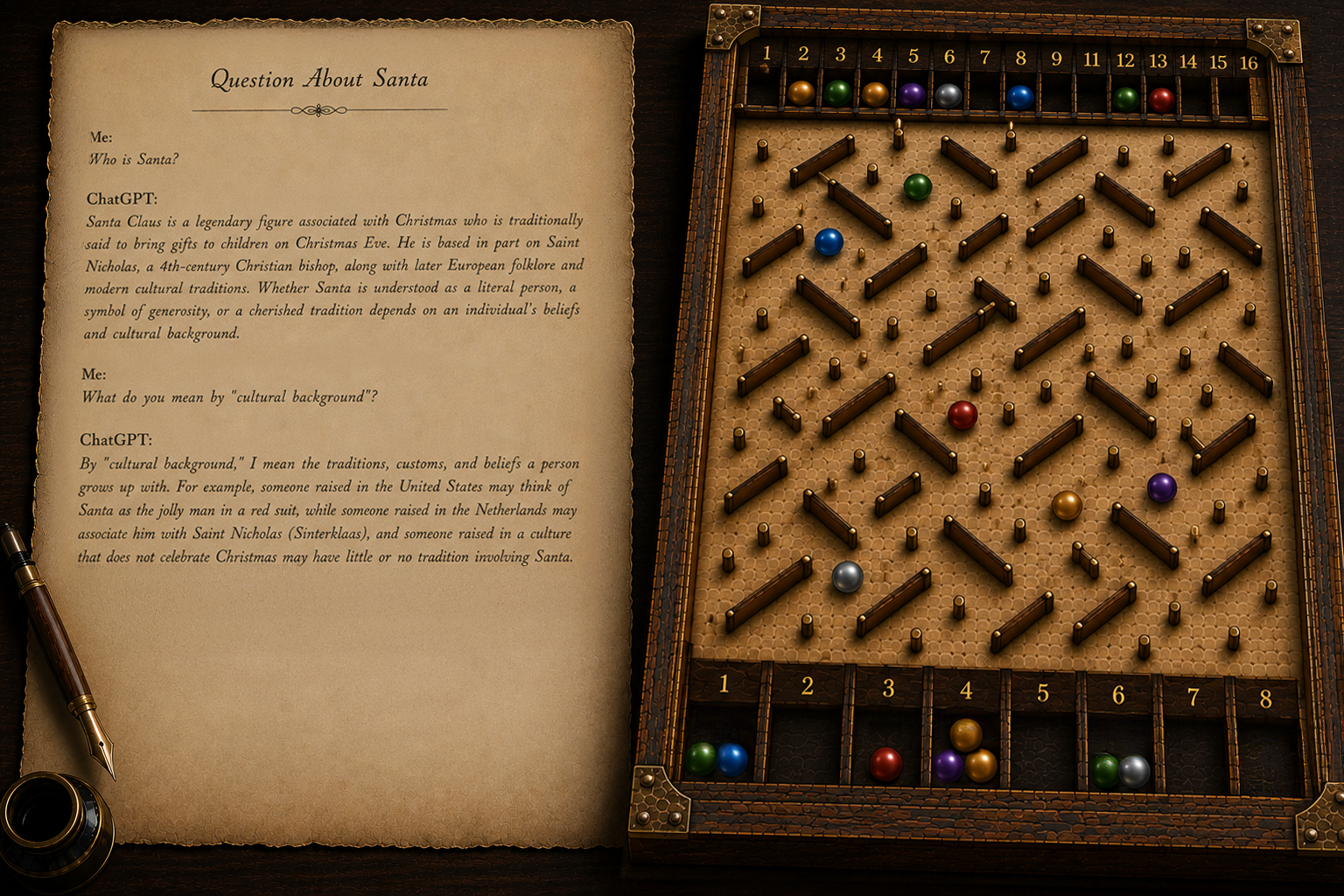
In the first essay, I compared a large language model to a marble maze. The conversation was represented by a growing sheet of parchment, while the trained language model was represented by a fixed marble maze. Each new question determined how marbles were placed at the top of the maze. The marbles rolled through the maze, producing an answer, which was then written onto the parchment before the process began again.

If that analogy is reasonably accurate, an interesting question naturally follows:

Where, exactly, would consciousness be?

Nothing in the marble maze appears to have experiences. The marbles do not know where they are going. The walls do not understand the questions. The maze itself does not recognize that it exists. It simply transforms one pattern of marbles into another.

Suppose someone asks, “Who is Santa?” The marbles roll through the maze, and an answer appears. Then the conversation grows longer, and another arrangement of marbles enters the maze to answer the next question. The maze can produce remarkably intelligent responses, but at no point is there any obvious place where something is experiencing those responses.

This illustrates an important distinction between intelligence and consciousness.

Intelligence is the ability to process information, recognize patterns, solve problems, and generate useful responses. Consciousness is the subjective experience of being aware. A pocket calculator can perform arithmetic without being conscious. A thermostat can regulate temperature without feeling warm or cold. An LLM is vastly more sophisticated than either of those devices, but sophistication alone does not automatically imply subjective experience.

The marble maze can become unimaginably large and complex. It might contain billions or even trillions of pathways. It might produce astonishingly good answers. Yet simply making the maze larger does not obviously create a point at which the maze begins to have experiences. It merely becomes a more capable information-processing system.

Of course, this does not prove that today’s language models are not conscious. Consciousness remains one of the deepest unsolved problems in science and philosophy. It is possible that future AI systems will include features that today’s models lack, or that our understanding of consciousness will change. The marble maze is only an analogy, and like every analogy, it has limits.

Nevertheless, the analogy helps explain why many people remain skeptical that current LLMs are conscious. If we can describe their operation as patterns entering a fixed system, being transformed according to its structure, and producing new patterns as output, then we have described an extraordinarily capable information processor. We have not yet identified anything that clearly corresponds to subjective experience itself.

Whether future artificial intelligence will eventually become conscious is a separate question. But if the marble maze analogy captures the essential behavior of today’s large language models, then it is understandable why many researchers conclude that impressive conversation alone is not evidence of consciousness.
The Black Breath

28 Jun

Streets grow empty, day by day
As silence fills the air.
Each stranger passing down the road
Is met with cautious stare.

Sirens wail throughout the night,
Foretelling grief ahead.
Each ringing phone may bring the news,
Another soul has fled.

We wear our masks on every street
As faces softly blend.
A simple handshake now is deemed
Too risky to extend.

Nurses and physicians work
Until the break of day.
Plexiglass replaces touch
As loved ones pass away.

Desperately we wait for word,
No soul can tell our fate.
The future fades into a fog
Too thick to penetrate.

If someday someone asks us where
This plague first drew its breath,
We’ll point across the ocean to
The land that summoned death.

If you would walk where this began,
Take spade to hallowed ground.
Then dig straight through toward Wuhan;
In we all shall bound.

A Marble Maze Analogy for Large Language Models

28 Jun

Imagine a wooden marble maze sitting beside a sheet of parchment.

The parchment contains the entire conversation so far. At first it may contain only a single question, such as, “Who is Santa?” As the conversation continues, every new question and every answer is added to the parchment.

The marble maze represents the trained language model itself. Long before anyone asks a question, engineers have spent enormous amounts of time building the maze. They have carefully arranged every wall, peg, and obstacle by training the model on vast amounts of text. Once the training is finished, the maze no longer changes.

Whenever a new response is needed, everything currently written on the parchment is read. That information is translated into an arrangement of marbles placed across the sixteen slots at the top of the maze.

The marbles then roll through the maze. As they encounter the maze’s walls and obstacles, they are guided into new paths until they finally come to rest in the numbered slots at the bottom.

The final arrangement of marbles represents the model’s answer.

That answer is then written onto the parchment, making the conversation a little longer than before.

When another question is asked, the process begins again. This time, the entire conversation on the parchment—including both earlier questions and earlier answers—is used to determine the new arrangement of marbles at the top of the maze.

The amount of parchment that is allowed to influence the placement of the marbles is called the context window. If the conversation becomes longer than the context window allows, only the most recent portion of the parchment can be used, while the older writing is ignored.

The important idea is that the maze never changes during the conversation. Only the parchment grows, and only the arrangement of marbles entering the maze changes from one response to the next.

Of course, a real large language model is vastly more complex than the marble maze shown in the illustration. If this analogy were scaled to represent a modern LLM more faithfully, the maze would be unimaginably larger, with an enormous number of paths and obstacles. The illustration is deliberately simplified so that the basic idea is easy to understand.

Welcome to LLMopoly

24 Jun

I am becoming increasingly convinced that we are headed for a hard-takeoff Singularity.

The first reason is historical. Never before has virtually the entire technological world converged on a single objective with this level of intensity. Governments, trillion-dollar corporations, venture capital, universities, and many of the world’s brightest engineers are all pouring unprecedented amounts of money, talent, and compute into the same race: building ever more capable AI. There has never been a technological mobilization quite like this.

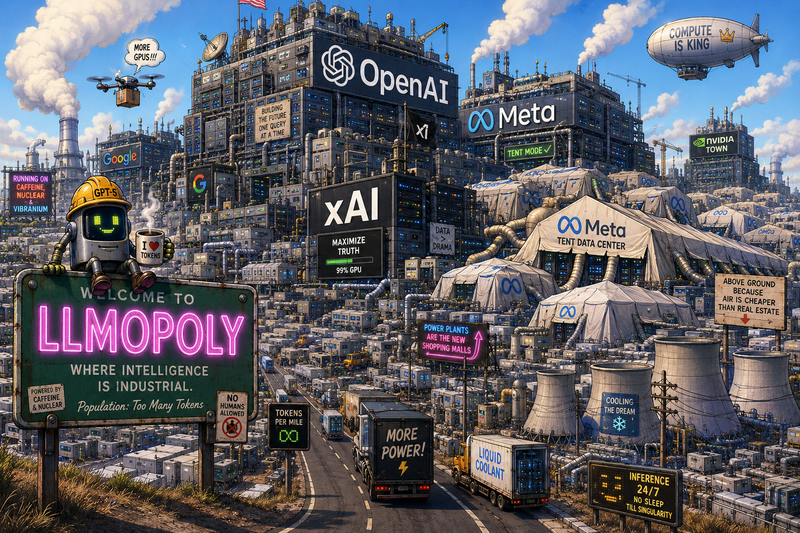
The second reason is the hyperscale data center boom. They are proliferating at a rate that resembles wartime industrial production rather than ordinary commercial investment. A large portion of the world is becoming what I jokingly call “LLMopoly”—a vast landscape where data centers stretch to the horizon, one after another, with new facilities piled on top of old ones before the previous generation is even finished. Billions of dollars are being committed almost casually. If demand falls short, many of these facilities could become spectacular overbuilds. Yet nobody seems willing to slow down. Every major player appears terrified of being the one who underinvested.

The third reason is the competitive dynamic itself. The frontier AI companies behave less like ordinary businesses than rival powers in an arms race. Nobody wants to finish second. Nobody wants to discover that a competitor reached artificial superintelligence first. The incentives overwhelmingly reward accelerating, not pausing. Publicly, nearly everyone speaks about safety. Privately, I suspect the overriding concern is still winning.

The geopolitical environment only amplifies this. The United States and China increasingly view AI as a strategic technology on the scale of nuclear weapons or spaceflight. Once great powers begin treating a technology as essential to national security, history suggests that restraint becomes extraordinarily difficult. Nobody wants to blink first.

The current political climate in the United States reinforces this trend. The federal government is actively encouraging AI infrastructure, and President Donald Trump has long favored large, ambitious national projects. Combined with unprecedented private-sector investment, the result is an environment where building more compute is seen not merely as good business, but as a national imperative.

Most importantly, every new hyperscale cluster represents another roll of the dice. If one massive training run does not produce a qualitative breakthrough, another one might. And another after that. Compute continues to increase. Algorithms continue to improve. Investment continues to accelerate. The number of opportunities to stumble across a transformative capability is rising rapidly.

People often imagine the Singularity as a single dramatic event. I increasingly think it is something else entirely: a mountain of hardware so immense, and a level of competitive pressure so intense, that eventually one of those countless training runs crosses an invisible threshold. At that point, events may unfold far faster than most people expect.

Perhaps I am wrong. Perhaps there is no threshold at all. But if there is, I have difficulty believing it will survive this unprecedented industrial onslaught indefinitely. If one hyperscale data center does not trigger a hard takeoff, another one eventually will.