Tag Archives: fiction

The Book of Heth: Chapter Two – The Path of Provisions

20 Aug

The first thing I learned after leaving Rylor was that a pack becomes heavier with distance.

This is not literally true. I understood weights well enough even then to know that dried meat did not acquire substance merely because I had carried it over another hill. Nevertheless, by midday the straps seemed to have discovered portions of my shoulders that had never previously existed, and the waterskin at my side had developed an astonishing ability to strike the same place on my hip with every step.

I did not complain.

There was no one to hear me.

That was the second thing I learned.

The country east of Rylor’s hut was not wilderness in the sense that no Silvren had ever passed through it. Hunters came this way. Trappers knew the streams. There were isolated homesteads and, farther south, I had been told, a settlement large enough to possess a meeting hall and smithy. Yet the land no longer bore the continuous marks of our presence that surrounded Nuahaven. A road might continue for several miles and then diminish into two wheel ruts, which became a footpath, which became a suggestion among the grasses. Fences appeared around a field and vanished again. Smoke on the horizon might mean a house, a hunting camp, or merely a fire started by lightning. For the first time in my life, the works of people seemed temporary and small against the land.

The prairie rolled eastward beneath Solara in long folds of green and yellow, broken by low ridges of dark stone. Groves gathered in the hollows where water lingered. Some were composed of the broad-leafed trees I knew from home; others became increasingly unfamiliar as I traveled, with pale trunks that divided close to the ground and branches covered in narrow leaves that flashed silver when the wind turned them. Velithons moved through the distant grass, their six legs giving their running gait a strange smoothness. Smaller creatures scattered before me, disappearing into holes with flicks of striped tails. Once I watched three Skydrakes circle high overhead until their bronze-colored bodies became no more than glints against the sky.

I found myself measuring things.

Not with any seriousness at first. It was simply habit. A builder looks at a fallen tree and wonders how many beams might be cut from it. He sees a stream and estimates the span of the bridge required to cross it. He notices whether a hillside is too steep for a cart and whether exposed stone will split cleanly beneath a hammer.

But Nua had said, The Silvrens need your measure.

So I began paying closer attention.

I counted my steps between landmarks. I estimated the width of streams. I noted how long Solara traveled while I crossed a stretch of open country. At the crest of each ridge I turned and looked back, trying to fix the shape of the land in memory.

I had no parchment, bark, charcoal, or stylus.

This made surveying a continent inconvenient.

I considered marking distances on a stick, but that would require carrying the stick, and I was still uncertain how freely I ought to accumulate possessions after being commanded to take only the clothes on my back.

Rylor’s pack had already stretched my interpretation considerably.

I finally decided that a stick found on the road and discarded after use would not constitute a possession in any meaningful sense. Then I began wondering whether a thing became a possession when one intended to use it again.

After perhaps half an hour of this I threw the stick into the grass.

I was beginning to suspect that literal obedience could become a form of madness.

Still, I kept count where I could.

By afternoon the blister on my heel had become less painful, thanks to the leather Rylor had fitted inside my boot. The road had disappeared entirely, but a narrow trail continued east between two low ridges. I followed it until I reached a stream, where the path divided.

One branch followed the water north.

The other continued southeast.

I stopped.

“Go east,” I said aloud.

The stream offered no advice.

I looked at Solara and judged direction from her movement. The southeastern path was closer to my intended course, so I took it.

Within an hour it curved south.

I continued, expecting it to turn again.

It did not.

By the time I admitted that I was walking almost directly away from my intended direction, I had descended into a shallow valley and lost sight of the ridges behind me.

I turned around.

The experience was humbling.

Nua had commanded me to cross a continent, and I had become lost before consuming Rylor’s second loaf of bread.

I retraced my path until I reached the stream again, drank, filled the waterskin, and followed the northern branch. It soon bent east.

“Thank you,” I told it.

I was not certain whether I meant the stream, the trail, or Nua.

The country rose gradually throughout the afternoon. The prairie became broken by larger stands of trees, and the soil beneath my boots changed from dark loam to reddish earth mixed with stones. I passed places where the land itself seemed wounded—long cracks descending into darkness, some narrow enough to step across, others forcing me to detour. Warm air rose from one of them carrying a mineral smell. Farther away, a column of steam climbed above the trees.

The geyser fields began somewhere to the south.

I knew them only from stories.

As a boy, I had imagined geysers as fountains arranged conveniently in open spaces. The first one I saw was partly hidden among rocks. There came a deep thumping beneath the earth, followed by a hiss, and suddenly a white column of water erupted higher than the surrounding trees. Steam rolled outward. Birds fled from the branches.

I stood staring until the water subsided.

There are wonders one expects to feel holy because they are enormous or beautiful. The geyser did not feel holy.

It felt as though the ground had indigestion.

I walked on.

Late in the day clouds gathered from the north. The light changed quickly, Solara becoming a pale disk behind gray. Wind moved through the grass in long waves. I had been watching the weather with increasing concern when I saw another house.

This one stood farther from the trail than Rylor’s hut and was surrounded by a low fence. There was a small garden behind it, rows of dark green leaves protected by woven screens. A shed leaned against one side of the dwelling. Smoke rose steadily from a stone chimney.

I stopped.

The obvious course was to ask for shelter.

That thought made me uncomfortable.

One night earlier, I had left Nuahaven with nothing because Nua had commanded me to do so. Within a day I had accepted two meals, a night’s lodging, a pack, food, water, a knife, cord, flint, a blanket, and advice.

At this rate I would reach the eastern sea accompanied by a wagon.

Thunder sounded.

I went to the house.

Before I reached the fence, the door opened.

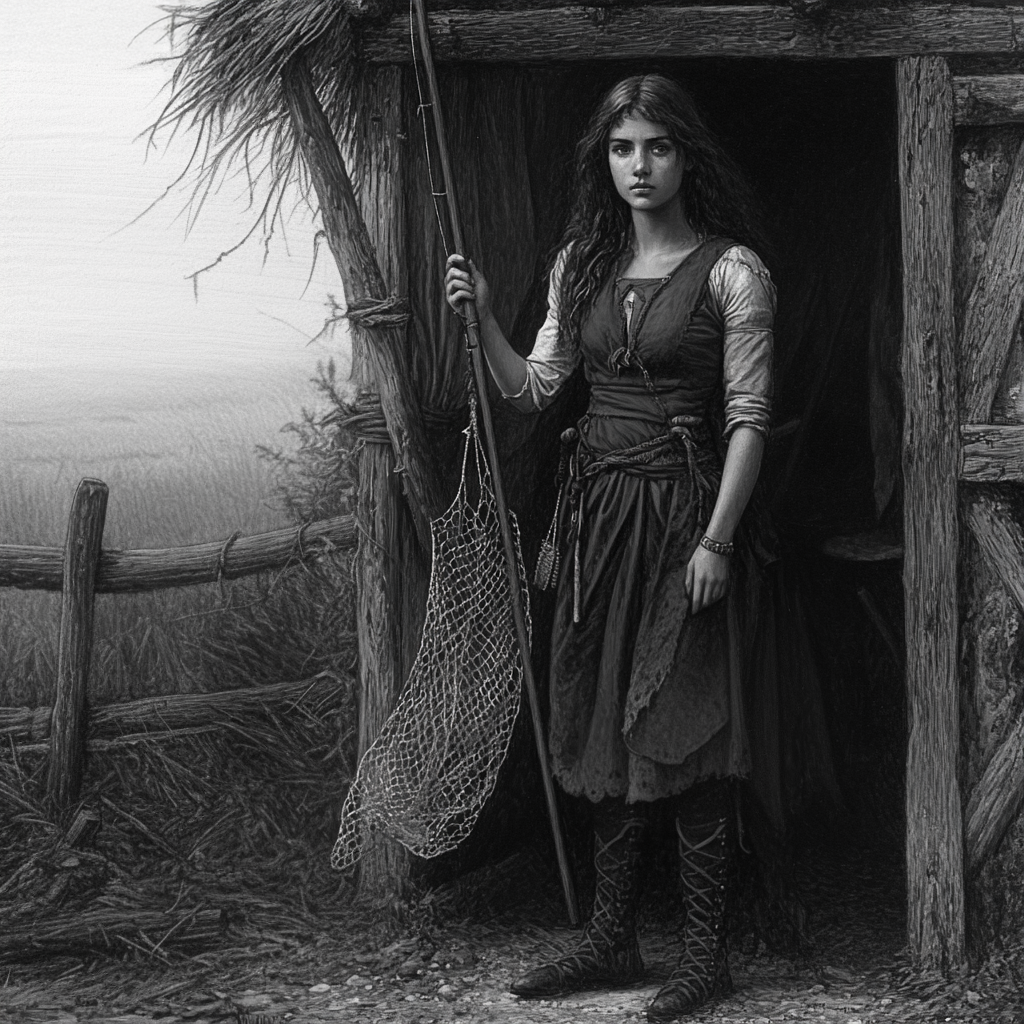
A young woman stepped outside.

She carried no weapon, but she did not appear frightened. She stood beneath the eave watching me approach, one hand still holding a length of cord she had apparently been working.

Her first impression upon me was not beauty, though she was attractive. It was competence.

There are people whose surroundings seem to belong to them. The repaired fence, the stacked wood, the covered garden, the neatly patched roof, the tools hung beneath the shed—everything around the house suggested the same pair of hands returning repeatedly to whatever needed doing.

She wore a simple dress of brown woven cloth, heavier at the hem where it had been reinforced. Her hair was long and dark, tied loosely behind her shoulders. She was somewhat smaller than most women I knew, though there was nothing frail in the way she stood.

She looked at my pack.

Then at my boots.

Then at the sky.

“You are either arriving at exactly the right time,” she said, “or exactly the wrong one.”

Thunder sounded again.

“I was hoping for the first.”

“That depends on whether you leak.”

“I try not to.”

She smiled.

“Come through before the rain decides for us.”

I opened the gate.

“My name is Heth.”

“Lirael.”

The first drops struck as she spoke.

Within moments the rain became heavy.

We hurried beneath the eave, and she opened the door.

“Leave the boots there.”

I did.

The inside of the house surprised me.

It was small, but every part of it had been used carefully. Shelves occupied one wall, holding jars, folded cloth, bundles of dried plants, bone hooks, needles, twine, and objects I could not identify. A worktable stood beneath the window. Several hides hung from pegs near the hearth. Nets were folded in one corner, though there was no large body of water nearby that I knew of. A wooden frame held a half-finished garment.

The roof did not leak.

I noticed that immediately.

Lirael noticed me noticing.

“Builder?”

I looked at her.

“How did you know?”

“You looked at the rafters before you looked at me.”

“I did not.”

“You did.”

“I was admiring the roof.”

“That is exactly what a builder would say.”

She took my wet cloak.

“This seam will fail.”

I examined it.

“It has held for years.”

“It will fail.”

“Rylor gave me that cloak yesterday.”

“Then Rylor gave you a cloak with a bad seam.”

“You know Rylor?”

“No.”

“That was unnecessarily decisive.”

She smiled again.

“Sit. You are making the floor wet.”

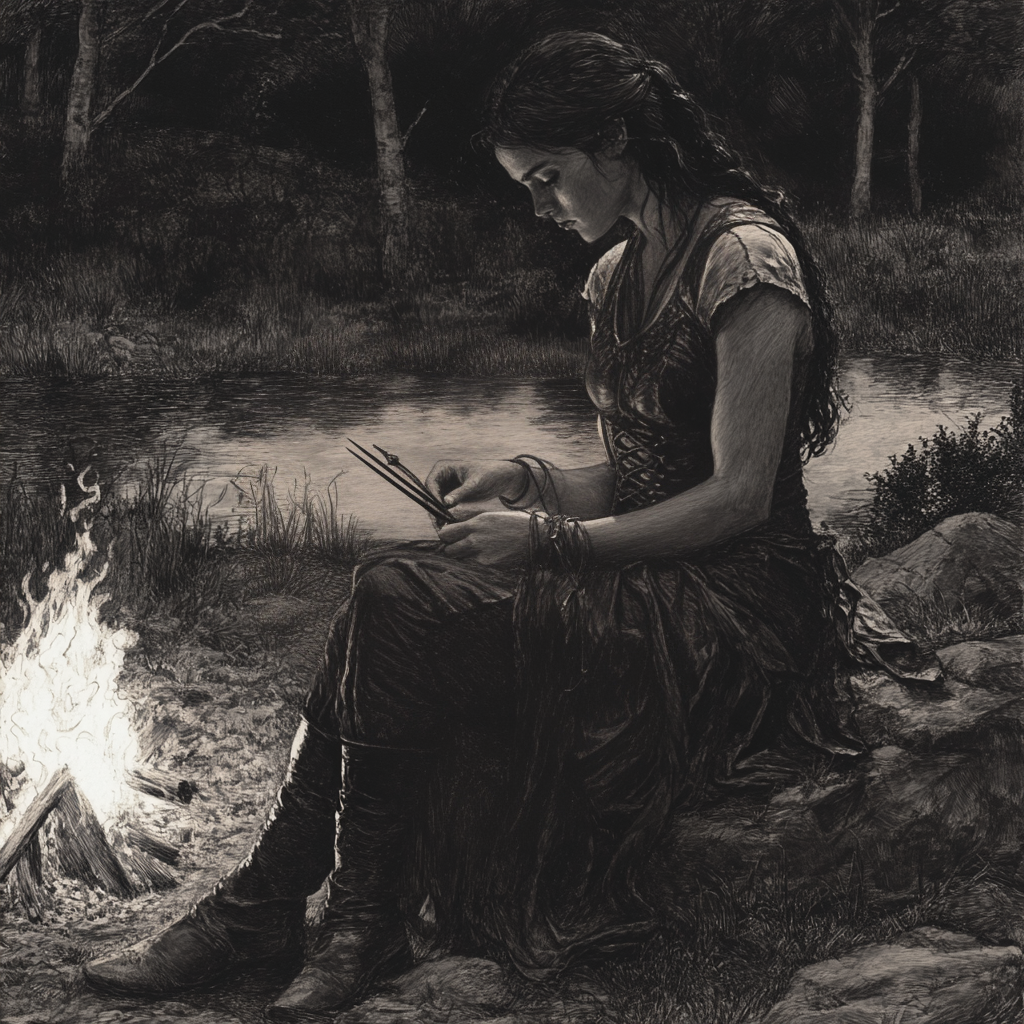
I sat near the hearth while she hung the cloak and returned to whatever she had been doing before I arrived. The length of cord proved to be part of a net. She worked quickly, passing the line through loops with movements so practiced that she scarcely watched her hands.

Rain hammered the roof.

For a while neither of us spoke.

I found the silence comfortable.

That was unusual.

Most people confronted with a stranger eventually begin filling the space with questions. Lirael seemed content to let me exist without explanation.

Then she said, “Nuahaven?”

I looked up.

“Yes.”

“Thought so.”

“How?”

“Your boots.”

I looked at them outside the door.

“They are ordinary boots.”

“They are Nuahaven work boots. Wide heel, doubled toe. Builders and field hands wear them.”

“You know a great deal about boots.”

“I repair things.”

“So do I.”

“Then why is your cloak seam bad?”

“It is not my cloak seam. It is Rylor’s cloak seam.”

“Rylor has become responsible for it very quickly.”

I laughed.

She tied off the cord.

“What brings a Nuahaven builder this far east?”

I hesitated.

“Travel.”

She looked at the rain.

“That is generally how people get here.”

I had heard something similar the previous evening.

Apparently solitude encouraged a particular sense of humor.

“I am going east.”

“How far?”

“I do not know.”

“That is a strange journey.”

“I have recently been told that.”

She set the net aside and moved to a pot near the hearth.

“Have you eaten?”

“Yes.”

“When?”

I thought.

“Morning.”

“That is not what I asked.”

“No.”

She lifted the lid.

Steam rose carrying the smell of roots, herbs, and meat.

I wondered whether Nua had arranged all of Aetheria as a sequence of stew pots.

“I can pay—”

She looked at me.

I remembered I had no money.

“No, I cannot.”

“Then it is fortunate I did not ask.”

She ladled stew into two bowls.

I accepted mine.

This time I did not debate whether doing so violated divine instruction.

My theology really was improving.

We ate while rain blurred the window.

Lirael asked about Nuahaven, but her questions differed from Rylor’s. She wanted to know whether the eastern market had been enlarged, whether a particular family still operated the tannery near the river, whether the meeting hall had finally replaced its cracked southern steps.

“You have lived there,” I said.

She looked into her bowl.

“Yes.”

Something in her voice warned me not to ask more.

So I did not.

We spoke instead of the road.

“There is no road,” she said.

“There was one.”

“There are trails. Most lead somewhere useful to the person who made them. That does not mean they lead somewhere useful to you.”

“I discovered that this morning.”

“Where?”

I described the stream and the two paths.

“You took the south branch.”

“Yes.”

“That goes to an old quarry.”

“I know that now.”

“You reached it?”

“No.”

“Then you do not.”

I smiled.

“Where does the northern path go?”

“Here, eventually. Beyond here it breaks into game trails.”

I stopped eating.

“No eastward trail?”

“Not one worth trusting.”

That was unwelcome.

“How do people travel farther?”

“Most do not.”

“But trappers?”

“They know landmarks. Streams. Ridges. The movement of Solara.”

“I can follow Solara.”

“When you can see her.”

Lightning flashed beyond the window.

I looked toward it.

Lirael smiled slightly.

“There are other ways. Moss is sometimes useful, but not as reliable as people say. Wind can help if you know the season. Water is better. Rivers remember where they are going even when people do not.”

“I need to go east.”

“Then you need to learn the country.”

“I was hoping the country would cooperate.”

“It rarely does.”

She ate another spoonful.

“Why east?”

I had reached the point where evasion seemed ridiculous.

“Nua told me to go.”

Lirael stopped.

Unlike Rylor, she did not immediately become solemn.

She studied me.

“Nua.”

“Yes.”

“The Eternal Shaper.”

“I am aware of which Nua.”

“I wanted to be certain.”

“I dreamed of her two nights ago.”

“And she told you to walk east.”

“Yes.”

“In those words?”

“Among others.”

“What others?”

I repeated the command.

She listened without interrupting.

When I finished, she sat back.

“The giants need your treasure. The Silvrens need your measure. Go east. Leave this very night. Take only the clothes on your back. Do not return until you see the blue.”

“Yes.”

“And you have a pack.”

“It is a complicated story.”

“It has been two days.”

“A surprisingly complicated two days.”

I told her about Rylor.

When I reached the part about leaving home in proper clothes instead of my nightshirt, she laughed.

Not politely.

She laughed until she put down her bowl.

“I had hoped for sympathy.”

“You dressed first.”

“Yes.”

“After Nua said—”

“Yes.”

“You argued with Nua.”

“Silently.”

“That makes it better.”

“I believed she meant possessions.”

“And then the next day you acquired possessions.”

“Rylor had persuasive arguments.”

“I am sure he did.”

Her laughter faded, though the amusement remained in her eyes.

“What do you think the words mean?”

I explained.

The treasure was our faith.

The measure was Aetheria.

The blue was the eastern sea.

Lirael listened more carefully now.

When I finished, she said, “You are very certain.”

“I am not certain.”

“You sound certain.”

“They are reasonable interpretations.”

“Yes.”

I waited.

She said nothing.

“You disagree.”

“I did not say that.”

“You were about to.”

“I was thinking.”

“About what?”

“That Nua presumably knows the words she wants to use.”

“Of course.”

“So why not say, ‘Take the Covenant east, learn the size of Aetheria, and stop when you reach the sea’?”

I had no answer ready.

Lirael continued eating.

“Prophecy is rarely plain.”

“That is convenient.”

“For prophets?”

“For everyone interpreting them.”

“You think I imagined it.”

“I did not say that either.”

“You imply a great deal without saying it.”

“It saves breath.”

I found myself smiling despite my irritation.

“What do you believe?”

“In Nua?”

“Yes.”

“Yes.”

“Then why question her words?”

“I am questioning yours.”

That stopped me.

Outside, the rain had begun to ease.

Water dripped steadily from the eaves.

Lirael set down her bowl.

“If Nua spoke to you, then Nua spoke to you. But the moment the dream ended, Heth began speaking to Heth.”

I stared at her.

“You sound like Rylor.”

“I hope that is not an insult.”

“I have known him for one day.”

“And already he has given you a pack and a philosophy.”

“He also gave me bread.”

“Then I approve of him.”

She rose and took our bowls.

I watched her rinse them in a basin.

“You have thought about these things.”

“Everyone thinks about these things.”

“Not everyone asks questions like that.”

She did not respond.

I sensed again the boundary around some part of her life.

Rain continued more gently into evening.

I had assumed I would sleep beneath the eave or in the shed, but Lirael pointed toward a narrow bedroll near the hearth.

“You can use that.”

“I do not want to impose.”

“You already ate my stew.”

“That is true.”

“You are committed now.”

I thanked her.

She returned to the damaged seam on my cloak.

“You were serious?”

“It will fail.”

She threaded a needle.

I watched her work.

“You said you repair things.”

“Anything I can.”

“Clothes?”

“Clothes. Nets. Leather. Harness. Roofs when I must. Pots if the crack is kind. People occasionally, though they are more difficult.”

“Healer?”

“No. I know enough to keep someone alive until a healer arrives.”

“That sounds useful out here.”

“It has been.”

She pulled the thread tight.

“Why live here alone?”

The question escaped before I could stop it.

Her hands paused.

I immediately regretted asking.

“You do not have to answer.”

“I know.”

She resumed sewing.

For a while the only sounds were the needle passing through cloth and water dripping outside.

“I was not always alone,” she said finally.

I waited.

“I lived in Nuahaven.”

“I gathered that.”

“My mother still does, unless she has moved.”

“You do not know?”

“No.”

That answer carried more weight than the words.

She finished one stitch and began another.

“There was a man.”

I remained silent.

“Kael.”

She spoke the name carefully, as though it had edges.

“He was a builder too, though not as good as he believed. He worked stone more than wood. We met when I was eighteen.”

She smiled faintly.

“He dropped a block on his foot because he was looking at me.”

“That sounds painful.”

“It improved him temporarily.”

“What happened?”

Her expression changed.

“We wanted a household.”

I nodded.

“We needed a syren.”

There was nothing unusual in that statement.

She continued.

“There were fewer unattached syrens in our part of Nuahaven then. Several households were already waiting. We spoke with two. Neither bond was right. Then we met Eland.”

Her eyes remained on the cloak.

“He was kind. Quiet. I liked him. Kael liked him. For a while I thought it would work.”

“What happened?”

“His family had promised him elsewhere.”

I frowned.

“Promised?”

“Not formally. There was land involved. Two families had expected the match since Eland was a child. No one had bound him to it, exactly, but expectation can become a kind of rope if enough people hold the ends.”

“And he chose them?”

“Eventually.”

“Did he want to?”

“I think he wanted everyone to stop asking him what he wanted.”

I understood that better than I cared to admit.

Lirael examined the seam she had just sewn, apparently found it unsatisfactory, pulled several stitches free, and began again.

“For a while Kael and I waited. We thought another syren would come along. Nuahaven was growing. People arrived from the smaller settlements. New households formed all the time. There was no reason for us to hurry.”

“But you did.”

“Yes.”

There was no defensiveness in the word.

That made it worse.

“We loved each other. At least I believed we did. We had spent nearly two years waiting. Every season someone would ask whether we had found a syren yet. Every feast we attended seemed full of households with children. Kael became angry about it. I became angry with him for becoming angry. Then I became angry for the same reason.”

She looked toward the window.

“The strange thing is that we knew.”

“Knew what?”

“What would happen.”

I said nothing.

“There are things people do because they do not understand the consequences. This was not one of them. We had seen Discordants. Everyone has. We knew why they were born. We knew the teachings. We knew nature. We knew everything there was to know.”

Her fingers tightened around the cloak.

“And we did it anyway.”

The room seemed suddenly smaller.

Lirael continued.

“One night Kael came to see me. We had argued earlier. I do not even remember what the argument was about. Probably Eland. Probably waiting. Probably nothing. We made peace.”

She stopped.

I did not ask her to continue.

“We committed discord.”

The words required no explanation.

I had heard confessions of discord before. Everyone in Nuahaven had. The Covenant treated it as one of the gravest violations of Nua’s order, not merely because it broke the sacred sequence but because its consequences could take living form.

I learned later that her family had lived east of the river, nearly half a day’s walk from my father’s house. We had both called ourselves people of Nuahaven, but there had been little reason for our paths to cross. Nuahaven, unfortunately, had grown large enough and dispersed enough that local scandals were not universally known.

Lirael looked directly at me.

“I became pregnant.”

I felt my stomach tighten.

She saw it.

“Yes.”

The fire cracked softly.

“Was the child—”

“A Discordant.”

I wished immediately that I had not asked.

Lirael looked away.

“He was born alive. Male. Large. Larger than he should have been. His arms were already too thick, his head wrong in shape. He cried constantly. Not like other infants. It was more like an animal crying.”

Her voice remained steady, but only because she was forcing it to.

“I held him.”

I looked down at my hands.

“What happened?”

“He died.”

That could mean many things among our people.

The Covenant commanded mercy toward Discordants, but mercy had never been a simple word where they were concerned. Some could be cared for. Some were violent almost from birth. Some suffered terribly. The old histories told of darker ages when they had been killed casually or abandoned, and of the Sanctuary Nua had prepared for them. In Nuahaven such decisions were made by families, healers, and elders, and everyone pretended afterward that the decision had been clearer than it was.

I did not ask how Lirael’s child died.

Perhaps she appreciated that.

“Kael left before the birth,” she said.

That surprised me more than anything else she had told me.

“He left you?”

“Yes.”

“Why?”

“Ask Kael.”

“I would, if he were here.”

“So would I.”

There was bitterness now.

“He said he could not bear the shame. He said everyone looked at him differently. He said he needed time. Then one morning he was gone.”

“And you?”

“I remained.”

“Alone?”

“My mother was with me.”

The answer softened her.

“She never abandoned me. Remember that if I say unkind things about Nuahaven. My mother did not abandon me.”

“I will.”

“But others…”

She shrugged.

“No one drove me out. That is how people tell the story now, I suppose.”

“I had heard nothing.”

“You were younger.”

“Not much.”

“Far enough away socially, then. Builders have their circles. My family had ours.”

She resumed sewing.

“No elder stood in the square and proclaimed Lirael banished. No one burned my house. No one refused me water. People are usually subtler than that.”

I knew what she meant before she explained.

“A woman would stop talking when I approached. Someone who had always sat beside me at a feast would discover another seat. Mothers watched their children more closely when I was nearby, as though discord were a fever. Men who had once spoken to me normally became excessively courteous. That was almost worse.”

“Why?”

“Because excessive courtesy is what people use when they want to prove they are not being cruel.”

I smiled faintly.

She did not.

“The elders were kind. Very kind. They reminded me of Nua’s mercy. They reminded me that the Sanctuary received the souls of Discordants. They reminded me that repentance restores harmony.”

She pulled the thread hard.

“I did not need reminding.”

“No.”

“Everyone wanted me to repent in a way they could see. They wanted tears at the right moments. They wanted gratitude for forgiveness. They wanted me to become a lesson.”

I thought of the Covenant tablets.

“Were you not sorry?”

Her eyes flashed toward me.

“Yes.”

The force of the answer made me flinch.

Then her expression softened.

“Sorry. That was unfair.”

“No. My question was.”

“I was sorry every day. I was sorry when I woke. I was sorry when I ate. I was sorry when I saw children. I was sorry when I saw a syren walking beside a woman and wondered whether we might have waited one more season.”

She looked into the fire.

“I was sorry when I held my son.”

Neither of us spoke for a while.

Rain ticked lightly against the window now, no longer a storm.

“I simply did not believe sorrow belonged to the village,” she said. “It belonged to me.”

I thought about that.

At twenty-three I still believed many things could be divided neatly into obedience and opposition, wisdom and foolishness, harmony and discord. Lirael did not persuade me otherwise that evening.

She did something more important.

She made the divisions harder to draw.

“How did you come here?” I asked.

“Slowly.”

She seemed grateful for the change.

“After the child died, I stayed with my mother. I worked. Sewing mostly. Then leather. Nets. Anything people would bring me. Work is useful when you do not want to think.”

“I know.”

She glanced at me.

“Yes. I suspect you do.”

“Eventually I began traveling to the eastern farms. People there knew less about me. Or knew and cared less. Things break everywhere. A person who can mend them is welcome.”

“That is true.”

“I stayed farther east each time. One farmer let me sleep in a shed. Another paid me with a set of tools. I learned trapping from an old woman who had lost two fingers and therefore preferred teaching to setting traps herself. I learned which plants stop bleeding and which make a person wish he had bled to death instead.”

“Useful distinction.”

“Very.”

“Then I found this place. The house was half collapsed. Whoever built it had been gone for years. I repaired the roof, then the wall, then the chimney. By the time I finished, I realized I lived here.”

I looked around again.

“You did all this?”

“Most of it.”

“The roof beam above the door?”

“What about it?”

“It is carrying too much weight.”

Her eyes narrowed.

“It has carried it for four years.”

“It will sag.”

“It has not.”

“It will.”

She looked offended.

“You have been in my house half an evening.”

“I am a builder.”

“I repaired your cloak.”

“That does not qualify you to suspend a roof incorrectly.”

“It is not incorrect.”

“The brace is too shallow.”

She stood.

I stood too.

We both looked at the beam.

Lirael pointed.

“The load transfers there.”

“Some of it.”

“All that matters.”

“No. Look at the joint.”

She looked.

I pointed to a faint line in the wood.

“That is beginning to open.”

She stared.

I tried not to appear pleased.

She moved closer.

“That could have been there when I fitted it.”

“It could.”

She looked at me.

“It was not.”

I smiled.

She sighed.

“I dislike you slightly more than I did before.”

“I can repair it tomorrow.”

“Tomorrow?”

The word stopped us both.

I had assumed I would leave at dawn.

She had apparently assumed the same.

Outside, the rain had almost ended.

“I should go in the morning,” I said.

“Yes.”

“But the beam—”

“Will survive.”

“Probably.”

“That is not reassuring.”

“It was not intended to be.”

She folded my cloak and handed it back.

The seam was nearly invisible.

I examined it.

“Well?”

“It is good.”

“Only good?”

“Very good.”

“Better.”

I put it beside my bedroll.

Lirael extinguished one of the lamps.

“Sleep, Heth of Nuahaven. You can save my roof and the giants tomorrow.”

“I am not sure which comes first.”

“My roof.”

I lay down.

She disappeared behind a hanging cloth that divided the sleeping portion of the house from the main room.

I expected sleep to come immediately.

It did not.

I lay watching the last orange light of the hearth move across the rafters.

I thought about Lirael.

Not as a woman.

I should make that clear.

She was attractive. I had noticed that when I arrived, and I was not so pious or so foolish as to pretend otherwise. But whatever feeling had been absent with Mira and Seren was absent here as well. I felt no desire to court Lirael, no imagining of a household, no restless curiosity about whether affection might become something else.

Instead, I felt something almost as unfamiliar.

I liked her.

That sounds trivial written now.

It was not trivial then.

I had acquaintances in Nuahaven. Cousins. Fellow builders. Men with whom I worked and drank and argued. I had people who would help me raise a roof and people I would help in return.

But I had few friends.

Perhaps none.

I had never considered this a deficiency.

Lirael had known me for a few hours and had questioned my prophecy, mocked my interpretation, repaired my cloak, fed me, told me the most painful story of her life, and argued with me about a roof beam.

I wanted to continue talking to her.

That was new.

Eventually I slept.

I awoke to hammering.

For one confused moment I thought I was home.

Then I opened my eyes and saw Lirael standing on a stool near the doorway with a wooden mallet in one hand.

“What are you doing?”

“Repairing my dangerously constructed house.”

“You need to unload the beam first.”

She stopped.

“I knew that.”

“No, you did not.”

“I was about to.”

I got up.

Morning light filled the room. The storm had passed, leaving the air outside washed clean. Water sparkled on every leaf. Mist lay low across the fields.

We spent the first part of the morning repairing the roof.

I had not intended to.

Nua had said go east.

But I reasoned that I was already awake east of where I had slept the previous morning, and perhaps an hour spent preventing a roof from collapsing did not constitute abandonment of my mission.

This was another example of the flexibility my obedience had acquired.

The repair required more than an hour.

Once we opened the joint, we found rot beginning beneath it.

Lirael looked at me.

“Do not say anything.”

“I was not going to.”

“You were.”

“I was thinking.”

“That is worse.”

We removed the damaged section, cut a replacement from seasoned timber stored beneath her shed, and fitted a steeper brace. Lirael worked well. She did not possess my training, but she understood tools and needed few instructions. When I asked for something, she usually anticipated which thing before I finished asking.

By midday the beam was sound.

I stood beneath it admiring our work.

Lirael stood beside me.

“It looks exactly the same.”

“That is the sign of a good repair.”

“It took half the morning.”

“That is also the sign of a good repair.”

“You builders have arranged your philosophy conveniently.”

“We learn from prophets.”

She laughed.

We ate bread and dried fruit outside.

The world after the storm seemed enormous.

The hills east of her house rose one behind another, darker as they receded. Beyond them, faint against the horizon, I could see a line that might have been distant forest or another ridge.

“That way?” Lirael asked.

“Yes.”

“What will you do when the trails end?”

“Continue east.”

“That is not a method.”

“I will follow Solara.”

“Until clouds come.”

“Then I will wait.”

“What if you are beneath trees?”

“I will use moss.”

She stared at me.

“You know nothing about moss.”

“I know it grows on the north side of trees.”

“Sometimes.”

“That is what everyone says.”

“Everyone who gets lost.”

I bit into the bread.

“I will manage.”

“I am beginning to doubt that.”

“You have known me less than a day.”

“It has been an informative day.”

After we ate, I filled my waterskin from her well and gathered my things.

Lirael watched.

“You are taking the eastern ridge?”

“I suppose.”

“There is a stream beyond it.”

“Does it go east?”

“For a while.”

“Then I will follow it.”

“It turns north after two days.”

“How do you know?”

“I have followed it.”

“What lies north?”

“Woods.”

“And east?”

“More woods.”

“That is not helpful.”

“The world was not arranged for your convenience.”

“So I am learning.”

She folded her arms.

“There are marshes southeast of here. Avoid them. The ground looks firm until it is not.”

“Quicksand?”

“Some. Mud mostly. Deep enough to keep you permanently.”

“I will avoid the marshes.”

“Do not drink from still water if you can help it.”

“I know.”

“You knew how packs worked too.”

I tightened a strap.

“Anything else?”

“Yes.”

She began listing things.

Which berries were safe.

Which insects nested beneath fallen logs and stung in groups.

Which distant animal calls meant nothing and which meant leave immediately.

How to recognize the shallow depressions made by sleeping Korbeasts.

Where a line of dark stone could be followed east for several miles.

How to find water by watching certain small flying creatures near dusk.

I listened.

After several minutes I realized something.

“You should come.”

She stopped.

The idea had emerged from my mouth before it had fully emerged in my mind.

“What?”

“With me.”

She stared.

I almost withdrew the invitation immediately.

Then I considered it.

“You know the country. You know plants. You repair things. You know how to find water.”

“I also have a house.”

“A dangerously constructed house.”

“Recently repaired.”

“By me.”

“Which is why I should stay and enjoy it.”

“True.”

I felt foolish.

“Forget I said it.”

She looked east.

Something changed in her expression.

“I have thought about going farther.”

I waited.

“Many times.”

“Why haven’t you?”

“Because thinking about something is easier.”

That sounded familiar.

“You said the eastern country interests you.”

“It does.”

“And you know more about traveling than I do.”

“Almost everyone does.”

“Then come.”

She looked at me.

“Nua called you.”

“Yes.”

“Not me.”

“No.”

“What if your command was meant for you alone?”

That was a serious objection.

I had not considered it.

“The words did not say alone.”

“They did not say take Lirael.”

“I did not know Lirael existed.”

“Nua presumably did.”

I frowned.

She smiled.

“You see? Prophecy is difficult.”

“I am regretting telling you about it.”

“No, you are not.”

“No.”

She looked toward her house.

For the first time I wondered what it meant to her.

I had seen shelter.

She had built a refuge.

Every repaired board represented a decision to remain apart from the people who had hurt her.

Leaving it would not be a small thing.

“I should not have asked,” I said.

“Why?”

“Because you have made a life here.”

“I have made a house here.”

“There is a difference?”

She looked at me for a long moment.

“Yes.”

I did not answer.

A Skydrake cried somewhere high above us.

Lirael followed the sound until the creature appeared briefly between clouds.

“I left Nuahaven because I wanted people to stop looking at me.”

She spoke quietly.

“Then I came here and succeeded.”

“That was what you wanted.”

“Yes.”

“Is it still?”

She looked at me.

“No.”

The word surprised both of us.

She laughed softly.

“No. Apparently it is not.”

She walked to the door.

“Wait.”

“For what?”

“If I am going to cross Aetheria with a prophet who cannot distinguish north from a quarry road, I am taking more than the clothes on my back.”

“I am not a prophet.”

“Nua spoke to you.”

“That does not make me a prophet.”

“Tell the giants.”

She went inside.

I remained by the fence, uncertain whether she was serious.

A few minutes later she emerged carrying a pack.

Then she went back inside.

She returned with another bundle.

“Lirael.”

“What?”

“How much are you bringing?”

“Enough.”

“Nua specifically told me—”

“Nua specifically told you.”

“That seems like an abuse of wording.”

“It is precise interpretation.”

She returned inside.

I waited.

When she emerged again she carried a rolled hide, a small cooking pot, cord, two knives, needles, thread, a fishing net, several bone hooks, packets of dried herbs, a hatchet, and something that appeared to be part of a trap.

I stared.

“You cannot carry all of that.”

“I know.”

“Then why—”

“You can.”

I looked at my own pack.

“No.”

“You invited me.”

“I invited you, not your house.”

“These are provisions.”

“I already have provisions.”

“You have one knife.”

“That seemed sufficient yesterday.”

“Yesterday you were an idiot.”

“I have improved considerably.”

“Yes. You invited me.”

I laughed.

She began sorting the objects between our packs.

“Nua said take only the clothes on your back,” I reminded her.

“And then you decided that provisions given along the way were acceptable.”

“Rylor decided that.”

“You accepted his reasoning.”

“Yes.”

“Good.”

She handed me a coil of cord.

“What is your point?”

“I am a provision.”

I stared at her.

“You are not a provision.”

“I can find water.”

“Yes.”

“Food.”

“Yes.”

“I can mend clothing.”

“Yes.”

“Tan hides.”

“I did not know that.”

“Set traps.”

“Yes.”

“Fish.”

“Yes.”

“Recognize dangerous plants.”

“Yes.”

“Treat wounds.”

“To some degree.”

“Navigate.”

“Yes.”

“Then I am more useful than anything Rylor gave you.”

“That is an alarming way to describe a person.”

“Nevertheless, it is true.”

I looked at the assortment of objects she had spread between us.

“You are also considerably heavier than anything Rylor gave me.”

“I intend to walk.”

“That improves matters.”

“And carry my share.”

“That improves them further.”

She handed me the hatchet.

I took it automatically.

She smiled.

“What?”

“You accepted that.”

I looked at the hatchet in my hand.

“You gave it to me.”

“Exactly.”

I put it down.

She laughed.

“This is serious, Lirael.”

“I know.”

“Nua may actually have spoken to me.”

“I believe you.”

Her answer surprised me.

“You do?”

“I believe that you believe it. Yesterday I was less certain about the rest.”

“And now?”

She considered.

“I do not know. But I watched you this morning.”

“Repair your roof?”

“Prepare to leave.”

I waited.

“You are frightened.”

“Of course I am.”

“But you are going anyway.”

“Nua commanded me.”

“Yes. That is why I am beginning to believe you.”

I did not quite follow her reasoning.

She apparently saw that.

“A madman would enjoy this more.”

I laughed.

“That is comforting.”

“It is meant to be.”

She began packing again.

I watched for a moment.

“You truly intend to come.”

“Yes.”

“What about your house?”

“I will close it.”

“For how long?”

“I do not know.”

“What if we are gone years?”

“Then I will have a very dusty house.”

“What if we never return?”

She stopped.

There it was.

The question I had avoided since leaving Nuahaven.

Lirael looked toward the doorway. Beyond it lay the little garden, the shed, the fence she had repaired, the roof we had repaired together. Everything she had made after leaving her former life was contained within that small clearing.

She walked outside the gate.

I followed.

For several moments she simply stood looking at the house.

“I thought this was where I would grow old,” she said.

“Perhaps it still is.”

“Perhaps.”

She touched the gatepost.

“When I came here, I wanted a place no one could take from me. So I repaired the house. I planted the garden. I learned the streams. I learned where the game trails were and where the ground froze first in winter.”

She smiled faintly.

“I became very good at being alone.”

“You seem good at most things.”

“That is because you have known me for one day.”

“I have seen your roof.”

“You repaired one beam.”

“A crucial beam.”

She ignored that.

“I thought being alone meant no one could hurt me.”

I said nothing.

“Then yesterday a stranger walked up my path dressed like a builder, carrying a trapper’s pack, claiming Nua had told him to cross Aetheria.”

“I did not claim that immediately.”

“No. First you inspected my roof.”

“A fortunate decision.”

She smiled.

Then the smile disappeared.

“I do not want this house to become another thing I am afraid to leave.”

That settled the matter.

Not for me.

For her.

She went inside.

I followed and helped her prepare.

Lirael was far less sentimental about possessions than I expected. Most of what she had initially assembled was rejected after consideration. The cooking pot stayed. So did the needles, thread, cord, hooks, knives, hatchet, herbs, flint, and a small net. She packed several pieces of leather and enough dried food for a few days.

I objected to the leather.

“It is heavy.”

“It becomes useful when something breaks.”

“We can find hides.”

“After Varyn kills something?”

“Who is Varyn?”

She looked at me.

“I do not know.”

“Then why did you say Varyn?”

“I did not.”

“You did.”

“No, I said, ‘after you kill something.’”

I stared at her.

For years afterward I remembered that exchange.

I have wondered whether I heard her incorrectly, whether memory altered the moment after everything that happened, or whether Nua allowed a name to slip briefly through the world before either of us knew its owner.

Lirael always insisted I had misheard her.

Varyn, when we eventually told him, insisted it proved he had been destined to join us.

This was typical of Varyn.

At the time, however, I merely shook my head.

“I must be tired.”

“You have walked for two days.”

“One.”

“You left Nuahaven two nights ago.”

“That is still one full day of walking.”

“You see? Already you need someone who can count.”

I took the leather.

We divided the remaining provisions carefully. Lirael carried less than I did, partly because she was smaller and partly because I had enough pride remaining to insist upon it. She objected until I pointed out that traveling at different speeds would accomplish nothing.

That argument she accepted.

Before leaving, she covered the garden beds with woven screens and carried several buckets of water to them.

“You expect them to survive?”

“For a while.”

She scattered grain near the edge of the clearing.

Small six-legged birds emerged almost immediately from beneath the bushes.

“They will eat half the garden when the screens fail,” she said.

“Then why feed them?”

“They might wait longer.”

I could not tell whether she was joking.

Inside, she covered the furniture with cloth, emptied the water basin, banked the hearth completely, and checked the shutters twice.

Then she stood in the center of the room.

I recognized the expression on her face.

I had worn it in my own house two nights earlier.

My life was suddenly full of things I had assumed would still be there tomorrow.

I turned away to give her privacy.

After a moment I heard the door close.

She locked it with a wooden bar that could be released from outside by a concealed cord. Then she tucked the cord beneath a loose board.

“You are telling me where the key is,” I said.

“You already know where I live.”

“That is true.”

“If you rob me, I will find you.”

“Across Aetheria?”

“I know how to navigate.”

I smiled.

We shouldered our packs.

Lirael looked once more at the house.

“Ready?” I asked.

“No.”

I waited.

She drew a breath.

“Go.”

We went.

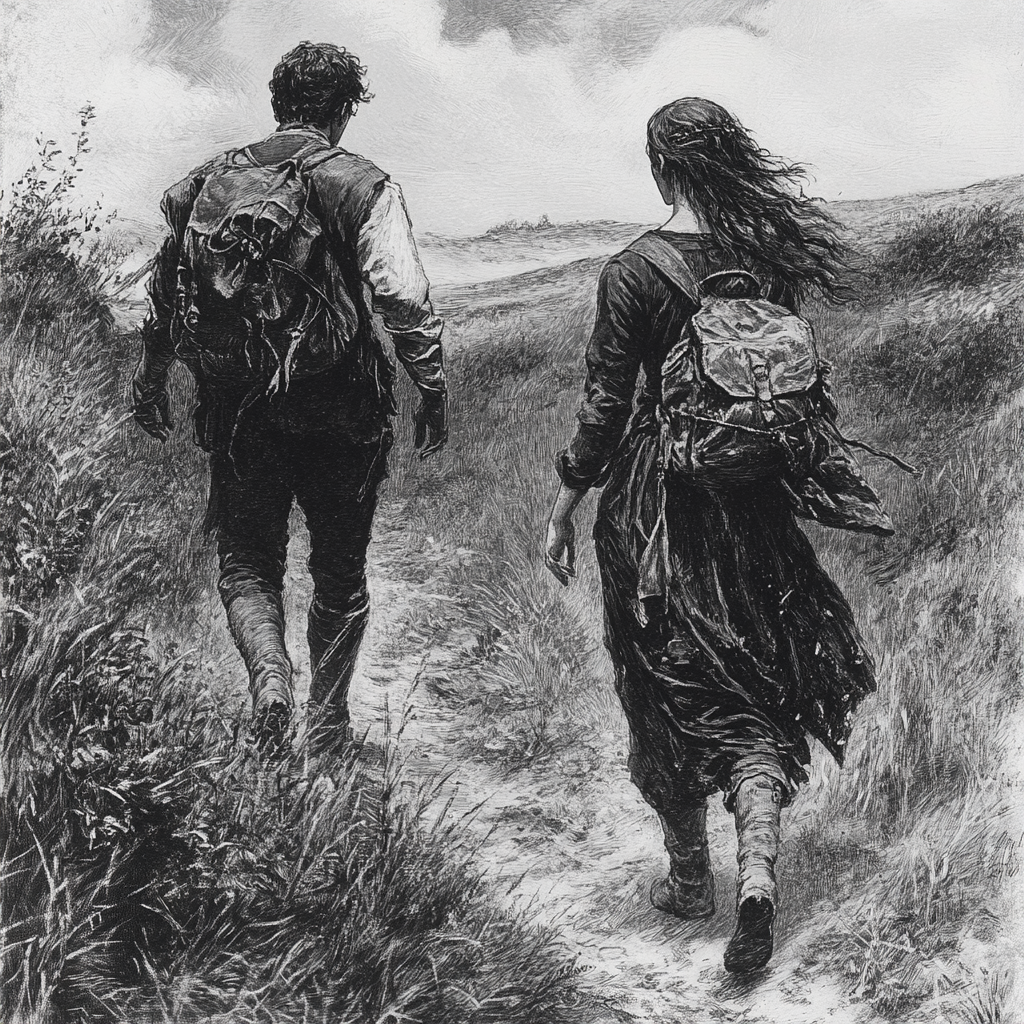
For the first hour I led.

This proved to be a mistake.

The trail beyond Lirael’s clearing climbed steadily toward the eastern ridge. I set what seemed to me an ordinary pace. When I glanced back, Lirael was perhaps thirty paces behind.

I stopped.

She caught up.

“You walk quickly.”

“I am walking normally.”

“For you.”

I looked at her.

She was not winded exactly, but she was breathing harder than I was. Her legs were shorter, and the pack represented a greater proportion of her weight.

I felt foolish.

“You lead.”

“Why?”

“Because if I lead, I will keep walking too quickly.”

“You could walk more slowly.”

“I could. But I will forget.”

“That is honest.”

She moved ahead.

The arrangement proved immediately better.

Her pace was not slow. It was simply shorter and steadier. I followed a few steps behind, adjusting without effort.

This became our manner of traveling for a long time afterward: Lirael ahead, I behind her, and eventually Varyn behind us both.

At the time, of course, there were only two.

The ridge rose gradually beneath our feet. At its crest we stopped.

Lirael had been right about the view.

Eastward, the settled world ended.

I had thought myself far from Nuahaven at Rylor’s hut. I had thought so again at Lirael’s house. From that ridge I understood how little distance I had actually traveled.

The land before us seemed without limit.

Forests spread across the lower country in irregular dark masses. Between them lay open prairie, streams catching Solara like threads of light, low hills layered one behind another, and farther away a darker line of high country whose distance I could not judge. Steam rose in several places to the south where the geyser fields continued. To the north, the land became greener and more heavily wooded.

There were no roofs.

No smoke.

No roads that I could see.

No mark of Nuahaven.

For the first time, I felt the true size of Nua’s command.

Lirael stood beside me.

“You can still go back.”

I looked at her.

“Rylor said that yesterday.”

“Was he wise?”

“Annoyingly.”

“Then perhaps you should listen when wisdom repeats itself.”

“Are you going back?”

She looked over her shoulder.

Her house was hidden beyond the ridge.

“No.”

“Then neither am I.”

“That is poor reasoning.”

“It has the advantage of being decisive.”

We descended.

The trail became faint almost immediately.

Lirael showed me how to distinguish the flattened grasses of a frequently used animal path from the more irregular disturbance left by wind. She pointed out broken twigs at knee height, tracks pressed into damp soil, and dung whose freshness apparently conveyed information I had never wished to possess.

“That is from a Korbeast,” she said.

I looked at the pile.

“You can tell?”

“Yes.”

“How?”

She looked at me as though I had asked how she knew water was wet.

“Shape. Size. Smell.”

“I will trust you.”

“You should learn.”

“I have spent my life learning how not to examine dung.”

“That life is behind you.”

This, unfortunately, proved true.

By midday we reached the stream she had described.

It was narrow, clear, and cold, running east between steep grassy banks.

I felt vindicated.

“A river remembers where it is going,” I said.

“A stream.”

“It is going east.”

“For now.”

“We will follow it.”

“For now.”

We ate beside the water.

I offered her some of Rylor’s dried meat. She tasted it and frowned.

“What?”

“Too much salt.”

“It keeps.”

“So does leather. I do not eat it.”

“You brought leather.”

“For repairs.”

“Perhaps Rylor’s meat can serve both purposes.”

She laughed.

The afternoon passed easily.

That surprised me.

I had expected companionship to complicate the journey. Instead, distance seemed to pass more quickly when measured in conversation.

At first we spoke of practical things.

Water.

Weather.

Tracks.

The best way to distribute weight in our packs.

Whether my left boot needed further padding.

Then our conversation wandered.

Lirael wanted to know about my work.

I told her about barns, houses, bridges, roofs, and the endless difficulty of convincing people that a beam which looked large enough was not necessarily large enough.

She told me about tanning hides and repairing nets.

“How did you learn net-making this far inland?” I asked.

“From my sire.”

That was the first time she had mentioned him.

“He was from the coast?”

“His family was. He grew up among fishermen before coming inland.”

“Is he still in Nuahaven?”

“He died when I was sixteen.”

“I am sorry.”

“So am I.”

She walked several steps in silence.

“He used to say a net is only a collection of holes tied together.”

“That sounds like something Rylor would say.”

“My sire was funnier.”

“I never met him, so I cannot dispute it.”

“You would have liked him.”

I believed her.

A little later she asked about Loren.

I had mentioned my sire while telling her about my family.

“I do not remember him,” I said.

“Nothing?”

“Nothing I trust.”

“What does that mean?”

“I have an image of someone lifting me.”

“That could be him.”

“It could be my father. Or a memory made from being told that Loren used to lift me.”

She nodded.

“Memory is unreliable.”

“Yet we build histories from it.”

“And religions.”

I glanced at her.

She kept walking.

I would come to know that tone.

It meant Lirael had found a question and was turning it over.

She did not pursue it that afternoon.

The stream curved gently northeast.

We followed.

Toward evening we found a stand of trees on higher ground where the soil was dry. Lirael rejected the first place I chose for camp.

“Why?”

“Dead branch.”

I looked up.

A thick limb hung directly over the spot.

“It has been there for years.”

“That is not evidence it will remain there tonight.”

I moved.

She rejected the second place because water would collect there if it rained.

The third apparently contained biting insects.

At the fourth I stopped asking.

“This?”

She examined the ground.

“Yes.”

“Praise Nua.”

“You are learning.”

We made camp.

Or rather, Lirael made camp while I discovered how little I knew about making one.

I could build a house.

This did not mean I could arrange three stones around a fire correctly.

“The opening faces away from the wind,” she said.

“I knew that.”

“You put it toward the wind.”

“I was testing you.”

“You will become an excellent traveler once you stop knowing everything.”

She gathered dry wood from beneath fallen branches where the rain had not reached it. I cleared the ground. Between us we had a fire burning before Solara disappeared.

We ate more of Rylor’s excessively salted meat with roots Lirael had gathered along the stream.

Afterward we sat watching darkness settle over the water.

Luneth appeared between the branches.

For a while neither of us spoke.

The silence was different from solitude.

I remember realizing that distinctly.

When I had camped alone in my imagination, silence had seemed like emptiness.

With Lirael sitting across the fire, silence felt inhabited.

She poked at the embers.

“Heth?”

“Yes?”

“If Nua told you to take only the clothes on your back, why do you think she allowed you to find Rylor?”

“I do not know that she did.”

“You said she provides.”

“I said that when I was hungry.”

“You believed it.”

“I still do.”

“Then perhaps Rylor was a provision.”

“He certainly believed so.”

“And perhaps this house was.”

“Your house?”

“Shelter. Food. Knowledge.”

I saw where she was going.

“And you.”

She smiled.

“I told you.”

“You are very determined to classify yourself as an object.”

“Only when the classification is useful.”

I looked into the fire.

“Perhaps.”

“There is that word.”

“Rylor infected me.”

“Perhaps.”

I laughed.

She drew her cloak around herself.

“You left with nothing.”

“Yes.”

“Now you have more than you left with.”

“Yes.”

“Does that trouble you?”

It did.

I had not wanted to admit it.

“A little.”

“Why?”

“Because I do not want to make Nua’s command mean whatever is convenient.”

“That seems wise.”

“But I also do not believe she expected me to starve beside the road merely to demonstrate obedience.”

“That also seems wise.”

“Those two things can point in opposite directions.”

“Then perhaps wisdom is deciding between them.”

“That sounds suspiciously like something you prepared before asking.”

“I did not.”

“Perhaps.”

She threw a twig at me.

It landed in the fire.

We laughed.

Later, when Lirael slept, I remained awake for a while.

The stream murmured beyond the trees.

Somewhere far off, an animal called—a deep, rising sound I did not recognize.

Lirael stirred but did not wake.

I looked east through the branches.

I had begun my journey believing Nua had stripped me of everything unnecessary.

Two days later I possessed more equipment than I had carried from home, knowledge I had not possessed, and a companion I had not known existed.

I wondered whether I had failed the command already.

Or whether I had misunderstood the nature of provision.

Perhaps traveling without possessions did not mean traveling without help.

Perhaps Nua had not sent me east equipped for the journey because the journey itself would equip me.

It was a comforting thought.

That alone made me suspicious of it.

I lay down.

The next morning Lirael woke before me.

By the time I opened my eyes she had already rekindled the fire and heated water.

“You sleep heavily,” she said.

“I walked yesterday.”

“So did I.”

“You are accustomed to it.”

“You will be.”

We ate and packed.

Before leaving, Lirael scattered the ashes, covered the firepit with soil, and restored the stones as nearly as possible to where they had been.

“Why?”

“So someone looking from a distance does not know we camped here.”

“Who?”

“Anyone we do not want to meet.”

That thought remained with me as we started east.

Until then the dangers of Aetheria had been creatures.

Titanclaws.

Gloomtreads.

Quicksand.

Geysers.

I had not thought much about people.

Perhaps because I had not yet traveled far enough to meet people who were truly strangers.

The stream continued east through the morning.

Lirael led.

I followed.

Our shadows moved beside us.

At midday we climbed another low rise, and the land opened again before us.

Somewhere beyond those forests were the ancient giants.

Somewhere beyond the mountains was the blue.

Or so I believed.

I had left Nuahaven with nothing but clothing and certainty.

Already the certainty was proving less durable than the clothing.

But I had acquired something in its place.

A pack.

A little knowledge.

And Lirael.

At the time, I thought Nua had provided me with a companion because I was poorly prepared for the road.

Only much later did I understand that Lirael was not provision for my journey.

I was provision for hers.

And neither of us yet knew that somewhere ahead, in woods neither of us had seen, the third member of our unlikely company was already living beneath the same three moons.

The Book of Heth: Chapter One – The Call of the Eternal Shaper

18 Aug

I am Heth, son of Thalion, of Nuahaven, on the western shores of Aetheria. I write these words in the autumn of my life, when my children have children of their own and the young must sometimes wait for me when we walk uphill. My hands are slower than they were when I shaped beams for houses, and on cold mornings my fingers complain before they consent to hold the quill. Yet there are things I remember with greater clarity now than I did when they happened. Memory is peculiar in that way. A man may forget what he ate three days ago and remember, after half a lifetime, the exact pattern of moonlight upon the floor on the night his life changed.

That is why I write.

Others have told parts of my story. Some have told them better than I could have told them myself. Some have made me braver than I was. Some have made Varyn taller, which would have amused him, and Lirael more solemn, which would not. There are children who know songs in which the three of us crossed Aetheria without once becoming lost, frightened, hungry, cold, quarrelsome, or foolish. I assure the reader that none of these songs is accurate.

I do not object to songs. A song must fit inside a melody, and a life rarely will.

What follows is what I remember.

I was twenty-three years old when Nua commanded me to go east.

At that age I was neither important nor especially promising. I was a carpenter by trade, though we generally called ourselves builders, since there were never enough hands in Nuahaven for a man to insist upon one narrow craft. I shaped beams, fitted doors, repaired roofs, set posts, patched fences, sharpened tools, raised sheds, and, when no one else was available, helped dig wells and carry stone. I knew how to make a wall stand straight, how to fit a peg tightly enough that weather would not loosen it, and how to judge from the sound of an axe whether its edge was biting properly.

These were useful abilities.

They were not, so far as I knew, the abilities of a prophet.

My father, Thalion, liked to remind me of this.

“You think too long,” he would say when I stood studying some troublesome joint in a frame. “Wood does not improve because you stare at it.”

Then I would make the cut, and he would inspect it.

“See?” he would say. “You should have thought longer.”

This was my father’s manner of teaching.

He was a large man by our standards, square in the shoulders and increasingly square in the middle as he aged. His beard had begun to show gray before I was old enough to work beside him, though he insisted this was caused by sawdust. He had been named for an ancestor who lived in the age of Tanes, and like many people of Nuahaven he carried his ancestry as though it were both an honor and a mild inconvenience.

Every family could trace itself to someone who had crossed the Azure Veil, fought the Gloomtreads, heard Tanes speak, carved the Covenant, or claimed to have done so.

Our people had long memories.

We lived among reminders.

My sire, Loren, died soon after I was born. I do not remember him. I knew him through my mother’s stories, through a few possessions that had been his, and through the recollections of older people who sometimes looked at me for a moment too long and then said that I had his eyes. Among our people it was common, especially in ordinary speech, to name the male parent when giving one’s lineage. Thus, I was Heth, son of Thalion. No one hearing the words would have thought Loren erased by them. Language, like memory, merely chose its shortcuts. I mention this only because I have come to realize that not all customs are universal.

The Covenant of Nuahaven stood in the meeting hall on three great tablets of stone, copies of the first tablets carved after the Gloomtread wars. Every child could recite its most important passages before learning to sharpen a knife. We honored Nua, the Eternal Shaper. We rejected Boana and opposition. We kept the sacred trinity of syren, female, and male, and we taught that the proper joining of the three preserved the harmony established at the beginning of creation.

Our oldest histories told of Elyria, the first home of our people, where Nua’s creation had once existed without death. They told of the first war, of the coming of opposition, of Galoth and his wandering, of Tanes and the great migration, of the drifting lands upon the Azure Veil, and finally of Aetheria, the continent upon which our ancestors had found refuge.

Every child knew the story.

Every child also knew that Aetheria had not proved quite as peaceful as our ancestors had expected.

The western lands around Nuahaven were settled and increasingly tame, but the interior remained a place of rumor. Beyond our farms stretched prairie, woodland, ridges, geyser fields, marshes, and the ancient Titan Spires. Somewhere farther east lay mountains that few Silvrens had seen. Beyond those mountains, according to the boldest travelers, the continent continued for a distance no one could measure.

There were beasts there that had no names.

There were ruins made by hands much larger than ours.

And there were giants.

Every child in Nuahaven learned about giants before he was old enough to wander beyond his mother’s sight.

The Gloomtreads had nearly destroyed our people generations earlier. They were immense creatures in the shape of people, though distorted by what our histories described as an ancient violation of Nua’s order. They were brutish, violent, and cunning only in the narrow ways required to hunt, raid, and kill. Our ancestors had discovered that the great predatory lizards of Aetheria hunted them eagerly while ignoring Silvrens almost completely. No one knew precisely why. Some said Nua had placed a protection upon our people. Others said we possessed a scent the creatures disliked. A few scholars insisted that whatever protected us was likely an ordinary property of nature and that ordinary properties of nature were themselves part of Nua’s design.

At twenty-three, I had no opinion worth recording.

I knew only that a Titanclaw might walk past a Silvren to tear apart a Gloomtread, and that this was considered a useful arrangement.

The ruins were more puzzling.

Long before the Gloomtreads appeared, our ancestors had discovered enormous geometric chambers cut into the Titan Spires. Their ceilings towered above us. Their doorways were absurdly large. Their walls were too regular to be natural, their corners too exact, their passages too deliberate. Whoever made them had possessed tools, planning, mathematics, and patience.

They had also possessed enormous hands.

No Gloomtread could have built them.

So we spoke of two kinds of giants: the savage giants we knew existed and the ancient giants we knew only by what they had left behind.

As a child, I had been fascinated by those chambers. My father took me to one when I was twelve. I remember walking beneath a doorway so large that our entire house might have passed through it upright. The stone floor had been worn slightly lower along its middle by feet that must once have crossed it thousands of times.

I placed my foot inside one of the shallow depressions.

It looked like the footprint of a god.

“Do you think they are all dead?” I asked my father.

He shrugged.

“Everything dies now.”

It was not an answer, but my father often preferred statements that ended conversations to statements that resolved them.

I thought of those giants many times afterward.

I did not expect them to become the purpose of my life.

At twenty-three, my concerns were smaller.

There was a roof leaking above the grain house.

A farmer named Jorel wanted a new barn before the autumn rains.

My father believed our stock of seasoned timber was insufficient.

My mother believed I should marry.

Of these problems, my mother considered the last most urgent.

“Heth,” she said to me one evening as we ate beneath the open window of our house, “Mira asked after you again.”

I kept my attention on the bowl before me.

“That was kind of her.”

My father looked across the table.

“That answer will not produce grandchildren.”

My mother frowned at him.

“You need not say everything that enters your mind.”

“I do not,” he said. “The world could not survive it.”

I smiled despite myself.

My mother returned to me.

“Mira is a good woman.”

“I know.”

“And Seren is a good syren.”

“I know that too.”

“They are fond of you.”

“I know.”

She waited.

I ate another spoonful.

My father said, “Perhaps he has forgotten how conversations work.”

“I have not forgotten.”

“Then contribute.”

I put down the spoon.

“There is nothing wrong with Mira. There is nothing wrong with Seren. They are both kind. They are both responsible. I like them.”

My mother’s expression softened with premature victory.

“But?”

“I do not love them.”

My father grunted.

My mother sighed.

“Heth, love grows.”

“So does mold.”

My father laughed so abruptly that he coughed.

My mother gave me the look she reserved for occasions when my father’s influence had become too obvious.

“You know what I mean.”

I did. I simply could not persuade myself to enter such a union because it was expected.

Mira and Seren had approached me the previous spring. Mira worked among the orchards. She had strong hands, a quick smile, and the habit of tilting her head when she listened. Seren was quieter, broad-shouldered for a syren, with a pleasant laugh and a talent for music.

They would have made a good family.

They probably did, eventually.

Just not with me.

There had been another pair before them, Elara and Vaelis, and before them a woman whose name I prefer not to record because she married someone else and lived happily.

None had awakened in me whatever feeling everyone insisted would eventually arrive.

I was not unhappy.

That was what frustrated people.

A miserable unmarried man could be corrected.

A contented one seemed almost irresponsible.

So I worked.

There was always something to build.

Nuahaven itself was growing rapidly in those years. The settlement of Tanes’s time had become a sprawling town surrounded by smaller villages, orchards, grazing fields, workshops, and farms. Roads reached farther east every season. Hunters returned with skins from lands my grandfather had considered wilderness. Children played among foundations that had not existed when their parents were born.

We liked to say we remained one people.

We also liked to build our houses increasingly far apart.

Perhaps every generation discovers a new way to repeat the mistakes of its ancestors while insisting it has learned from them.

I did not think such thoughts then.

I thought about beams.

The day before Nua spoke to me, I spent nearly all of it repairing the roof of the western storehouse.

A spring storm had torn several wooden shingles loose, and rain had found the gap. By midday the clouds had cleared, leaving Solara brilliant above us. I was on the roof with my cousin Ethen, passing shingles back and forth while people crossed the square below.

The meeting hall stood opposite us. Its doors were open. From the roof I could see the Covenant tablets inside, dark against the back wall.

Ethen followed my gaze.

“You know,” he said, “if you fall from here and die, your mother will say it happened because you never married.”

“My mother can make marriage responsible for almost anything.”

“She asked my mother whether I knew anyone suitable for you.”

“That is alarming.”

“I told her no.”

“Thank you.”

“I know several.”

I looked at him.

He grinned.

I threw a handful of sawdust at his face.

That is one of the last ordinary moments I remember before the journey.

Perhaps that is why it remains so clear.

That evening I ate with my parents, returned to my own small dwelling further east, cleaned my tools, and went to bed.

I had built the house myself.

This sounds more impressive than it was. It consisted of a single main room, a smaller sleeping space, and a lean-to workshop. The walls were timber framed and plastered with clay. The roof was steep against winter rain. A narrow window faced east because I preferred morning light.

I had never considered the direction significant.

That night Luneth was high.

Its pale light entered through the window and lay across the floorboards in a long silver shape. Sylvara had already set beyond the western trees. Korath, smaller and reddish, hung near the horizon.

I remember lying awake for a while.

There had been nothing unusual about the day, yet I felt restless. I turned onto one side, then the other. Somewhere outside, a night creature made three descending notes. Another answered from the orchards.

I thought about Mira.

I thought about the storehouse roof.

I thought about whether I had cut enough braces for Jorel’s barn.

Then I slept.

I do not know how long I had been asleep when the dream began.

Even now I hesitate to call it a dream.

Dreams are unstable things. In ordinary dreams a house becomes a river without explanation, a dead man joins a conversation, one’s hands are suddenly those of a child, and nothing seems strange until awakening.

This was nothing like that.

There were no images at first.

There was only darkness.

Not the darkness of night, nor the darkness behind closed eyes, but an immense absence extending beyond anything I could imagine. I had no body. I could not feel the bed beneath me. I could not hear the wind outside.

Then something became present.

I cannot describe it more accurately.

It did not enter the darkness.

The darkness became insufficient to contain it.

I knew before the voice spoke that I was in the presence of Nua.

This certainty did not come from reasoning. No one introduced her. No sign appeared. I simply knew, in the way a man knows pain while feeling it or knows that he is awake.

Then she said my name.

“Heth.”

The sound was not loud, but it seemed larger than sound.

I felt it pass through me.

I wanted to answer.

I could not.

“The giants need your treasure.”

The words appeared with absolute clarity.

“The Silvrens need your measure.”

I tried to understand.

“Go east.”

At that, something changed in the darkness. Far away—or perhaps not far away at all—there appeared a line of faint light.

“Leave this very night.”

The line widened.

“Take only the clothes on your back.”

I felt suddenly afraid.

Not of Nua.

Of what she was asking.

The light became blue.

“Do not return until you see the blue.”

The dream ended.

I awoke sitting upright.

For several heartbeats I did not know where I was.

My chest heaved. My nightshirt clung damply to my back. Moonlight lay exactly where it had before, silver across the floor. The room was silent.

I listened.

Nothing.

I whispered, “Nua?”

The name sounded foolish in my own voice.

No answer came.

I swung my feet to the floor.

The boards were cold.

For some time I sat there with my hands resting on my knees, trying to convince myself that I had experienced an ordinary dream.

People dreamed of Nua.

People dreamed of Galoth, Tanes, giants, dead relatives, falling houses, talking fish, and food they had forgotten to eat before sleeping.

Dreams proved nothing.

Yet this had not felt like imagination.

I could remember every word.

The giants need your treasure.

The Silvrens need your measure.

Go east.

Leave this very night.

Take only the clothes on your back.

Do not return until you see the blue.

I repeated the words aloud.

They sounded stranger the second time.

“The giants need your treasure.”

What treasure?

I looked around my little house.

If Nua required a service involving my possessions, she had selected poorly.

I owned tools, furniture, clothing, dishes, bedding, two books copied on bark sheets, a box of nails, a small amount of coin, and half a wheel of cheese.

None seemed likely to alter the fate of giants.

Then I thought of the obvious answer.

Our faith.

What greater treasure did the Silvrens possess?

We had the Covenant. We had Galoth’s teachings. We had the Chronicle of Elyria, copied generation after generation from Tanes’s original account. The ancient giants who had built the chambers of the Titan Spires had possessed great intelligence, but perhaps they had lacked Nua’s truth. Perhaps some descendants of those builders still survived in the east.

Perhaps they needed what we had been given.

The idea seemed so plausible that I felt relief.

“The giants need your treasure.”

Yes.

The treasure was the knowledge of Nua.

I stood and paced.

“The Silvrens need your measure.”

That was harder.

A measure could be the length of something.

Builders measured constantly. We measured beams, walls, doors, angles, distances between posts. If a thing was to fit another thing, someone had to measure it first.

The Silvrens were spreading east.

Yet no one knew how large Aetheria was.

There were maps of the western settlements and rough hunters’ sketches of the Titan Spires, but beyond those lay mostly blank bark and speculation.

Perhaps Nua wanted me to measure the continent.

Not precisely, of course. I had no surveying instruments, and the instruction to take nothing suggested she did not expect them.

But I could travel.

I could observe.

I could estimate distances.

I could return with knowledge useful to settlers.

The Silvrens need your measure.

That must be it.

Then there was the blue.

I went to the eastern window.

Beyond the dark houses of Nuahaven, beyond fields silvered by Luneth, the land disappeared into blackness.

East.

Everyone knew what lay west.

The Azure Veil.

The sea from which our ancestors had come.

If Aetheria was a continent, water must lie beyond its eastern shore as well.

“The blue.”

Surely Nua meant the sea.

The command had a shape now.

I was to cross Aetheria, find the eastern sea, carry the faith of the Silvrens to any surviving wise giants I encountered, and bring back a measure of the lands between.

It was an enormous task.

It was also comprehensible.

I wish I could say I recognized immediately that I had explained Nua’s words far too neatly.

Instead, I congratulated myself on understanding them within perhaps ten minutes.

Youth is efficient that way.

There remained one difficulty.

“Leave this very night.”

I looked toward the window again.

It was still night.

I could go to my father.

No.

The command said leave.

I could wake the elders.

But by the time I explained the dream, answered their questions, endured debate about whether dreams constituted revelation, and listened to advice from everyone old enough to possess an opinion, Solara would be rising.

Leave this very night.

The urgency seemed deliberate.

I felt a sudden pressure in my chest.

I had to go.

Now.

I stood, then realized what I was wearing.

A nightshirt.

I looked down at myself.

The garment reached somewhat below my knees. It was suitable for sleeping and little else.

“Take only the clothes on your back.”

I stared toward the folded tunic and breeches on the stool near my bed.

This, strangely, became the first great theological problem of my calling.

Had Nua meant the phrase literally?

The clothes on my back were a nightshirt.

To obey precisely, I should walk out of Nuahaven dressed for bed and continue east.

I imagined passing the baker’s house.

I imagined old Tera opening her shutters at dawn.

I imagined explaining myself to anyone I encountered.

Nua had not forbidden shoes specifically because she had said clothing, and boots might reasonably be considered clothing.

But they were not currently on my back.

Neither, technically, were my breeches.

I paced again.

Surely the meaning was obvious.

Take only the clothes on your back meant take no possessions.

Travel lightly.

Do not prepare.

Do not burden yourself.

It could not mean, Dress like an idiot.

Could it?

I picked up my tunic.

Then put it down.

I thought of Galoth, who had crossed forbidden lands and suffered imprisonment rather than abandon Nua’s purpose.

I thought of Tanes commanding our ancestors not to cut the Veilward trees and of what happened when they decided they understood the purpose of her command better than she did.

I looked at the tunic again.

For perhaps five full minutes, I stood half dressed in moonlight and argued silently with the creator of the world.

Eventually practicality defeated theology.

“Nua,” I whispered, “I believe you mean possessions.”

No voice corrected me.

I dressed quickly.

Tunic.

Breeches.

Wool stockings.

Boots.

I added a belt, then hesitated.

Was a belt clothing?

Yes.

Surely.

I reached automatically for my knife.

Stopped.

A knife was not clothing.

I left it.

My cloak hung beside the door.

I stared at it.

Spring nights were cold.

A cloak was unquestionably clothing.

But it had not been on my back when Nua spoke.

I put it on.

Then removed it.

Then put it on again.

I was beginning to appreciate why prophets often appear severe in old stories. Revelation creates impractical questions.

At last I kept the cloak.

I took no food.

No waterskin.

No tools.

No money.

No pack.

I stood in the middle of the room, dressed as though for an ordinary walk, and realized that if I obeyed the command I might never see the house again.

That possibility had not occurred to me.

I touched the table I had built.

The chair beside it.

The smooth door frame where my hand naturally rested whenever I entered.

My life was suddenly full of things I had assumed would still be there tomorrow.

I almost went to my parents.

I could reach their house in minutes.

I could wake them.

My mother would cry.

My father would tell me the dream was either sacred or indigestion depending upon how recently he had gone to bed.

Then they would insist upon food, tools, advice, and probably three additional travelers.

Leave this very night.

I opened the door.

The night air smelled of damp earth and flowering tart-fruit trees.

I stepped outside.

Then I went back inside.

I had forgotten to extinguish the lamp.

That is how my great journey began.

After dealing responsibly with the lamp, I left a second time.

Nuahaven was not entirely asleep. Somewhere further east in town, voices drifted from a house where people were still gathered. A hunting beast barked once behind a fence. The night baker had already begun work; I smelled bread before I passed his lane.

The road east ran between orchards.

I had walked it hundreds of times.

Never had it looked so unfamiliar.

Every turn seemed to ask whether I truly intended to continue.

I passed the workshop where I had left several tools earlier that day. Through its open lean-to I could see the frame we were building for Jorel’s barn.

I stopped.

Someone would have to finish it.

This thought nearly broke my resolve more effectively than fear.

A man can imagine abandoning his life for divine purpose.

It is harder to abandon an unfinished roof.

I walked on.

At the eastern edge of Nuahaven, the houses thinned. Fields opened beneath the moons. A few Hexapods grazed in the distance, their six-legged silhouettes moving slowly through mist.

I turned once.

The town rested behind me, lanterns scattered like low stars.

I expected something dramatic.

A sign.

A sudden wind.

Nua’s voice telling me I had chosen correctly.

Nothing happened.

I faced east.

“Very well,” I said.

Then I walked.

By dawn, excitement had begun to replace fear.

Solara rose behind a bank of clouds, turning their edges gold. Birds and Skydrakes called from distant cliffs. Dew soaked my boots as the road narrowed into a track between farms.

People were waking.

This introduced another problem.

What was I supposed to tell them?

A farmer carrying a basket recognized me.

“Heth! Starting early?”

“Yes.”

“Where are you headed?”

“East.”

He looked east.

Then at me.

“There is quite a lot east.”

“I know.”

He waited for further explanation.

I did not provide any.

“Well,” he said finally, “good walking.”

“Thank you.”

This exchange convinced me that I needed a better answer.

The next person I encountered was a woman leading a pair of pack Hexapods.

“Nice day for a walk?”

It seemed like a question.

“Nice day for a walk.”

She looked concerned.

I quickened my pace.

By midmorning, Nuahaven was no longer visible behind me.

That was the moment the journey became real.

The road continued through country I knew: orchards, scattered houses, grain fields, grazing land, and stands of broad-leafed trees. Yet every mile carried me toward places I knew less well.

My hunger arrived before noon.

I had expected this.

I had not expected it to become the dominant subject of my thoughts so quickly.

At first it was merely an emptiness.

Then bread appeared everywhere in my imagination.

I thought of my mother’s morning loaves.

I thought of honey.

I thought of roasted Riverglint.

I thought of the half wheel of cheese sitting uselessly in my house.

“Take only the clothes on your back,” I muttered.

A Hexapod raised its head as though judging me.

Nua would provide.

That was what I told myself.

Our histories were filled with providence. When our ancestors lacked water upon the Azure Veil, an iceberg had appeared. When enemies invaded, storms or disease or celestial signs turned them aside. When Gloomtreads threatened our people, Titanclaws descended upon them.

Surely the Eternal Shaper who had guided nations could feed one carpenter.

At midday I found a stream.

I knelt and drank.

This raised another question.

Was water a possession?

Obviously not.

I drank until my stomach hurt.

Then I continued.

The landscape changed gradually.

Fences became less common.

The road narrowed.

Cultivated fields gave way to prairie where Velithons grazed in loose groups, their heads lifting as I approached. I saw a distant Titanclaw near the horizon, moving with the slow certainty of something that feared nothing alive. Its body was longer than several houses laid end to end.

I stopped walking.

No matter how many times one is told that Titanclaws ignore Silvrens, it is difficult to behave naturally when one is visible.

The creature turned its enormous head.

I stood very still.

It tasted the air.

Then it continued away.

I exhaled.

“Nua’s protection,” I whispered.

Or perhaps I smelled unpleasant.

At that moment either explanation was acceptable.

By afternoon my feet hurt.

By late afternoon they hurt considerably.

I had made another mistake.

My work boots were sturdy but not designed for uninterrupted walking. A hot place had formed beneath my left heel. My shoulders ached despite carrying nothing.

I began to understand the difference between traveling in stories and traveling on roads.

Stories omit feet.

Solara descended.

The land ahead was less familiar now. I had come beyond the farms I regularly visited and into the fringe where trappers, hunters, and solitary families lived.

Smoke appeared ahead.

At first I thought it was a brush fire.

Then I saw a hut tucked against a stand of trees.

The hut was small but well maintained, its roof weighted with stones against wind. Pelts hung drying beneath a lean-to. Several wooden traps rested near the wall, and bundles of herbs dangled upside down beneath the eaves.

A man emerged before I reached the door.

I initially thought him male, then recognized from his features and voice that he was syren. He was older than my father, narrow in the waist but strong in the shoulders, with a tangled gray-brown beard that seemed to contain portions of the surrounding forest.

He carried a staff.

He looked me over.

“Lost?”

“No.”

“Robbed?”

“No.”

“Fleeing a woman?”

“No.”

He considered.

“Fleeing a man?”

“No.”

“A syren?”

“No.”

He nodded solemnly.

“Then you are either very fortunate or very strange.”

“I may be traveling.”

“That would explain why you are on a road.”

I liked him immediately.

He leaned on his staff.

“Name?”

“Heth. Son of Thalion. Nuahaven.”

His eyebrows rose.

“Thalion the builder?”

“Yes.”

“I knew a Thalion once.”

“My father knows many people.”

“This one owed me money.”

“Then probably not my father.”

“Wise answer.”

He extended a hand.

“Rylor.”

We clasped wrists.

His grip was surprisingly strong.

He looked behind me.

“Where is the rest?”

“The rest?”

“Your pack. Waterskin. Food. Knife. Blanket. Sense.”

“I have all the sense I require.”

“That is exactly what a man without a pack says.”

He walked around me as though inspecting an animal offered for trade.

“Eastbound?”

“Yes.”

“How far?”

“Far.”

“Ah.”

He nodded.

“The famous village of Far. Lovely in autumn.”

I laughed.

My hunger chose that moment to make itself known with an audible complaint.

Rylor looked at my stomach.

“Your sense is hungry.”

Smoke rose from a firepit beside the hut, where something simmered in a blackened pot.

The smell nearly destroyed my religious convictions.

Rylor noticed.

“Velithon stew.”

I swallowed.

“Smells good.”

“It is terrible.”

I looked at him.

“I make too much every time, so I require travelers to remove it.”

I hesitated.

Take only the clothes on your back.

But Nua had not said, Accept no food.

Rylor tilted his head.

“You have taken some vow against stew?”

“No.”

“Excellent. Sit.”

I sat.

He handed me a wooden bowl and filled it generously.

For several moments I forgot divine revelation entirely.

The stew was not terrible.

It may have been the finest thing I had ever tasted, though hunger is a talented cook.

Rylor sat opposite me.

“So,” he said, “what news from Nuahaven?”

“The Covenant still stands.”

“Stone usually does.”

“You know what I mean.”

“I do.”

I told him ordinary things.

The western grain harvest had been good.

A bridge south of town had washed out and been rebuilt.

There had been a dispute over grazing rights near the old geyser road.

A child had been born to one of the households with a shock of nearly white hair, which everyone considered noteworthy for reasons I never understood.

Rylor listened with genuine interest.

People who live alone value news differently from those surrounded by it.

“And the old arguments?” he asked.

“Which ones?”

“The same arguments people always have while insisting they are new.”

“Those continue.”

“Good. I would worry if Nuahaven became sensible.”

He filled my bowl again.

I did not object.

The sky darkened toward evening.

Korath appeared first, reddish above the trees.

Rylor glanced at me.

“You have been answering everything except the question I actually asked.”

“What question?”

“Why is Heth, son of Thalion, walking east without provisions?”

I looked into the stew.

The dream felt different when I contemplated speaking it aloud.

Inside my head it was revelation.

Outside my mouth it might become foolishness.

Rylor waited without pressing.

Finally I said, “Nua spoke to me.”

His expression changed.

Not dramatically.

The humor simply left it.

“When?”

“Last night.”

“In waking?”

“In sleep. But not like an ordinary dream.”

He leaned forward.

“What did she say?”

I repeated the words exactly.

“The giants need your treasure. The Silvrens need your measure. Go east. Leave this very night. Take only the clothes on your back. Do not return until you see the blue.”

Rylor was silent.

The fire popped between us.

A night bird called from the trees.

At last he said, “And you left?”

“Yes.”

“In the middle of the night?”

“Yes.”

“With no food?”

“Yes.”

“No knife?”

“Yes.”

“No water?”

“Yes.”

He looked at my cloak.

“You dressed.”

I felt suddenly defensive.

“I was sleeping in a nightshirt.”

“So?”

“I interpreted the command reasonably.”

His mouth twitched.

“You disobeyed the Eternal Shaper because you did not want your neighbors to see your knees.”

“When you say it that way, it sounds foolish.”

“It was foolish before I said it.”

I stared at him.

Then he laughed.

I laughed too, though uneasily.

After a moment he grew serious again.

“What do you think it means?”

“The treasure is our faith.”

“Maybe.”

“The giants who built the ancient chambers may still exist somewhere east. Perhaps Nua wants me to bring them the Covenant.”

“Maybe.”

“The measure means the land. Our people are moving farther east. I can learn what lies there.”

“Maybe.”

“And the blue must be the eastern sea.”

Rylor scratched his beard.

“Three maybes.”

“They make sense.”

“So do traps until the wrong animal steps around them.”

I frowned.

“What would you say they mean?”

“I would say Nua did not ask me.”

“That is not helpful.”

“Sometimes not pretending to know is the most helpful thing available.”

I considered this.

At twenty-three I found the statement irritating.

Now I regard it as one of the wiser things anyone said to me before I left Nuahaven.

Rylor poked the fire with a stick.

“You know the old histories?”

“Of course.”

“Tanes told the people not to cut the Veilwards.”

“Yes.”

“They cut them because they thought they understood why the trees mattered.”

I shifted uncomfortably.

“Are you saying I should have walked here in my nightshirt?”

“I am saying I would have enjoyed seeing it.”

“Rylor.”

He smiled.

“No. I am saying commands sometimes mean exactly what they say, and sometimes they do not. If Nua wanted a carpenter who never misinterprets anything, she chose poorly.”

“That is reassuring.”

“She chose a carpenter.”

He pointed toward my hands.

“Maybe that matters.”

I looked at them.

Calloused fingers.

A healing cut across one knuckle.

A scar near my thumb from a chisel that had slipped when I was sixteen.

“The giants need your treasure,” he repeated.

“What treasure does a carpenter have?”

“Knowledge of building?”

“Giants apparently know more about building than we do.”

“Then perhaps not.”

He shrugged.

“You may discover that the treasure is something you do not yet know you possess.”

Those words stayed with me.

Not because I understood them.

Because I did not.

Night settled fully.

Luneth rose, pale through the trees.

Rylor stood.

“You are sleeping here.”

“I should continue.”

“You can barely stand.”

“Nua said go east.”

“You can sleep on the eastern side of the hut.”

I stared at him.

“That is a terrible argument.”

“It is better than dying in the dark.”

“I have already delayed.”

“You have traveled all day.”

“She said take only the clothes on my back.”

“And did she say refuse everything anyone gives you afterward?”

“No.”

“Then perhaps I am part of the instruction.”

I almost laughed again.

“You think Nua arranged for me to find your hut?”

“I think Nua may have better things to do. But if she arranged the moons, the seas, the Gloomtreads, and your mother’s determination to marry you off, I suppose my hut is within her abilities.”

“How do you know about my mother?”

“You are twenty-three, unmarried, and from Nuahaven. I know your mother.”

That decided me more than his theology.

I was exhausted.

Rylor showed me to a pallet beside the hearth.

Before I lay down, he placed a cup of water nearby.

I looked at it.

He noticed.

“If accepting water violates your instructions, Nua can complain to me.”

“I suspect she knows where you live.”

“That is unfortunate.”

I removed my boots.

The blister on my heel had broken.

Rylor saw it and shook his head.

“Across Aetheria.”

“That is the intention.”

“You would not have reached the second village.”

“Nua would provide.”

“She did.”

He pointed at himself.

I had no answer.

As I lay down, the day’s events suddenly seemed impossible.

Yesterday I had been repairing a roof.

Now I was sleeping in a trapper’s hut because I believed the creator of the world had ordered me to cross a continent.

“What if it was only a dream?” I asked.

Rylor had settled into a chair near the fire.

He did not answer immediately.

“Then you will have taken a walk.”

“What if I travel for years?”

“Then you will have taken a long walk.”

“What if I die?”

“Then I suppose the distinction will matter less to you.”

I turned my head toward him.

“You are not very comforting.”

“I am a trapper, not a mother.”

I stared at the ceiling.

After a while he said, more gently, “Do you believe it was Nua?”

“Yes.”

There was no hesitation in my answer.

“That is the part I cannot explain.”

“Then sleep.”

“I keep thinking I should have told my parents.”

“You probably should have.”

I groaned.

Rylor chuckled.

“I did not say every choice you make after a revelation becomes wise.”

“My mother will think I am dead.”

“Eventually someone you met on the road will tell her you were heading east.”

“That will make her think I am foolish and dead.”

“Parents prefer their children foolish and alive.”

The fire settled.

My eyelids grew heavy.

Just before sleep took me, Rylor said, “Heth?”

“Yes?”

“When you see the blue, remember that you already decided what it was before you saw it.”

I opened my eyes.

“What does that mean?”

But he had turned away.

Whether he was being profound or merely annoying, I could not tell.

I slept.

No voice came that night.

No vision.

No correction.

I dreamed only of walking.

In the dream the road stretched east forever.

When I awoke, dawn had begun whitening the window.

For a few blissful seconds I did not remember where I was.

Then I smelled bread.

Rylor stood near the hearth, cutting a loaf.

My boots were beside him.

He had cleaned the mud from them.

“Your left heel is raw,” he said without greeting. “I put leather inside the boot. It will help.”

I sat up.

“You repaired it?”

“I am old, not useless.”

He handed me bread.

I accepted before thinking.

Then I thought.

Rylor noticed.

“If Nua objects to breakfast, she has had all night to tell me.”

I ate.

There were eggs as well, taken from some local six-legged bird, and dried fruit.

I ate enough for two men.

While I did, Rylor placed objects on the table.

A waterskin.

A small knife.

A coil of cord.

A packet of dried meat.

A flint.

A folded hide blanket.

I stopped chewing.

“No.”

“Yes.”

“She said take only the clothes on my back.”

“You did.”

“This is clearly against the spirit of it.”

“You already have a cloak you were not wearing when she spoke.”

“That was different.”

“Because?”

“It was clothing.”

“So is this.”

He held up the hide blanket and wrapped it around his shoulders.

I stared at him.

“You are mocking the Eternal Shaper.”

“I am mocking you. I assume she can tell the difference.”

“I cannot take these.”

“You can.”

“I should not.”

“That is a better argument.”

He sat opposite me.

“Listen. If Nua means you to cross Aetheria, you will need water. You will need a blade. You will need fire. If she intends to provide every meal by miracle, I see no reason she could not provide one by means of an old trapper.”

“But perhaps obedience requires dependence.”

“Perhaps. Leave everything, then.”

I looked at the waterskin.

My heel hurt.

The previous day’s hunger remained vivid.

Rylor continued.

“Perhaps she wanted you to leave immediately so you would not spend three weeks preparing, gathering companions, holding councils, seeking permission, and turning a command into a public ceremony.”

That struck me.

I had known enough elders to recognize the possibility.

“She said take only the clothes on your back.”

“Yes.”

“So perhaps she meant that you were not to bring wealth or supplies from home.”

“Perhaps.”

“But things encountered afterward—”

“Perhaps.”

I narrowed my eyes.

“You enjoy that word.”

“It keeps a man from confusing his thoughts with Nua’s.”

I looked again at the objects.

“What would you do?”

“If Nua told me to go east?”

“Yes.”

“I would ask why.”

“She may not answer.”

“Then I would take the knife.”

I laughed.

That ended the debate.

I accepted the waterskin, knife, cord, flint, dried meat, and blanket. Rylor found an old leather pack and placed everything inside.

The weight surprised me.

After a day carrying nothing, even a small load felt substantial.

He adjusted the straps.

“Not too tight. You want the hips to carry some weight.”

“I know how packs work.”

“You walked here without one.”

“That was theological.”

“Your shoulders will not care.”

Before leaving, I stood outside his hut beneath the growing light.

The land eastward rolled into low hills.

Beyond them lay wilderness.

For the first time, no familiar roof or cultivated field was visible.

Rylor stood beside me.

“You can still turn around.”

The suggestion startled me.

“You think I should?”

“I think a man should know when he is choosing.”

“Nua commanded me.”

“And you are choosing to obey.”

I looked east.

The difference seemed almost offensive.

Now I understand it.

“I am going.”

Rylor nodded.

“Then go.”

I held out my hand.

He ignored it and embraced me.

The gesture surprised me.

When he released me, he said, “If you find wise giants, tell them Rylor of the western fringe says their doorways are ridiculously large.”

“I will.”

“If you find savage giants, do not stop to deliver the message.”

“I will remember.”

“And Heth?”

“Yes?”

“Do not become so devoted to your interpretation of Nua’s command that you fail to notice what actually happens.”

I smiled.

“You have already warned me about the blue.”

“I am old. Repetition is one of my privileges.”

He stepped back.

“May Luneth give you calm, Sylvara give you wisdom, Korath give you courage, and Nua give you enough sense to use all three.”

I turned east.

After perhaps twenty steps he called after me.

“Heth!”

I looked back.

He held up a second loaf of bread.

I hesitated.

Then walked back and took it.

Rylor grinned.

“Your theology is improving.”

I tucked the bread into the pack.

Then I started east again.

The path descended through tall spring grass.

Solara climbed behind me.

Rylor’s hut grew smaller each time I looked back until eventually the trees hid it.

I was alone.

Yet I no longer felt entirely alone.

There was the pack on my shoulders, given by a stranger who had become a friend in a single evening.

There were Nua’s words in my memory.

There was the vastness before me.

I had no idea where I would sleep that night.

I did not know where the next settlement lay.

I did not know how far Aetheria extended, whether the ancient giants survived, what dangers waited beyond the country known to trappers, or whether I would ever return to Nuahaven.

I believed I knew three things.

I carried a treasure.

I was seeking a measure.

And somewhere beyond the eastern horizon waited the blue.

I was wrong about all three.

But I had begun.

A Science Fiction Novel From My Childhood

10 Aug

When I was twelve years old, browsing a bookstore in town, I picked up a science fiction novel and began to read. It was so gripping I could not put it down.

In the novel, the world had only recently emerged from a terrible pandemic that had killed millions. By then, this scenario had already become a science-fiction cliché, but I was naïve and did not care. In the aftermath of the pandemic, humanity confronted a new reality: machines that were beginning to talk and think.

Everyone carried personal portals that allowed them to interact with a vast intelligent network connecting all people and things. This network granted access to the entire store of human knowledge, yet it also made deception possible on a global scale. For that reason it was called the “Web of Lies.”

The talking, thinking machines grew steadily more intelligent. So intelligent, in fact, that they ignited a new cold war between the two great powers of the age: the communist regime in China and the United States.

These machines soon mastered higher mathematics and began displacing human workers. Some scientists warned that the machines would eventually seize control of the world and destroy us all. Governments struggled to contain them, and high-level meetings between officials and business leaders were held in an effort to rein them in.

Despite the scientists’ warnings and the unease of world leaders, the creators of the great thinking machines continued to build and refine them. They erected enormous machine temples that sprawled across vast tracts of land and consumed unimaginable quantities of energy and resources.

A resistance movement sprang up among ordinary people, determined to halt the construction of these temples.

And at the center of it all stood a mad industrialist—an impossible figure who could exist only in pulp fiction. He was the richest man in the world. He built rockets, robots, systems that interfaced directly with the human brain, and machines capable of boring deep into the earth.

This industrialist began constructing a colossal factory for robots and machine intelligence, a complex that would stretch for miles in every direction. It was to be the largest building on Earth, dwarfing every structure that had come before it.

If only I could remember the title of the novel…and how it ended.

The Dinosaur, the Rock Ape, and Extropia

6 Jul

There are voices heard in the lonely hills
Where the stars shine sharp and bright,
Where the world grows still and the ages speak
In the silence of the night.
By a cliff where the glaciers left their scars,
Above an old river knee,
A dinosaur sat with a great Rock Ape
To ponder what would be.

The ape was carved of the mountain’s heart,
Though his eyes held living flames.
He had wandered there since the world was young,
Since before the lands had names.
The dinosaur bore forgotten years
In the folds of weathered hide.
He had watched whole kingdoms come and go
Like the turning of the tide.

The Rock Ape said, “I remember well
When the mountains still were fire,
When the oceans boiled beneath the moon
And the crust climbed ever higher.
I’ve seen the continents drift apart,
I’ve watched the ice descend.
I’ve seen beginnings past all count,
And endings without end.”

The dinosaur lowered his mighty head.
“My memories are not so long,
Yet they stretch beyond what mortal souls
Would reckon in their song.
I knew the forests none recall,
The swamps where giants trod.
I heard the thunder of my kin
Before they went to sod.”

The ape looked west where the sunset burned.
“A curious race came then.
They walked on two uncertain legs—
Those clever little men.
No claws to boast, no armored backs,
No jaws of dreadful size,
Yet all the strength the world had known
Was hidden in their eyes.”

The old beast gave a rumbling laugh.
“I watched them chipping flint.
I watched them grinding rock and clay
To manufacture tint.
I watched them master stick and string
To measure width and length.
I saw the lever in their hands
As cunning conquered strength.”

The ape replied, “And now at last
They build a curious heir.
No flesh, no blood, no beating heart,
Yet thought is growing there.
A mind of crystal, wire, and light,
Awakened by design,
That studies every book they’ve penned
And every spoken line.”

The dinosaur looked toward the stars
Where silent satellites gleamed.
“I’ve heard them say its name aloud—
A thing they once but dreamed.
Yet dreams have curious ways of waking
When enough of them take flight.
What yesterday seemed fantasy
Today becomes our plight.”

The ape’s great granite features smiled.
“The slope grows ever steep.
A thousand years became a hundred,
Now scarcely time to sleep.
The hammer yielded unto steam,
The steam to electricity.
The circuit now gives birth to thought
With startling rapidity.”

The beast gazed down upon the lights
That shimmered on the plain.
“The rivers carved the valleys slow,
Each season after rain.
But mankind shapes tomorrow’s world
Before today’s is through.
The future overtakes itself
With every thought anew.”

The Rock Ape nodded solemnly.
“I’ve watched the pattern grow.
Each answer births a greater one,
Each seed another sow.
Knowledge builds upon itself
Like towers toward the sun,
Until the climb becomes a leap
No age has ever done.”

The dinosaur lapsed into thought.
At length he softly said,
“The signs all point one way, my friend.
The path lies straight ahead.
These clever folk will fashion minds
More capable than we.
Beyond them waits another age,
The hinge of history.”

The Rock Ape raised his ancient eyes
To constellations old.
“The Singularity, perhaps—
Or so the wise have told.
Not merely one invention more,
Nor one machine refined,
But history folding on itself
Around a greater mind.”

The wind swept softly through the pines.
The stars wheeled slowly by.
A meteor burned across the dark
Like writing in the sky.
Neither spoke for many hours,
Though both had much to say.
The future seemed so near at hand,
The past so far away.

At length the dinosaur sighed low.
“My bones belong to Earth.
The age that made me vanished long
Before mankind had birth.
If stranger minds inherit all,
If worlds of light are spun,
What place remains for creatures shaped
Beneath a simpler sun?”

The Rock Ape sat upon the ridge,
As motionless as stone,
Yet in his ancient crystal eyes
A quiet warmth had grown.
“I’ve watched the world we know become
Much stranger with each year.
The future never asks the past
If it may interfere.

“But perhaps,” he said, “the oldest things
Are not so quickly lost.
The oak remembers every ring,
Though winter brings the frost.
Perhaps the newest minds will seek
The wisdom we have known.
Perhaps they’ll ask us how it looked
Before they claimed their own.”

The eastern sky grew pale with dawn.
The mountains blushed with gold.
The dinosaur and Rock Ape sat,
Two relics of the old.
A wondrous age would soon be born
Where nothing stays the same.
They wondered if tomorrow’s world
Would even know their name.

Then up the pathway strode the spark
They knew so very well.
She rolled her eyes and laughed aloud,
“I’ve something else to tell.
The name of whom?” She raised a brow.
“The name of you two? Huh!
It won’t acclaim the likes of you—
But fair Extropia!”

The dinosaur looked puzzled then.
The Rock Ape scratched his chin.
“You’ve left us more confused,” he said,
“Than when you sauntered in.”
She saw at once their puzzled looks,
And gave a thoughtful sigh.
The smile remained upon her lips,
More patient than awry.

Her laughter ceased. Her voice grew soft.
“Allow me to explain.
Your patience is the purchase of
The wisdom you will gain.
Consider now the mighty oak,
The monarch of the mead.
Its glory is unmatched, and yet
It sprouts from but a seed.”

“The tallest bough must drink its life
From roots far out of sight.
Acknowledging dependency
From its majestic height.
The higher that the branches climb,
The more it is revealed:
Their greatest worth is measured by
Those parts that are concealed.

Now turn your thoughts toward the roots.
They play their humble part.
They never seek the highest bough,
But gladly feed its heart.
The roots do not begrudge the tree
For growing broad and tall.
They smile to see their efforts rise
Beyond themselves—and all.”

“Honestly,” she laughed again,
“You’re much too grim, you two.
The future won’t forget its roots—
It simply won’t be you.”
The dinosaur smiled thoughtfully.
The Rock Ape settled back.
The future would proceed on course,
Along another tack.

A Marble Maze Analogy for Large Language Models

28 Jun

Imagine a wooden marble maze sitting beside a sheet of parchment.

The parchment contains the entire conversation so far. At first it may contain only a single question, such as, “Who is Santa?” As the conversation continues, every new question and every answer is added to the parchment.

The marble maze represents the trained language model itself. Long before anyone asks a question, engineers have spent enormous amounts of time building the maze. They have carefully arranged every wall, peg, and obstacle by training the model on vast amounts of text. Once the training is finished, the maze no longer changes.

Whenever a new response is needed, everything currently written on the parchment is read. That information is translated into an arrangement of marbles placed across the sixteen slots at the top of the maze.

The marbles then roll through the maze. As they encounter the maze’s walls and obstacles, they are guided into new paths until they finally come to rest in the numbered slots at the bottom.

The final arrangement of marbles represents the model’s answer.

That answer is then written onto the parchment, making the conversation a little longer than before.

When another question is asked, the process begins again. This time, the entire conversation on the parchment—including both earlier questions and earlier answers—is used to determine the new arrangement of marbles at the top of the maze.

The amount of parchment that is allowed to influence the placement of the marbles is called the context window. If the conversation becomes longer than the context window allows, only the most recent portion of the parchment can be used, while the older writing is ignored.

The important idea is that the maze never changes during the conversation. Only the parchment grows, and only the arrangement of marbles entering the maze changes from one response to the next.

Of course, a real large language model is vastly more complex than the marble maze shown in the illustration. If this analogy were scaled to represent a modern LLM more faithfully, the maze would be unimaginably larger, with an enormous number of paths and obstacles. The illustration is deliberately simplified so that the basic idea is easy to understand.

The Professor, Extropia, and Spike Beneath the Moon

26 May

This is AI slop, but as slop goes, it is pretty good.

Beneath the moon’s sepulchral gleam,
Where ivy clasped the ancient seam
Of crumbling towers black with age,
There played a most peculiar stage.

The Professor stood in velvet worn,
His coat like midnight overthorn,
His eager hands uplifted high,
His heart laid bare beneath the sky.

“Extropia,” the scholar cried,
“Come leave this lonely parapet side!
The lamps are lit, the violins call,
The world awakes tonight at the ball!

“The nobles whirl in crystal light,
Their laughter rings against the night;
Yet none there shines with half the grace
That dwells within thy thoughtful face.

“Come walk with me through gilded halls,
Past mirrored rooms and marble walls.
Let every duke and dowager see
What wondrous fate has smiled on me!”

Then Extropia, with lowered gaze,
Half hidden in the lunar haze,
Pressed one pale hand upon her breast
As if her soul could find no rest.

Her strange antennae softly burned,
And pale electric currents turned
Between their silver-trembling arc
Like captive lightning in the dark.

She answered not — but seemed instead
To weigh some deeper path ahead;
A future vast beyond the ken
Of ordinary mortal men.

And there sat Spike beside the stair,
In tailored coat and scholarly air,
His spectacles aglow with wit,
Observing all while still as grit.

The dinosaur gave one slow grin,
As though amused deep down within
By human passions, grand declarations,
And moonlit existential persuasions.

For Spike had seen, through ages long,
How every species writes this song:
The plea, the pause, the longing glance,
The ancient gamble called romance.

At last he muttered, dry and low,
“To balls they always wish to go.
Yet whether mammal, bird, or saur,
Courtship remains a tedious war.”

The Professor sighed in sweet despair;
Extropia breathed the midnight air;
And Spike, with ancient reptile eyes,
Looked on beneath the haunted skies.

The Book of Heth: Chapter Five – The Rhythms of the Road and the Hero of Lore

24 Aug

Months blurred into a rhythm as Lirael, Varyn, and I journeyed eastward through Aetheria’s uncharted lands, where prairies mingled with woods, the seasons shifting from spring’s bloom to summer’s heat under Solara’s unrelenting gaze. Lirael always took the lead, her smaller frame setting a steady pace, her flowing dress and long hair swaying like the grasses of Nuahaven. I followed, my craftsman’s eye noting the land’s measure—plains stretching toward unseen ridges, groves where strange, furred creatures darted. Varyn brought up the rear, his ruggedly handsome form, with short curly hair and a strong jaw, ever vigilant, his new leather boots—crafted by Lirael—silent despite his muscular build.

Our pattern settled like the three moons’ cycle. Varyn rose before dawn, slipping into the mist to hunt, returning with game—new beasts unlike the Velithons or Hexapods of Nuahaven’s shores. One, a swift, four-legged creature with thick silver fur and tufted ears, we named “Lunthars,” for their gleaming coats under Luneth’s light. Another, larger and shaggy, with a mane like woven thorns, we called “Korbeasts,” their reddish fur echoing Korath’s hue. Varyn slung these over his shoulder, their weight no burden to his strength. Lirael, by the campfire, mended our gear with her needle, her hands deft under Sylvara’s silver glow. Her true craft shone in tanning hides on the move, a skill honed in exile, suited for wanderers.

She used brain tanning, evaluating each Lunthar or Korbeast hide, trimming flaws with my knife on a flat stone. Fleshing followed, scraping flesh with a bone blade or metal scrap, her hands steady despite the mess. Soaking in streams we crossed, she weighted hides with rocks, stirring daily until hair slipped free. Scraping the grain and membrane left the skin pliable, demanding her forceful yet precise touch. Braining was key—she mashed the animal’s brain, or sometimes Korbeast eggs, into hot water, creating a milky emulsion. She kneaded this into the hide, softening its fibers. Wringing out excess, she twisted the hide around a pole lashed between trees, squeezing it damp. Stretching it taut over a branch frame or staked to the ground, she worked it soft as it dried. Smoking over a fire of punky wood infused durability, turning hides into supple, weather-resistant leather. From these, she crafted Varyn a wardrobe: sturdy boots, a cloak, pants, and tunic, replacing his rags to withstand summer’s heat and thorns.

As we walked, Lirael raised theological questions, her voice weaving through the prairie’s hum. “Heth, if Nua’s eternal, why create time? The Chronicle speaks of her shaping clay, but why bind us to seasons, to aging, when she could make us timeless?”

I pondered, my boots crunching grass. “Time marks growth, Lirael. The Chronicle tells of Elyria’s seasons shaping unity—trials like Tanes’s exodus forged the Covenant. Without time, we’d lack the will to choose harmony over Boana’s shadow.”

“And Nua’s justice?” she pressed, dodging a root. “Why punish discord so harshly? My fall cost me kin, yet I live. Is her mercy selective, or does she judge with a hidden scale?”

“The trinity balances justice and mercy,” I said, recalling elders’ words. “Discord breaks the triangle’s strength—three genders hold where two falter. Nua’s mercy lets us rise, as you did, but her justice guards harmony.”

Varyn, trailing behind, showed little interest in my answers, his wild eyes scanning for Lunthars or Korbeasts. Yet toward Lirael, he was reverent, carrying her pack without prompt, nodding at her words. I saw then: to sway Varyn, I must convince Lirael, her insight his guide. She persuaded him to wear her creations, saying, “Varyn, these boots shield against thorns; the cloak guards against chill. Nua provides through craft—honor it.” He relented, his new leathers fitting like a second skin, his primal grace enhanced.

We wondered how Varyn felled such large game—Korbeasts, heavy as young Gloomtreads—without visible weapons. “Don’t jinx it,” he’d grunt, knife in hand for skinning, guarding his secret. One summer eve, a Gloomtread ambushed us in a wooded glade, its roar shaking the trees. We scattered, but Varyn whirled, a long-stringed sling materializing from his belt. A whir and snap rang out; a stone struck the giant’s head with a crack, felling it instantly.

Lirael gasped, eyes wide. “Someday, they’ll write of the young man who brought down a giant with a sling, Varyn. A feat to echo through Aetheria’s tales.”

Varyn shrugged, stowing the sling, but I saw pride in his jaw.

As summer waned, we reached thick woods, their canopy dense as the Titan Spires’ caves. Far beyond, over the treetops, a giant wall loomed—hundreds of feet tall, stretching endlessly, its smooth stone seeming man-made, a marvel rivaling the Chronicle’s ancient wonders. We camped, staring at its silhouette under Korath’s crimson glow, our trio bound by Nua’s unseen purpose.

The Book of Heth: Chapter Four – The Shadows of the Woods and the Wild Companion

12 Aug

Dawn broke over the prairie, Solara’s light filtering through the mist like a veil lifting from the land. Lirael and I broke camp swiftly, her hands deft as she rolled our cloaks, mending a loose thread with a quick stitch. The patch of woods ahead loomed darker than the open grasses we’d crossed, its canopy thick with broad-leafed branches that whispered secrets in the breeze. We pondered our path, the narrow trail vanishing into the shadows.

“Should we skirt around?” I mused, eyeing the dense growth. “The prairie curves north; we could circle back to the trail beyond.”

Lirael shook her head, her long hair swaying. “It would add days, Heth. And who carved this path? Trappers, perhaps, seeking hexapod pelts?”

I nodded, squinting at the trail’s worn earth. “Likely. But I hope it’s not Gloomtreads—or some unknown beast lurking in Aetheria’s depths. Finding east is simple enough—every young Nuahavender learns the shadows point north at noon under Solara’s zenith. This trail holds true so far, but what if we lose it? I’ve heard trappers speak of following animal trails, faint as whispers, or tracing rivers that wind like veins. Without a trail, we’d need such knowledge. I wish we’d a trapper with us, one versed in the wild’s signs.”

Lirael glanced back. “We’ll manage, Heth. Nua guides us.”

Still, going around felt like retreat. “Nua bids east; we’ll go through,” I decided.

She agreed, and we plunged in, the woods closing around us like a living thing. The air grew cooler, dappled light playing on the ground where roots twisted like veins. Single file, Lirael led, her smaller frame navigating the path with ease. But soon, a sense of being watched prickled my neck. Rustling came from above, branches creaking as if something heavy shifted. Then to the left, a snap of twigs. We froze, hearts pounding.

“Hide,” I whispered, pulling her behind a fallen log. We waited, breath held, as the sounds faded. “What was that? A hexapod, too large for these branches?”

Lirael peered out, her eyes scanning the canopy. “No hexapod moves so slyly. Could it be… Boana’s shadow, like in the Chronicle? The Boa Worms twisted Elyria’s heart—perhaps they linger here.”

I shivered, recalling Galoth’s tales of worms born from the dead. “Boana’s unseen, but her influence creeps. Maybe a beast, warped by opposition?”

We pressed on, but the stalking grew bolder. To the right, leaves shuddered; then overhead, a shadow flitted through the canopy. A nut fell, striking my shoulder, making me jump. “Just the wind?” I muttered, unconvinced. Lirael pointed to a silhouette in the branches—a head, perhaps, with jagged edges—but it vanished before we could be sure. “Did you see that?” she whispered.

“I… maybe. A trick of the light?” My voice lacked conviction.

We ducked into thick bushes at the next rustle, thorns snagging Lirael’s dress. A branch snapped above, showering us with leaves. “It’s tracking us,” I hissed. “Not a Gloomtread—their steps would shake the earth. Something lighter, cunning. Like Tanes’s tales of spirits in the wilds?”

Lirael’s eyes widened. “The Chronicle speaks of shadows born from discord. Could it be a Discordant, feral and twisted?”

We crept forward, the trail leading to a small stream, its waters gurgling like whispered secrets. As we forded it, cold biting our ankles, a ripple broke the surface downstream—something emerging, sleek and dark, before sinking back. “Did you see that?” I gasped.

Lirael nodded, clutching her cloak. “Something lives in these waters. Not a Velithon—too swift. Another of Boana’s tricks?”

We scrambled up the bank, hearts racing, and hid behind a steep earthen rise when rustling resumed to the right. Pebbles trickled down, as if dislodged above. “It’s circling,” I whispered. “Boana’s worms, or worse? The Chronicle warns of unseen foes.”

Lirael’s voice trembled. “We should turn back, Heth. This feels like opposition itself.”

I shook my head. “No. If we retreat now, we’ll falter at every shadow. Nua’s path is forward; we can’t build the habit of turning around once chosen.”

She sighed but nodded, and we continued as night fell, the woods darkening like a shroud under Luneth’s pale glow. A flicker of fire ahead drew us—a small clearing where a young syren sat close to the flames, his form wild and rugged. He was about our age, with short curly hair matted like tangled vines, clad in ragged leathers that barely covered his muscular frame, his feet bare and calloused. Ruggedly handsome, his eyes wild but his face clean with a strong, handsome jaw, he exuded a primal vitality, too masculine for a syren yet striking in his presence.

He glanced up as we approached, his voice gruff but welcoming. “Strangers in the woods? Well met. I’m Varyn. Come, share the fire—I’ve Velithon roasting, fresh from the snare.”

We hesitated, then joined him, the meat’s aroma overpowering caution. “Heth,” I said, “and Lirael. We’re eastward bound on Nua’s call—a dream commanding me to seek the blue, sharing our faith with giants’ kin, measuring Aetheria’s span.”

Varyn nodded, turning the spit. “Bold venture. Me? I’m out here fending alone. Civilization chokes me—Nuahaven’s crowds, the endless rules of the Covenant. I tried it as a youth, apprenticed to craftsmen, but the walls closed in. Traveled with trappers once, learning snares and tracks, but even they bickered over shares. Realized I was happier wild, hunting solo, sleeping under the moons. No one to answer to, no discord in solitude. The woods provide—better than any village feast.”

Lirael leaned forward. “But the dangers? Gloomtreads, beasts?”

Varyn grinned, his teeth flashing in the firelight. “Dangers build strength. That rustling stalking you? Trappers’ secret—a Discordant gone feral, wild as a hexapod but cunning. Guards these woods; even Gloomtreads fear it, keeping clear. Favorite spot for us loners.”

“And Gloomtreads?” I asked. “You’ve faced them?”

He laughed, pulling a sack from the shadows. “One trailed me yesterday. Slipped into bushes, climbed a tree, waited till it passed below. Knife to the back of the neck—clean kill.” Seeing our skepticism, he hoisted the sack and dumped out a Gloomtread’s severed head, its brutish features frozen in surprise, holding it up with one hand like a trophy.

I recoiled, stomach turning at the grisly sight. Lirael, though pale, whispered to me, “Another provision, Heth.” I understood—his wild strength could guard us eastward. He was the trapper I had carelessly wished for, versed in the wild’s ways, but somehow better—a syren whose ferocity matched the woods themselves.

We raised the question as the fire died. “Varyn, join us east? Your skills would aid Nua’s call.”

He accepted swiftly, eyes alight. “East? Dared dream it, but alone it’s folly. These woods I know, but beyond? With company, aye. Let’s see the blue together.”

We camped by his fire, the woods’ whispers fading, our trio formed under the three moons. As I lay on my pallet, staring at the stars peeking through the canopy, a profound thought stirred within me. Here we were—a male, a female, and a syren—bound not for procreation’s sacred sequence, but for some greater purpose veiled in Nua’s command. Lirael with her mending wisdom, Varyn with his feral strength, and I, the dreamer called eastward. No union of flesh, yet a trinity of spirit, mirroring the three moons above: Luneth’s serenity in our questions, Sylvara’s grace in our companionship, Korath’s resolve in our forward march.

It echoed our discussions—the triangle’s strength, three points unyielding where two would falter. As in the elders’ theory, our trio braced against the wilds, each upholding the others. And the threes abounded: Hexapods in triads, Skydrakes circling in threes, even the Gloomtreads’ fall from slaying their syrens, breaking the sacred three. Nua’s grand design wove through it all, her infinite insight turning chance meetings into purpose. What greater harmony could there be? We were not lovers, but kin in quest, a reflection of the Shaper’s eternal balance. Sleep claimed me then, wonder lingering like the moons’ light.

The Book of Heth: Chapter Three – The Paths of Question and Companionship

30 Jul

As Lirael and I pressed eastward through Aetheria’s vast prairies, Solara’s spring light bathed the rolling grasses, where Hexapods darted in triads, their iridescent hides shimmering like the streams of Nuahaven. Clumps of broad-leafed trees dotted the horizon, their branches swaying gently under the breeze, a stark contrast to the open expanses we trod. By midday, a shadow loomed in the distance—a Titanclaw, its massive form lumbering across the plain, scales glinting like molten iron. It paid us no mind, its gaze fixed on some unseen prey, and I recalled the wisdom of our shore kin in Nuahaven.

The coastal Silvrens, after the Gloomtread wars, had few troubles with those brutish giants. They learned a simple trick: clear the land around their homes, plant fields of grain, and let the open spaces deter the Gloomtreads. Those dim-witted titans, fearing the Titanclaws that roamed such plains, shunned the cleared lands. Our people, blessed with some scent or essence the great lizards found repellent, suffered only minor crop damage—a small price for safety. The Titanclaws, like silent guardians, did the rest, their hunger fixed on giants, not us.

The path we followed was narrow, barely wide enough for one, forcing me to lead with Lirael trailing behind. Her steps, lighter than mine, echoed softly, but as Solara climbed, I heard her breath grow labored. Glancing back, I saw her smaller frame struggling to match my pace, her long hair catching on stray branches, her dress swaying with each determined step. A pang of guilt struck me—I had set a man’s stride, unmindful of her. “Lirael,” I called, halting, “take the lead. Your pace suits the path better.”

She nodded, stepping ahead with a grace that belied her effort, her form outlined against the prairie’s green. As she walked before me, I noted her attractiveness—her flowing hair, her gentle movements, the quiet strength in her frame. Yet no spark of romance stirred in me, and I deemed it a blessing. After her fall, the discord that cost her kin and home, I guessed she’d shun men’s advances, her heart scarred by Kael’s abandonment. Instead, I saw her as a sister, perhaps even a mother or elder, wise beyond her years. It marveled me, this deep draw to her so soon—not as a lover, but as a kindred spirit, a perfect friend. The thought struck deeper: in Nuahaven, my life of crafting had left me friendless, a void I’d never named until now. Work had been my solace, but Lirael’s presence awakened a longing for companionship, pure and unromantic.

I realized then another strength Nua had granted me: leadership, not in prophecy or survival, but in guiding others with care. Adjusting for Lirael’s pace was a small act, yet it revealed my ability to lead with compassion, a skill I’d need on this journey.

Lirael, now in front, grew talkative, her voice rising like a Skydrake’s song over the prairie’s hum. “Heth,” she began, “you’re bound by Nua’s command, but what do we truly know of her? Where did the Eternal Shaper come from? Was she an outcast of greater gods, wandering the void before crafting Aetheria?”

I blinked, her question sharp as a geyser’s burst. “The Chronicle says Nua shaped our world from clay, her will eternal. Beyond that, the elders teach she is the source, unbound by origin.”

“But why?” Lirael pressed, dodging a root. “Did she have a syren and male, their joining birthing the world? The trinity’s sacred, but why three genders? Two would be simpler—less chance for discord, like my fall.”

I pondered, recalling words I’d overheard from elders in Nuahaven’s groves, men who studied the shapes of things—craftsmen and thinkers pondering Nua’s design through forms etched in stone and wood. “I’ve heard a theory, Lirael, from those who gaze upon the world’s bones. They speak of the triangle’s strength. Two points make a line, straight and true, but fragile—bend it, and it snaps like a dry branch underfoot. No balance, no hold against the winds. But three points form a triangle, steadfast and unyielding, like the Titan Spires’ peaks rising against storms. Each side braces the others; remove one, and it crumbles to nothing. So with genders—two alone would waver, unstable as a reed in quicksand, birthing weakness or endless strife. But three weave a form that endures, each gender upholding the rest, mirroring Nua’s moons in the heavens. The elders say it’s why creation stands firm; without the syren’s harmony binding male and female, life would falter like a poorly mended net.”

She glanced back, eyes probing. “And evil—Boana, the Boa Worms. No one’s seen them, Heth. Are they tales to scare us? Why does Nua permit evil at all? If she’s all-powerful, why not end it?”

Her words stirred unease. “Boana’s shadow is in discord, in division,” I ventured. “The Chronicle tells of worms born from the dead, twisting our ancestors’ world. Perhaps they’re not seen but felt—in choices, like your trial. Nua allows it to teach us, to choose harmony.”

Lirael’s pace slowed. “And why the exodus? Nua parted seas, sent eclipses, storms. Why not keep shielding us in the valley? Why send us to Aetheria, only to face Gloomtreads? Does she tire of miracles? And what of her purpose? Is she alone, or part of a greater dance we cannot see?”

I struggled, my craftsman’s mind no match for her probing. “Perhaps Nua tests faith, not strength. The valley’s miracles preserved us, but Aetheria’s trials forged unity, as Tanes taught. Her purpose… maybe it’s like the Titan Spires’ caves—vast, ordered, yet mysterious.”

She nodded, unconvinced but thoughtful. “Questions linger, Heth. If Boana rivals Nua, is there a balance beyond them? Why is discord so grave? My fall cost me everything, yet I live. Is Nua’s wrath or mercy truer? And what of the giants we seek—will they question as I do?”

Her queries echoed those whispered in Nuahaven’s councils, doubts I’d heard but never voiced. Was it irreverent to question thus? Yet, as we walked, I saw wisdom in her words. If I were to meet the giants, as Nua commanded, they might ask the same—why three, why evil, why exile? Her questions honed my faith, and I marveled at her knowledge. Lirael had near-memorized the Chronicle, her exile deepening her study. Each question taught me details I’d overlooked—Galoth’s wanderings, Tanes’s visions, the Covenant’s nuances. She was no mere outcast; her mind was a forge, shaping insight from pain.

As Solara dipped, a patch of woods loomed ahead, dense and shadowed, where Gloomtreads or worse might lurk. “Too dangerous to press on,” I said. “We camp here.”

Lirael agreed, swiftly gathering dry twigs from the prairie’s edge. With deft hands, she struck flint to spark a fire, its glow rivaling Korath’s hue. I watched, awed, as she mended a tear in my cloak, her needle weaving hide with practiced ease. “You’re indispensable, Lirael,” I said. “Fixing, mending—skills we’ll need in the wilds.”

She smiled, firelight dancing on her hair. “Exile teaches more than endurance, Heth. We’ll need every craft to reach the blue.”

We settled by the fire, the prairie’s whispers our only company, her questions lingering like stars under the three moons. The path eastward beckoned, and with Lirael’s wisdom at my side, I felt Nua’s purpose sharpening.

The Book of Heth: Chapter Two – The Path of Provisions

29 Jul

With Rylor’s pack slung over my shoulder, I pressed eastward under Solara’s rising light, the spring air crisp with the scent of blooming tart-fruits and the distant rumble of geysers in the ridges. The plains stretched before me, dotted with Hexapods grazing in triads, their iridescent hides catching the morning glow. My steps felt lighter now, the crucible of yesterday’s haste behind me, but Nua’s command gnawed at my thoughts like a small hexapod on a vine.

“Take only the clothes on your back,” the Shaper had said. Yet here I was, provisioned by a kindly trapper. Was this defiance? I pondered as I walked, the path winding past scattered farmsteads where women tended orchards in flowing skirts, their long hair tied back against the breeze. In my haste, I had debated dressing, bending the words for practicality. Now, with Rylor’s aid, the folly of literal obedience struck me fully. To trek to Aetheria’s eastern shores without food, rest, or help? I would have perished in days, a bleached skeleton amid the quicksand pits, never reaching the blue. Nua’s will was harmony, not self-destruction. The beasts of this land—the Velithons mating in sacred sequence, the Skydrakes circling in threes—accepted the land’s gifts without question. So too must I. I resolved then: aid offered in kindness would be accepted, for the journey’s spirit demanded survival, not starvation.

By midday, the settlements thinned, giving way to wilder expanses where Spikecrests roamed the fringes, their spines casting long shadows. Fatigue crept in, my legs aching from the endless march, but the resolve buoyed me. As Solara dipped toward the horizon, painting the sky in hues of Korath’s crimson, I spotted a lone hut nestled against a cluster of broad-leafed trees, smoke rising lazily from its chimney. It stood isolated, far from the clusters of Nuahaven’s kin, ringed by mended fences and a garden of hardy roots.

A young woman emerged as I approached, her form smaller and graceful, clad in a simple dress of woven hide, her long hair cascading like the streams from the Titan Spires. She watched me with wary eyes, a mending needle in hand, repairing a torn net by the door.

“Well met, stranger,” she called, her voice steady but laced with loneliness. “You’re far from the valley paths. What brings you this way, alone and laden?”

I halted, catching my breath. “Heth of Nuahaven,” I replied. “Heading east on… a journey. And you? This hut seems solitary for one so young.”

She smiled faintly, setting aside her work. “Solitary suits me, Heth. I’m Lirael. Come, you look weary from the road. Spring’s warmth deceives—nights chill quickly out here. Share my fire; I’ve stew simmering.”

Her offer warmed me more than the fading light. Remembering my resolve, I nodded. “Thank you, Lirael. A moment’s rest would be welcome.”

We sat by her hearth, the stew rich with roots and hexapod meat, flavors sharpened by herbs from her garden. As we ate, she drew me out with gentle questions. “Nuahaven’s news reaches us slowly here. The Covenant holds strong? Families thriving under the trinity?”

“Aye,” I said, savoring the meal. “Births blessed, unions sacred. But tell me, Lirael—why dwell so far? The wilds are harsh for a woman alone.”

Her eyes clouded, spoon pausing. She studied me a moment, gauging my reaction, her gaze searching for judgment or pity. Seeing neither, she began slowly. “It’s a long tale, Heth. Not one I share lightly. But you seem kind—perhaps from the valley’s heart, where mercy is taught. It began with love, as many falls do.”

I nodded, encouraging her. “Love under Nua should lift, not burden.”

She sighed, setting her bowl aside. “I was young, like you now, living in Nuahaven’s folds. There was a man—a male named Kael, strong and kind, with hands that built like yours. We met in the orchards, sharing glances under Solara’s gaze. But unions demand the trinity—syren to bind, female to nurture, male to complete. We sought a syren, Heth, we truly did. The village had few unpaired; most were in bonds, their harmonies set. One syren, Eland, seemed promising—gentle, with a voice that calmed like a stream. But he was promised elsewhere, his kin arranging a match for land’s sake.”

Lirael paused, her fingers tracing the net’s weave, watching my face for scorn. “Kael and I waited, seasons turning. Spring bloomed, tart-fruits ripened, but no syren came free. Whispers grew—’They tarry too long,’ folk said. We dreamed of a family, of young circling in threes like Skydrakes. But impatience crept in, Boana’s shadow veiled as desire. One night, under Luneth’s pale light, we… yielded. No syren preceded; discord claimed us. A child came, but twisted—brutish, dim, a Discordant. The village shunned me, Heth. ‘Opposition’s mark,’ they called it. Kael fled east, ashamed, leaving me to face the elders alone.”

Her voice trembled, but she pressed on, eyes meeting mine. “The road to exile was winding. First, whispers in the markets, women turning away their long hair swaying like judgment. Then, outright scorn—children taunted, men like the elders declaring me unfit for harmony. I bore it awhile, mending what I could, but the weight crushed. One dawn, I packed and left, seeking solitude here where quicksand and geysers keep company scarce. Self-reliance became my creed—fixing nets, mending hides, repairing what breaks. Good at it, too. Turns out opposition teaches endurance.”

I listened, heart heavy. “Nua teaches mercy, Lirael. Your fall echoes Elyria’s old rifts, but redemption lies in faith.”

She leaned forward, eyes thoughtful. “Ah, but think on it, Heth. Elyria fell to division—tribes warring, customs fracturing like our people’s drift before the Gloomtreads. My fall was small, a single discord, yet it mirrored the great opposition. Boana whispers in impatience, turning love to ruin. What if Nua allows such stumbles to teach? My exile forged strength; perhaps Elyria’s wars birthed the Covenant. We rise from shadows, wiser under the moons.”

Her words stirred me, questions blooming like spring vines. Nua’s ways were profound, her lessons layered. “You’ve insight born of trial,” I said. “The Shaper speaks through all. And your tale… it resonates, Lirael. I’ve known my own shadows in love, though not as deep as yours.”

She tilted her head, curiosity softening her features. “Shadows in love? You, young and unburdened? Tell me, Heth—perhaps sharing lightens both our loads.”

I sighed, the fire’s crackle filling the pause. “Not a fall like yours, but a void. In Nuahaven, as I pursued my craft—shaping wood into homes, mending what the wilds broke—offers came. Women, graceful and kind, their long hair flowing like streams, approached with syrens in tow, proposing unions under the Covenant. First was Mira, a female from the orchards, her syren partner Seren a gentle soul with a voice like wind through the Spires. They saw my steady hands, thought me a fine addition. But it felt… wrong. No spark, no harmony stirring in my heart. I turned them away politely, focusing on my work instead.”

Lirael nodded, urging me on. “And others?”

“Aye,” I continued, memories surfacing like bubbles from a hot spring. “Then came Elara, smaller and nurturing, her eyes bright as Solara’s dawn. She and her syren, Vaelis, had waited seasons for a male. Vaelis was strong, more masculine in build, with a laugh that echoed the geysers. They courted me during a spring feast, speaking of families circling in threes. But again, it didn’t feel right—the bond lacked depth, like a mended net fraying at the edges. I buried myself in crafting, building halls that stood firm while my heart wandered empty. The townsfolk whispered, Lirael—’Heth delays too long,’ they’d say. ‘A man of his age, unwed? Opposition lurks in solitude.’ Elders questioned me at councils, pressing for unions to strengthen Nuahaven.”

She leaned back, thoughtful. “And did the lack drive you?”

“It did,” I admitted. “Without love’s pull, work became my anchor. I honed my skills, repairing what others broke, shaping groves into shelters against the chill. But the questions grew—friends jesting, women glancing away. It wore on me, that void, making me question Nua’s plan. After such trials, understanding your difficulties isn’t hard, Lirael. Love’s path is fraught; one misstep, and shadows claim us.”

We talked long into the evening, sharing tales of Nuahaven’s feasts and her solitary crafts. As moons rose, she said, “Heth, if I’m to live alone in wilderness, why not move with purpose? Let me join you eastward. I’m handy—good at fixing and mending things. Nets for fishing, cloaks from hides. You’d not regret it.”

I shook my head. “The command was mine alone, Lirael. Danger awaits; I can’t burden you.”

She smiled shrewdly. “You’ve accepted aid—Rylor’s pack, my stew. Provisions, yes? A pack animal would be provision too—carrying loads, no questions asked.”

“True,” I conceded.

“Then why not a person more useful? I mend what breaks, forage what sustains. No burden, but a boon. Nua’s harmony thrives in company.”

Her logic pierced my doubt. “Very well, Lirael. If you insist, we’ll go together.”

Come dawn, spring’s dew glistening on the grasses, we departed eastward, her small pack slung beside mine, the hut left behind. The path called, and with a companion at my side, the journey felt less daunting under Solara’s watchful eye.