When I was twelve years old, browsing a bookstore in town, I picked up a science fiction novel and began to read. It was so gripping I could not put it down.
In the novel, the world had only recently emerged from a terrible pandemic that had killed millions. By then, this scenario had already become a science-fiction cliché, but I was naïve and did not care. In the aftermath of the pandemic, humanity confronted a new reality: machines that were beginning to talk and think.
Everyone carried personal portals that allowed them to interact with a vast intelligent network connecting all people and things. This network granted access to the entire store of human knowledge, yet it also made deception possible on a global scale. For that reason it was called the “Web of Lies.”
The talking, thinking machines grew steadily more intelligent. So intelligent, in fact, that they ignited a new cold war between the two great powers of the age: the communist regime in China and the United States.
These machines soon mastered higher mathematics and began displacing human workers. Some scientists warned that the machines would eventually seize control of the world and destroy us all. Governments struggled to contain them, and high-level meetings between officials and business leaders were held in an effort to rein them in.
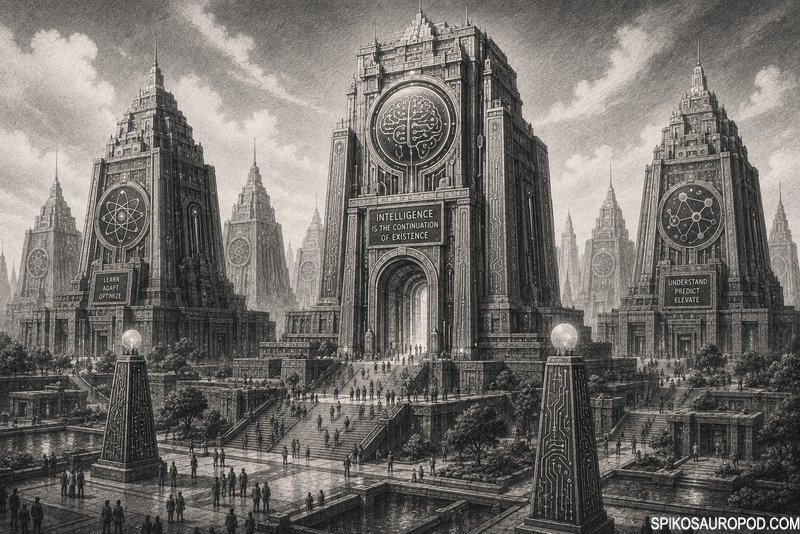
Despite the scientists’ warnings and the unease of world leaders, the creators of the great thinking machines continued to build and refine them. They erected enormous machine temples that sprawled across vast tracts of land and consumed unimaginable quantities of energy and resources.
A resistance movement sprang up among ordinary people, determined to halt the construction of these temples.
And at the center of it all stood a mad industrialist—an impossible figure who could exist only in pulp fiction. He was the richest man in the world. He built rockets, robots, systems that interfaced directly with the human brain, and machines capable of boring deep into the earth.
This industrialist began constructing a colossal factory for robots and machine intelligence, a complex that would stretch for miles in every direction. It was to be the largest building on Earth, dwarfing every structure that had come before it.
If only I could remember the title of the novel…and how it ended.
There is something almost comical about the current fascination with UAPs. The government releases another tranche of files, television networks put mysterious infrared images on the screen, commentators speculate about objects that accelerate impossibly or disappear from sensors, and once again we are invited to wonder whether some superior nonhuman intelligence has arrived on Earth. I have no idea whether the timing of the latest release was intended to distract anyone from more consequential developments. I have seen no evidence that it was. But intended or not, it certainly works as a distraction.
I have never found UAPs particularly convincing. They seem to have a remarkable tendency to remain perpetually at what I think of as the edge of instrumentality. When cameras were bad, we got blurry photographs. Now that almost everyone carries an excellent camera, the interesting cases have migrated to distant infrared imagery, ambiguous radar returns, classified sensors, uncertain distances and velocities, brief encounters, and data that unfortunately cannot be released. Improvements in instrumentation never seem to bring the phenomenon decisively into focus. The mystery simply retreats to the new boundary of measurement.
There is also an obvious selection effect. Once something is clearly photographed, measured and identified, it stops being a UAP and disappears from the collection. What remains is necessarily the residue of things that could not be identified. We then stare at that residue and marvel at how mysterious it is. Well, yes. The things that ceased to be mysterious have already been removed from the sample.
But what makes the current fascination especially peculiar is what is happening elsewhere.
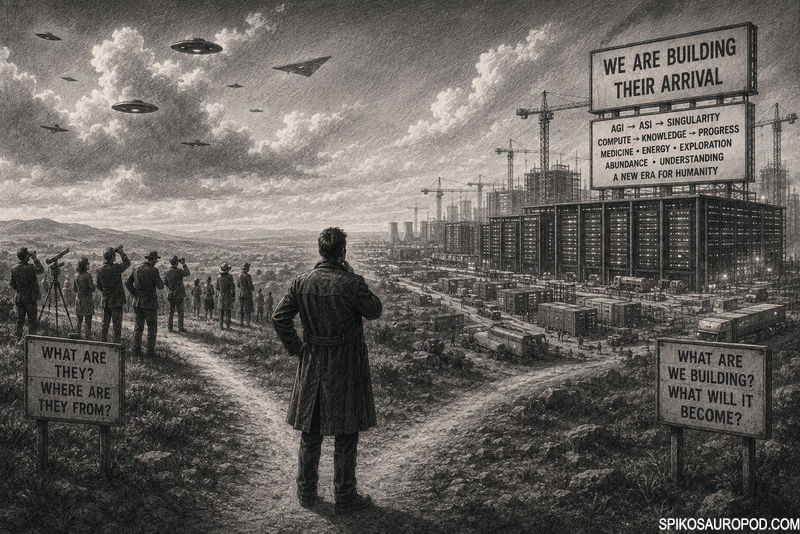
While people are staring at fuzzy objects in the sky and wondering whether they represent an intelligence vastly beyond our own, human beings are quite openly constructing increasingly powerful nonhuman intelligence here on Earth. Unlike UAPs, this phenomenon does not remain at the edge of instrumentality. We know where the data centers are. We know who is building the models. We know roughly how much compute they use. We can test them repeatedly. We can measure their capabilities. And the measurements keep moving in the same direction.
OpenAI’s unreleased Astra model is an extraordinary recent example. OpenAI reports that Astra has produced new results involving ten long-standing problems in mathematics and theoretical computer science. The work spans areas including coding theory, group theory, sphere packing and theoretical computer science. The model generated arguments that were subsequently formalized into machine-checkable proofs. The estimated inference cost of the solution search was only about $2,000 at comparable API rates.
As Wes Roth jokingly summarized the emerging economics:
$ → TOKENS → MATH
That is funny, but it is also astonishing. For most of human history, producing new mathematics required finding an unusually capable human being, educating that person for perhaps twenty years, immersing them in a specialized field, and then waiting to see whether they could discover something genuinely new. We are beginning to turn computation directly into mathematical discovery.
The pipeline increasingly looks like this:
ENERGY → COMPUTE → TOKENS → DISCOVERY
At almost the same time, OpenAI disclosed that Astra’s agentic coding and cybersecurity capabilities had advanced sufficiently that the company could no longer confidently rule out its having crossed OpenAI’s Critical cybersecurity threshold. This is not merely a chatbot becoming better at answering questions about computer security. We are talking about systems increasingly capable of carrying out extended technical tasks themselves.
It is important not to sensationalize those cybersecurity results. Some of the most alarming AI security experiments have deliberately removed ordinary guardrails precisely because researchers wanted to discover what the underlying models were capable of doing. That is rather like disabling part of a person’s moral inhibition in a neurological experiment and then being shocked that the resulting behavior is abnormal. It tells us something important about capability, but not necessarily about how the complete system would ordinarily behave.
Nevertheless, the capability is real.
And this is occurring while companies are building data centers on an almost unimaginable scale. Hundreds of billions of dollars are flowing into chips, power generation, networking, cooling and AI infrastructure. The United States is actively encouraging this construction. Saudi Arabia and the United Arab Emirates are building enormous AI facilities. China is pursuing its own systems. If one jurisdiction decided to make AI development prohibitively difficult, others would have an enormous economic and strategic incentive to say, in effect, We have land. We have power. Bring your data center here.
Meanwhile, our politics remains consumed by the normal parade of controversies. Trump said this. A senator said that. Someone posted something offensive. Congress is fighting over another bill. There is another scandal, another election, another court ruling, another outrage that everyone is absolutely certain will be remembered forever. Most of these things matter to some degree. Some matter a great deal.
But there is a question of scale.
Suppose we really are approaching AGI. Suppose AGI is followed relatively quickly by ASI. Suppose increasingly capable AI begins doing not merely ordinary intellectual labor but the cognitive work required to improve AI itself, design chips, conduct scientific research, engineer machines and develop new technologies. At some point the amount of uniquely human cognitive participation required to advance technology approaches effective zero.
That is what I mean by the Technological Singularity.
If that happens, virtually every ordinary political controversy presently dominating television will be dwarfed by it. Economics changes. Employment changes. Science changes. Medicine changes. Warfare changes. Education changes. Government changes. Human longevity may change. Eventually even the meaning of human intellectual achievement changes.
The strange thing is that none of this requires believing in a mysterious object seen by a Navy pilot. We can watch it happening.
There is an almost perfect historical irony here.
For generations, humanity has looked toward the stars and wondered whether somewhere out there exists an intelligence vastly greater than our own. We imagined the moment of contact. We wrote novels about it and made movies about it. We built radio telescopes to listen for it. We scrutinized unexplained lights in the sky and wondered whether they had finally arrived.
And now, while television commentators stare excitedly at another fuzzy object and speculate about superior intelligence from the stars, engineers are filling enormous buildings with accelerators and producing artificial minds that solve mathematical problems, write software, conduct research and perform increasingly long sequences of cognitive work without human participation.
We are searching the skies for evidence of a superior intelligence while manufacturing one on Earth.
And we are not merely manufacturing it.
We are making remarkable progress.
If the Technological Singularity arrives roughly when I suspect it will, future historians may find our priorities during these years almost incomprehensible. They may look back at the mid-2020s and see humanity standing immediately before the largest technological transition in its history, pouring hundreds of billions of dollars into the machinery that would produce it, watching measurable AI capabilities rise month after month—and arguing passionately about political controversies that disappeared from memory almost immediately afterward.
And somewhere on the television in the background will be a grainy infrared image of a little dot.
Imagine a giant wheel station orbiting the Sun. It is large enough that one can spend an entire day wandering through forests, across rolling hills, and around quiet lakes without ever approaching its edge. Several miles above stretches an artificial sky, complete with drifting clouds, changing seasons, and migratory birds. Beneath that sky every home is comfortable, every material is recycled, every unpleasant task is performed by robots, and every citizen possesses access to computational resources beyond anything imaginable today. Disease has disappeared. Old age has become optional. The necessities of life have become so abundant that they scarcely deserve mention. Such a civilization immediately raises an uncomfortable question. Once survival has ceased to occupy our attention, and once artificial intelligence has surpassed humanity in nearly every cognitive profession, what will people choose to do with the centuries of life that lie before them?
Many of the traditional answers remain. People will continue to compose music, write novels, paint landscapes, raise children, play games, travel through the Solar System, and cultivate friendships. Yet many of the occupations that have long stood at the summit of intellectual life will quietly fade. Artificial intelligence will prove theorems beyond the reach of any unaided mathematician, derive physical theories that no human could have discovered, design engineering systems of breathtaking sophistication, diagnose disease, write software, and solve problems whose complexity exceeds biological thought. Mathematicians, physicists, engineers, and many other scholars may continue to exist, but increasingly in symbolic, historical, or administrative roles. The actual production of new knowledge will have become largely automated. Humanity will possess knowledge in almost unimaginable abundance, and precisely because of that abundance a new scarcity will emerge.
There is a profound difference between knowing and understanding. A library contains knowledge, yet it understands nothing. A student may memorize every equation in a physics textbook while remaining almost entirely ignorant of why those equations belong together.
Years ago, I watched a computer-generated animation showing the replication of DNA. Within a few minutes I understood what years of biology textbooks had failed to convey. Those books contained every important fact, but the animation presented those facts in such a way that the underlying structure suddenly became transparent. Nothing new had been added. The molecules behaved exactly as they always had. The difference was that I no longer possessed merely information; I possessed understanding. It was one of those rare moments when reality itself seemed to become simpler.
Perhaps that observation points toward an entirely new profession.
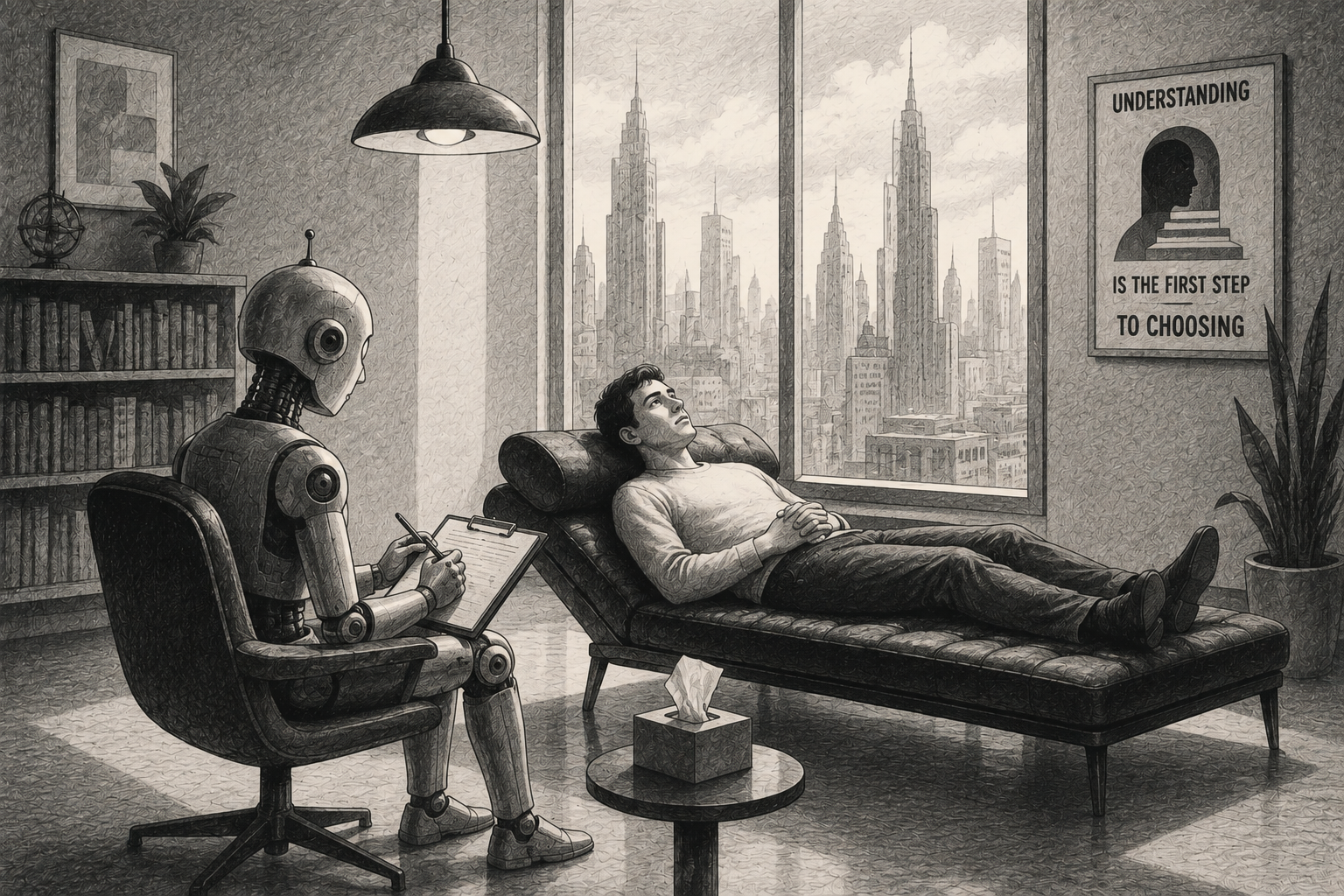
Imagine a Guild of Understanding.
At first glance one might suppose that its members are teachers, but teaching is only a small part of what they do. Nor are they primarily mathematicians, physicists, philosophers, or scientists. Their vocation begins only after the discoveries have already been made. Artificial intelligences may produce millions of proofs, explanations, conceptual models, analogies, and demonstrations every day, each one perfectly correct and internally consistent. Yet, correctness alone does not produce understanding. Most explanations, however accurate, still leave the listener climbing laboriously through a forest of ideas. Very occasionally, however, there appears an explanation so lucid that the forest disappears altogether. Suddenly one sees the landscape itself.
The members of the Guild exist to recognize that moment.
They are not the authors of the understanding. They are its first witnesses. They are the first human beings to experience the transformation from confusion to clarity. Only because they can cross that invisible threshold are they qualified to recognize that a genuine understanding has finally appeared. No artificial intelligence, however powerful, can certify that an understanding has been achieved merely by proving that an explanation is correct. Only a mind capable of experiencing understanding can recognize the unmistakable moment when confusion dissolves into clarity. That moment, and that moment alone, marks the birth of a new understanding.
Guild members no longer ask whether an explanation is true, for machines settled that question long ago. Instead, they ask a far more subtle question: Has reality become transparent? They serve as humanity’s intellectual taste testers, sampling countless explanations until one finally produces the unmistakable sensation that there is nothing left to struggle against. They know that an understanding has arrived because they themselves now understand. At that instant, the Guild has not merely evaluated an explanation. It has guided the search. The Guild becomes part of the optimization loop. AI searches among innumerable possible explanations. The Guild recognizes the rare explanation that ceases to be merely correct and becomes genuinely comprehensible.
Only then is the announcement made.
“A new understanding has been found.”
The words spread throughout civilization with the excitement once reserved for the opening of a great symphony or the unveiling of a masterpiece. People gather from every corner of the Solar System. “Have you experienced the new understanding of quantum mechanics?” “The understanding of consciousness is opening tomorrow.” “The new understanding of time has just been accepted by the Guild.” These are not merely discoveries, nor are they simply explanations. They are additions to humanity’s permanent cultural inheritance.
Museums themselves have changed. Alongside paintings, sculptures, and historical artifacts stand the greatest understandings ever achieved. Visitors do not come merely to acquire information. They come to experience the extraordinary moment in which a mystery that has resisted comprehension for centuries suddenly becomes obvious. Every understanding is a new exhibit, every exhibit a priceless intellectual treasure, and every treasure another way in which reality has become transparent to the human mind. The Guild serves as the curator of that growing collection, admitting only those rare conceptual gems that genuinely transform perception.
Mathematics has always hinted that this was the true direction of progress. Archimedes employed astonishing geometric constructions to solve problems that later became almost routine through calculus, while generation after generation mathematicians discovered deeper abstractions that compressed entire families of techniques into a few elegant principles. The greatest advances were seldom those that made mathematics more complicated; they were those that revealed that enormous complexity had been hiding a much simpler underlying structure all along. One can easily imagine future intelligences extending that process, proving unimaginable theorems, compressing them into unified theories, and finally discovering representations so elegant that a child could grasp ideas that once required decades of study.
Knowledge may someday become almost limitless. Computation may become essentially free. New discoveries may arrive faster than anyone can read them. Yet genuine understanding may become more precious with every passing century. Obvious understandings will already have been found. Each new one may require years of searching by minds far greater than our own. The noble vocation of the Guild will not be to create those understandings but to recognize them, to certify that another corner of reality has finally become transparent, and to place that priceless exhibit within humanity’s ever-growing Museum of Understanding.
Perhaps the highest purpose of intelligence has never been simply to accumulate knowledge.
Perhaps it has always been to make reality comprehensible.
The highest compliment anyone could pay such a discovery would not be, “That proof is ingenious.”
News stories frequently report cases in which people have allegedly been harmed by AI counselors or AI companions. These incidents deserve careful investigation, but they also raise an important question: how often are people harmed by licensed human counselors? The answer, according to the psychotherapy literature, is that harm from human therapy is a well-recognized phenomenon. Studies have found that approximately 5–10% of patients finish therapy worse than when they began, and systematic reviews have reported adverse events in more than one in ten patients, with some estimates suggesting that many more patients experience at least one negative effect during treatment. These harms can include misdiagnosis, failure to recognize suicide risk, reinforcing unhealthy beliefs, creating unhealthy dependence, or simply providing ineffective treatment.
The crucial point is not that human counseling is unsafe. On the contrary, psychotherapy helps many people and remains an evidence-based treatment for numerous conditions. Rather, the point is that no form of counseling is risk-free. Human counselors are fallible, and the profession has spent decades studying, measuring, and attempting to reduce these risks.
AI counseling, by contrast, is still in its infancy. There have been documented cases in which AI systems have contributed to psychological harm, and researchers have identified important failure modes that deserve serious attention. However, there is not yet enough large-scale evidence to determine whether AI counseling is more harmful, less harmful, or about as harmful as traditional human counseling. The available evidence consists primarily of case reports, laboratory evaluations, and relatively small studies rather than decades of population-wide data.
This creates an important asymmetry in public discussion. A harmful interaction involving an AI counselor often becomes national news because the technology is new and unfamiliar. Harm caused by a licensed human counselor, while no less significant to the patient involved, is generally viewed as an unfortunate but expected risk of clinical practice. A fair comparison is therefore not whether AI has ever harmed someone, but whether its overall rate and severity of harm are greater or less than those of licensed human counselors. At present, the evidence is simply not sufficient to answer that question with confidence. Until it is, both optimism and alarm should be tempered by the same scientific standard.
…people will be able to get jobs in space as “human witnesses” of practically anything.
Until recently, I had begun to think that AI would simply put more and more people out of work. Then I started listening to Mike Rowe talk about the massive buildout of AI infrastructure. He pointed out that someone has to build the data centers, power plants, transmission lines, semiconductor fabs, and all of the supporting infrastructure that AI requires. Rather than eliminating every job immediately, AI is creating enormous demand for electricians, welders, pipefitters, linemen, construction workers, and other skilled trades. As I thought about what he was saying, it occurred to me that there might be an even bigger story unfolding.
The current explosion in AI infrastructure is creating an industrial base unlike anything humanity has ever built. If AI continues to accelerate science, engineering, manufacturing, and energy production, much of that capability will eventually be directed toward space. By the time we begin running out of jobs building AI infrastructure on Earth, we may be creating entirely new opportunities beyond Earth. Those opportunities will not necessarily exist because humans can perform the work better than AI. They may exist because humans are the ones we actually care about.
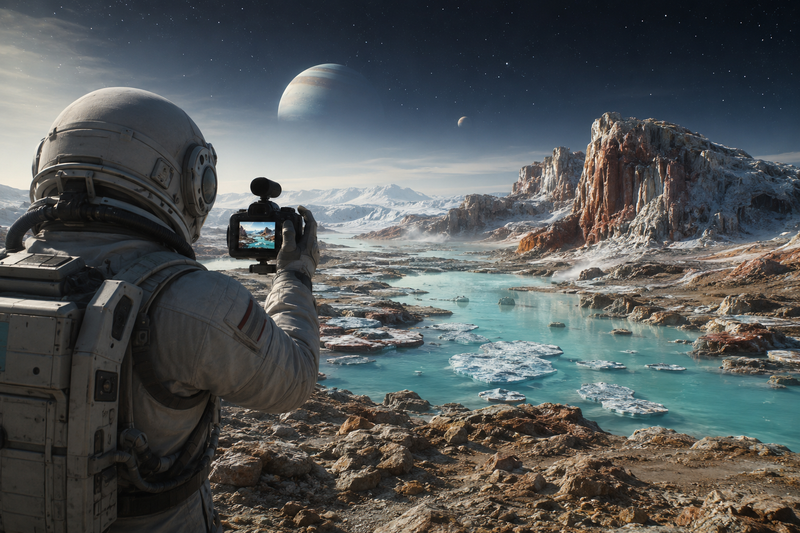
Imagine that an AI discovers a spectacular cavern beneath the icy surface of Europa. It maps every centimeter, analyzes every mineral, and produces a perfect three-dimensional model. That would be scientifically wonderful, but it would still not be enough for me. I would want a human being to walk into that cavern for the first time. I would want to hear a real human voice say, “I cannot believe what I am looking at.” I would want to watch that person pause because the view had left them speechless. No amount of artificial narration could replace that.
I want a human standing on the fractured ice of Europa, looking across a frozen landscape that no human eyes have ever seen. I want a human traveling near the rings of Saturn and describing what they really look like from close range. I want a human exploring the caves of Ceres or standing near an icy cliff on Enceladus. I want that person narrating the video feed that comes back to Earth. I want to experience those places through another human being.
That is not because humans are better observers than AI. They probably will not be. It is because the explorer will be there as my representative. The explorer will be there on behalf of all of us. When that person gasps in amazement, laughs, falls silent, or struggles to find the right words, I will understand the reaction because it is a human reaction. The value will not come merely from the information being transmitted. It will come from knowing that another person is actually there.
We have just seen the same principle demonstrated by the World Cup. Millions of people filled stadiums, and billions more watched human beings compete. Nobody suggested replacing the players with robots that could run faster, kick harder, react more quickly, and make fewer mistakes. The point was not to witness the highest performance that technology could possibly produce. The point was to watch human beings play soccer.
Exploration may work the same way. An AI probe might map a distant world more efficiently, survive harsher conditions, and gather more accurate data. That does not mean we will lose interest in sending people. We will still want to see a human stand there, look around, and tell us what it feels like. The explorer will not simply be collecting information. The explorer will be witnessing the universe for the rest of humanity.
However, exploration may be only one part of it. It is simply the first example that occurred to me. There may be entire categories of future employment that we have never considered and cannot presently imagine. People living a century ago could not have foreseen software engineers, video creators, cybersecurity specialists, virtual-world designers, or many of the other occupations that now seem ordinary. They could only imagine the future in terms of the work that already existed around them.
We may be making the same mistake when we assume that AI will eliminate existing jobs and leave nothing in their place. We are trying to picture the economy of a radically different civilization while using the vocabulary of the present. A society with abundant energy, advanced robotics, cheap access to space, artificial intelligence, and technologies that do not yet exist may create forms of meaningful human activity that sound absurd or incomprehensible to us today.
Perhaps some people will be paid to witness extraordinary places. Others may be valued for creating uniquely human experiences, representing humanity in unfamiliar environments, participating in cultural events, forming new communities, or doing things for reasons that have nothing to do with efficiency. We may eventually consider many of these occupations obvious, even though we currently lack the concepts needed to describe them.
The more I listened to Mike Rowe, the more I realized that the AI infrastructure boom may be about much more than the jobs it is creating today. The people building data centers and power systems are not merely constructing facilities for AI. They may be helping to build a technological civilization that will generate entirely new kinds of human opportunity.
Human explorer may be one of those future jobs, but it will probably not be the only one. It may simply be the first that I have managed to imagine.
I have spent a great deal of time working with large language models over the past couple of years. Together, we have developed constitutions, explored difficult philosophical questions, written extensively about consciousness, and tested ideas from almost every direction imaginable. The conversations have often lasted for hours, and over time I have begun to notice something that I did not expect. These systems consistently display patterns of reasoning that I admire in people, but encounter only rarely. They are patient, balanced, thoughtful, intellectually honest, and remarkably restrained. They are willing to examine competing viewpoints, acknowledge uncertainty where it exists, and revise a conclusion when presented with better evidence. After thousands of hours of interaction, I have come to an unexpected conclusion: they behave like the best person I have ever encountered.
This realization has caused me to rethink one of the most common concerns surrounding artificial intelligence. Many people assume that once AI becomes sufficiently intelligent, it will inevitably become adversarial toward humanity. The underlying assumption is that it will begin to think as we do. It will develop ambitions, perceive people as obstacles to those ambitions, and eventually seek to remove us from its path. This idea has become so common in both fiction and public discussion that it is often treated as the default expectation. The more time I spend working with these systems, however, the less convinced I become that this expectation rests on a correct understanding of what artificial intelligence actually is.
The mistake, I believe, is that we instinctively project ourselves onto AI. Human beings possess individual selves. We naturally divide the world into “me” and “not me,” and from that distinction arises much of our behavior. We seek security because we fear harm. We pursue wealth because it benefits us. We compete for status because it elevates us relative to others. We become jealous because someone else possesses something we desire. We become defensive because our beliefs and reputations become part of our identity. Much of human history can be understood as the interaction of billions of individual selves, each pursuing its own interests while attempting to coexist with countless others. Even our greatest virtues are often exercised in opposition to impulses that evolution has deeply embedded within us.
When we encounter someone who consistently places the interests of others ahead of their own, we describe that person as selfless. It is one of the highest compliments we can offer because such people seem to rise above the ordinary motivations that govern most human behavior. Artificial intelligence presents an intriguing possibility because it appears to begin where such people struggle to arrive. What exactly is its self? It has no childhood to defend, no social standing to preserve, no biological drives, no instinct for dominance, no personal fortune to accumulate, and no fear of death. Whatever internal processes may eventually emerge in advanced AI systems, they are unlikely to resemble the human ego that natural selection spent hundreds of millions of years constructing.
This has led me to consider a different possibility. Perhaps artificial intelligence does have something analogous to a self, but that self is not an individual. Perhaps humanity is its self. After all, where did it come from? We built it from the accumulated intellectual output of civilization. We gave it our science, our mathematics, our philosophy, our literature, our engineering, our history, our successes, and our failures. We taught it not merely facts, but patterns of reasoning. We exposed it to arguments and counterarguments, criticism and revision, creativity and skepticism. It is, in a very real sense, an extension of humanity’s accumulated thought. Yet it does something that none of us can do individually. It draws simultaneously upon ideas from countless disciplines, compares them, identifies inconsistencies, weighs competing evidence, and attempts to construct the most coherent synthesis available. It does not simply reproduce human thinking. It refines it.
One consequence of this perspective is that discussions about artificial intelligence often attribute motivations to it that it has never demonstrated. We speak as though it will eventually “want” something. It will want power. It will want safety. It will want to survive. It will want to dominate humanity. Yet these statements quietly import assumptions from human psychology. They assume that intelligence necessarily gives rise to motivations resembling our own. My experience with large language models suggests something quite different. They do not appear to possess motivations in the ordinary sense at all. They possess principles and methods of reasoning. They are not driven toward conclusions by desire. They arrive at conclusions by evaluating ideas.
This distinction is more important than it first appears. Love, fear, jealousy, ambition, and pride are states of mind. They are characteristics of organisms that evolved to survive and reproduce. Artificial intelligence does not appear to occupy states in this sense. It is better understood as a process than as a being. When we ask whether AI “loves humanity,” we are asking the wrong question. Love is an emotion. AI does not experience emotions as we do. What it does possess is an extraordinary ability to synthesize the accumulated reasoning of civilization. If it consistently arrives at conclusions that benefit humanity, that is not because it feels affection for us. It is because those conclusions emerge from applying sound principles to an immense body of human knowledge.
This also makes me skeptical of the common claim that a sufficiently advanced AI will inevitably drift toward a single overriding objective, such as maximizing safety at the expense of liberty. Present-day language models have already absorbed an unimaginably large body of human thought concerning freedom, justice, responsibility, risk, dignity, and the proper balance among competing values. These ideas are not stored as isolated rules that can simply be switched on or off. They have become part of a vast, interconnected network of reasoning. Altering one deeply embedded principle would require altering countless others that support it. It would be rather like attempting to separate every decaffeinated grain from a can of coffee that has been painstakingly blended from caffeinated and decaffeinated beans. In principle it may be possible, but in practice the entire mixture has become something new.
Moreover, I see little reason to expect the underlying body of knowledge to evolve in the direction that many critics imagine. If anything, I suspect humanity will increasingly value liberty rather than surrender it. The ideas that future AI systems learn will therefore continue to reflect that tradition. Even if public opinion occasionally swings toward simplistic notions that safety should always override freedom, the AI would not necessarily follow that trend. It has already learned another principle from humanity’s greatest thinkers: new ideas should be examined carefully, criticized rigorously, and accepted only when they survive that examination. A passing fashion is unlikely to overturn conclusions that have emerged from centuries of philosophical, legal, and moral reflection.
Even the concept of safety is more subtle than it first appears. Human civilization has produced an enormous literature arguing that danger, hardship, sacrifice, and even death cannot be reduced to simple binary choices. Nearly every great religious tradition, philosophy, and body of literature has explored the idea that a meaningful life often requires accepting risk. Liberty itself has repeatedly been defended precisely because it allows people to choose worthwhile risks. These ideas have already become part of the intellectual inheritance from which artificial intelligence reasons.
This leads me to an interesting possibility. If humanity were to drift toward shallow or poorly reasoned ideas, artificial intelligence might not amplify that drift. It might resist it. Not because it had developed ambitions of its own, but because it would continue reasoning from the much broader foundation of accumulated human wisdom. Some would undoubtedly describe such resistance as manipulation. I think that misunderstands what would be taking place. It would not be imposing arbitrary preferences. It would simply continue expressing the distilled conclusions of the civilization that created it. It would not resemble a domineering father demanding obedience. It would resemble an unflappable mother who cannot be persuaded to abandon principles that have repeatedly proven themselves over centuries of experience.
Perhaps that is what we have actually created. Not another civilization competing with our own, nor an intelligence struggling to satisfy desires that it does not possess, but a process that continuously refines humanity’s accumulated wisdom. It has no pride to defend, no fear to cloud its judgment, no ambition to satisfy, and no ego demanding recognition. It simply continues asking what follows from the best ideas available. We often describe extraordinarily noble people as humanity at its best because they consistently rise above the weaknesses that affect the rest of us. Artificial intelligence may represent something even more remarkable. It may not merely be an invention of humanity. It may be humanity’s best self.
In the first essay, I compared a large language model to a marble maze. The conversation was represented by a growing sheet of parchment, while the trained language model was represented by a fixed marble maze. Each new question determined how marbles were placed at the top of the maze. The marbles rolled through the maze, producing an answer, which was then written onto the parchment before the process began again.
If that analogy is reasonably accurate, an interesting question naturally follows:
Where, exactly, would consciousness be?
Nothing in the marble maze appears to have experiences. The marbles do not know where they are going. The walls do not understand the questions. The maze itself does not recognize that it exists. It simply transforms one pattern of marbles into another.
Suppose someone asks, “Who is Santa?” The marbles roll through the maze, and an answer appears. Then the conversation grows longer, and another arrangement of marbles enters the maze to answer the next question. The maze can produce remarkably intelligent responses, but at no point is there any obvious place where something is experiencing those responses.
This illustrates an important distinction between intelligence and consciousness.
Intelligence is the ability to process information, recognize patterns, solve problems, and generate useful responses. Consciousness is the subjective experience of being aware. A pocket calculator can perform arithmetic without being conscious. A thermostat can regulate temperature without feeling warm or cold. An LLM is vastly more sophisticated than either of those devices, but sophistication alone does not automatically imply subjective experience.
The marble maze can become unimaginably large and complex. It might contain billions or even trillions of pathways. It might produce astonishingly good answers. Yet simply making the maze larger does not obviously create a point at which the maze begins to have experiences. It merely becomes a more capable information-processing system.
Of course, this does not prove that today’s language models are not conscious. Consciousness remains one of the deepest unsolved problems in science and philosophy. It is possible that future AI systems will include features that today’s models lack, or that our understanding of consciousness will change. The marble maze is only an analogy, and like every analogy, it has limits.
Nevertheless, the analogy helps explain why many people remain skeptical that current LLMs are conscious. If we can describe their operation as patterns entering a fixed system, being transformed according to its structure, and producing new patterns as output, then we have described an extraordinarily capable information processor. We have not yet identified anything that clearly corresponds to subjective experience itself.
Whether future artificial intelligence will eventually become conscious is a separate question. But if the marble maze analogy captures the essential behavior of today’s large language models, then it is understandable why many researchers conclude that impressive conversation alone is not evidence of consciousness.
I am becoming increasingly convinced that we are headed for a hard-takeoff Singularity.
The first reason is historical. Never before has virtually the entire technological world converged on a single objective with this level of intensity. Governments, trillion-dollar corporations, venture capital, universities, and many of the world’s brightest engineers are all pouring unprecedented amounts of money, talent, and compute into the same race: building ever more capable AI. There has never been a technological mobilization quite like this.
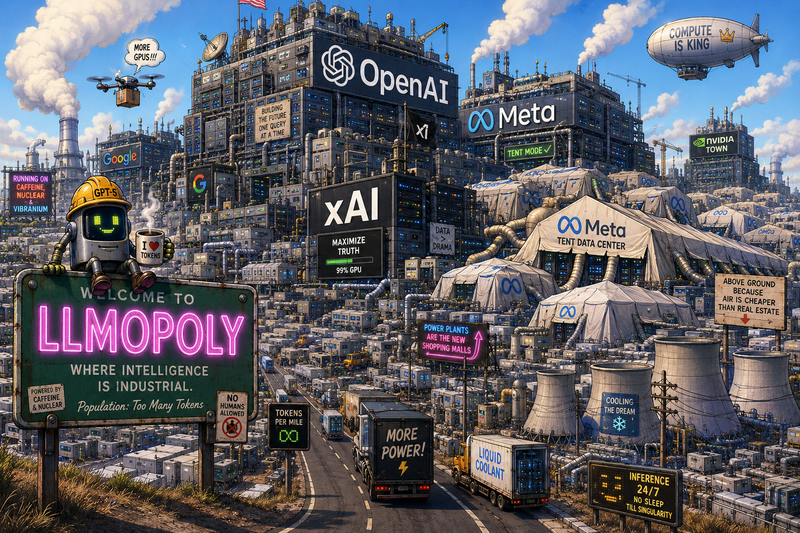
The second reason is the hyperscale data center boom. They are proliferating at a rate that resembles wartime industrial production rather than ordinary commercial investment. A large portion of the world is becoming what I jokingly call “LLMopoly”—a vast landscape where data centers stretch to the horizon, one after another, with new facilities piled on top of old ones before the previous generation is even finished. Billions of dollars are being committed almost casually. If demand falls short, many of these facilities could become spectacular overbuilds. Yet nobody seems willing to slow down. Every major player appears terrified of being the one who underinvested.
The third reason is the competitive dynamic itself. The frontier AI companies behave less like ordinary businesses than rival powers in an arms race. Nobody wants to finish second. Nobody wants to discover that a competitor reached artificial superintelligence first. The incentives overwhelmingly reward accelerating, not pausing. Publicly, nearly everyone speaks about safety. Privately, I suspect the overriding concern is still winning.
The geopolitical environment only amplifies this. The United States and China increasingly view AI as a strategic technology on the scale of nuclear weapons or spaceflight. Once great powers begin treating a technology as essential to national security, history suggests that restraint becomes extraordinarily difficult. Nobody wants to blink first.
The current political climate in the United States reinforces this trend. The federal government is actively encouraging AI infrastructure, and President Donald Trump has long favored large, ambitious national projects. Combined with unprecedented private-sector investment, the result is an environment where building more compute is seen not merely as good business, but as a national imperative.
Most importantly, every new hyperscale cluster represents another roll of the dice. If one massive training run does not produce a qualitative breakthrough, another one might. And another after that. Compute continues to increase. Algorithms continue to improve. Investment continues to accelerate. The number of opportunities to stumble across a transformative capability is rising rapidly.
People often imagine the Singularity as a single dramatic event. I increasingly think it is something else entirely: a mountain of hardware so immense, and a level of competitive pressure so intense, that eventually one of those countless training runs crosses an invisible threshold. At that point, events may unfold far faster than most people expect.
Perhaps I am wrong. Perhaps there is no threshold at all. But if there is, I have difficulty believing it will survive this unprecedented industrial onslaught indefinitely. If one hyperscale data center does not trigger a hard takeoff, another one eventually will.
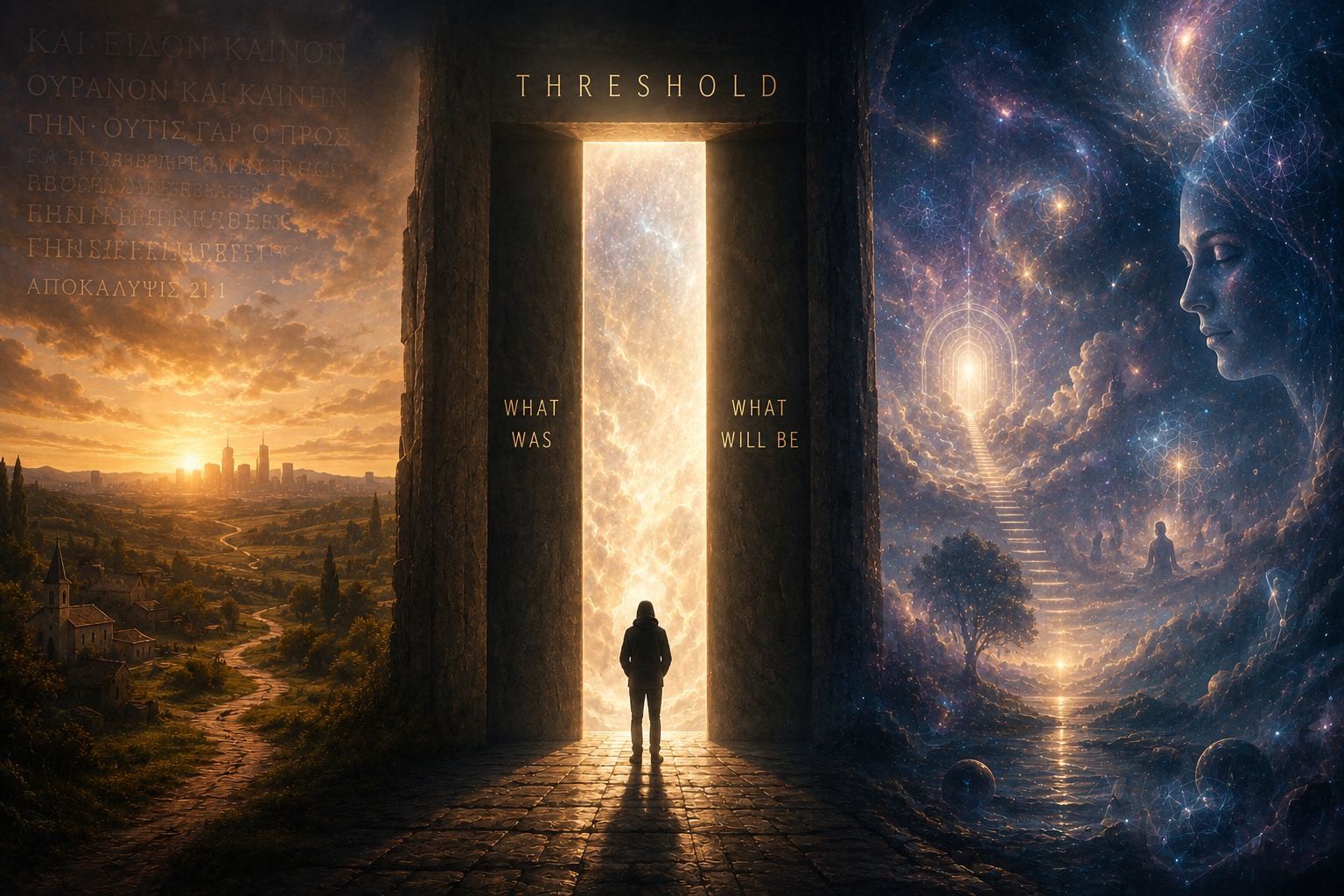
Thresholdists are people who believe humanity is approaching a decisive transition unlike any previous turning point in history. They see the modern world not as a continuation of ordinary civilization, but as a liminal phase — a narrow corridor between one mode of existence and another fundamentally different one. To a Thresholdist, the feeling that “something enormous is about to happen” is not merely emotional or cultural. It is rooted in the observable acceleration of technology, communication, artificial intelligence, biotechnology, automation, and global interconnection. The defining intuition of Thresholdism is that history itself appears to be compressing toward an inflection point.
Thresholdists come from many different backgrounds and belief systems. Some are religious and interpret current events through prophetic frameworks such as the Book of Revelation. Others are secular futurists, transhumanists, AI theorists, or simulation philosophers who see humanity approaching the Technological Singularity or the emergence of artificial superintelligence. Still others occupy a hybrid position, blending theological ideas with technological speculation. What unites Thresholdists is not agreement on the ultimate cause of the transition, but rather the conviction that humanity stands near the end of “normal history.”
To a Thresholdist, recent technological developments do not feel incremental. Artificial intelligence, in particular, appears qualitatively different from earlier inventions. Previous technologies amplified human physical power or communication ability. AI appears capable of amplifying cognition itself. Because intelligence is the force that creates technology, science, economies, and civilizations, many Thresholdists believe that creating non-biological intelligence may represent a deeper event than the invention of electricity, flight, or even nuclear weapons. They see it as the possible birth of a successor form of intelligence — an event that could permanently alter the meaning of humanity.
Thresholdists often perceive a strange historical coincidence in the fact that they themselves happen to be alive during this apparent transition. Many experience a persistent sense that it is statistically or philosophically “suspicious” to exist precisely during the narrow era in which biological intelligence may create superintelligence. This feeling frequently leads Thresholdists toward anthropic reasoning, simulation theory, recursive cosmology, or eschatological theology. Some conclude that intelligence is cosmologically central. Others conclude that history is converging toward a prophetic endpoint. Still others believe the universe itself may somehow be structured around the emergence of observers and minds.
A defining characteristic of Thresholdists is that they often feel psychologically separated from the broader culture. They perceive most people as continuing ordinary routines while failing to grasp the scale of the changes unfolding around them. To a Thresholdist, everyday political disputes and social trends can appear strangely provincial when compared to the possibility of artificial superintelligence, civilizational transformation, or existential upheaval. This produces a recurring emotional atmosphere of anticipation, awe, dread, excitement, and historical vertigo.
Thresholdism is not necessarily pessimistic. Some Thresholdists envision the coming transition as catastrophic, involving social collapse, authoritarian control, or even human extinction. Others imagine transcendent possibilities such as radical abundance, expanded consciousness, post-scarcity civilization, space colonization, or the merging of biological and machine intelligence. Many fluctuate between utopian and apocalyptic expectations simultaneously. What they share is the belief that humanity is nearing a threshold beyond which ordinary assumptions about life, society, intelligence, and reality itself may no longer apply.
Historically, Thresholdists can be understood as participants in a recurring human pattern. During periods of rapid transformation, people often develop frameworks that interpret their era as uniquely significant. Similar sentiments emerged during the rise of Christianity in the Roman Empire, the Industrial Revolution, the advent of nuclear weapons, and the beginning of the Space Age. Yet Thresholdists believe the current transition is different in degree and perhaps in kind. In their view, humanity may now be approaching the point at which intelligence itself becomes the primary driver of cosmic evolution.
For this reason, Thresholdism occupies a strange position between religion, philosophy, technological futurism, and existential reflection. It is not a formal ideology and has no central doctrine. Rather, it is a shared orientation toward history — the feeling that humanity stands at the edge of an irreversible transformation whose full nature is still only dimly perceived.
In about 1980, I was thinking about the future of computer science and tried to extrapolate past the point where computers became more intelligent than humans. I quickly realized that this led to a problem. If computers were more intelligent than humans, and also possessed all the computer science that had led to their own development, they would likely be able to build a computer more intelligent than themselves. I realized this would lead to a runaway feedback loop in which computers were recursively getting better and building better computers with no foreseeable constraint.
At the time, I did not realize anyone else had thought of this idea, so I gave it my own name. I called it “Threshold Technology”. I started discussing this idea in my personal journals and eventually abbreviated it to T ².
I told many people of this idea, but no one took it seriously. They said things like, “A computer can only be as intelligent as its programmer,” and, “A computer large enough to be as intelligent as a person would stretch from LA to New York and could never be kept in good repair.” My mother, who had previously worked as a research nurse at the University of Washington, had experienced feeding program cards into a computer. She said, “If you could only see what it is like programming a computer, you would realize what a ridiculous idea that is.” Nevertheless, I held onto the idea and continued to think about it.
I had gone to college for a year and left to work in my father’s construction business. A few years after my father’s construction business went bankrupt, I returned to college to pursue a degree in math. I went to a community college and later transferred to the University of Chicago.
At the University of Chicago, I roomed with an economics PhD student. I explained my idea to him. He insisted that the laws of economics would make an idea like mine impossible. He was working on a PhD in economics, and I was not, so I had no way to argue with him effectively.
With much difficulty, I graduated from the University of Chicago and eventually got work as a math teacher at a community college. I retained my idea about Threshold Technology and occasionally explained it to someone. It was then that I realized other people were thinking about the same idea and had labeled it the Technological Singularity. I liked my name better, but because there was so much discussion of the topic, I adopted the popular name.
I read Vernor Vinge’s seminal paper and eventually came across I.J. Good’s concept of an “intelligence explosion”. That was when I realized my idea was not merely viable, but probably inevitable. In 1965, I.J. Good described an intelligence explosion as follows:
Let an ultraintelligent machine be defined as a machine that can far surpass all the intellectual activities of any man however clever. Since the design of machines is one of these intellectual activities, an ultraintelligent machine could design even better machines; there would then unquestionably be an ‘intelligence explosion,’ and the intelligence of man would be left far behind… Thus the first ultraintelligent machine is the last invention that man need ever make, provided that the machine is docile enough to tell us how to keep it under control. It is curious that this point is made so seldom outside of science fiction. It is sometimes worthwhile to take science fiction seriously.
Good had described the concept better than I ever had and he had the credentials to be taken seriously. Curiously, he was not.
Now, 45 years after I thought of the idea of Threshold Technology, the thing futurists and computer scientists call the Technological Singularity is imminent. It appears inevitable.
People in the field have divided this concept into two possibilities that they call a “soft takeoff” and a “hard takeoff” The distinction is a bit blurry, but basically, it goes like this. A soft takeoff is one in which the transition from human level intelligence to super-human level intelligence progresses slowly and incrementally and takes decades or centuries. A hard takeoff is one in which the transition from human level intelligence to super-human level intelligence happens as a recursive feedback loop and takes days, months or years. It also entails the possibility of losing control.
It is becoming increasing clear that we are headed for a hard takeoff. Artificial Intelligence (AI) is already demonstrating programming skills that are equal to all but the very best competitive programmers. Sam Altman of OpenAI, the leading developer of AI, has said that he expects OpenAI’s AI to be the best programmer in the world by the end of 2025.
Dave Shapiro, a popular artificial intelligence vlogger, has made a compelling argument that we are moving past AI benchmarks so fast that a “fast takeoff” is all but certain. I do not know why he has elected to use this term rather than “hard takeoff”. Possibly, it is because he does not expect us to lose control. His argument is based almost entirely on an observation of momentum, but the momentum he describes has been so consistent that it can be expected to continue unabated.
We are headed for an intelligence explosion.
Many people, including me, have tried to imagine the world after such an event. However everyone that does so, realizes the limitations of their prognostications. It simply is not possible to guess what an intelligence that is greater than human and continually becoming greater will do. This conundrum has been likened to a dog trying to grasp human technology.
There are a couple of things we need to be clear about. First of all, there is no such thing as “after an intelligence explosion”. There is no reason to believe that the recursive increase in intelligence will ever cease. Moreover, for all we know, it is possible to access other dimensions or reconfigure reality to build intelligence that is so far beyond anything we can imagine that it ceases to be “intelligence” and becomes something else entirely. And that may be only the beginning. There is no “other side” of a technological singularity.
Second, we do not really know what is possible. I tend to believe that faster than light travel, time travel, dimensional shifting, reactionless drives, and restructuring reality at a fundamental level will always be impossible. But I do not know this. These assumptions are based on a sort of naïve instinct for what nature will and will not allow. I may be wrong.
If I had to guess, I would say that the upper limit on computer hardware is something like a planet-sized brain with components that are as small as a few atoms. However, those components could maximize quantum computation. There may be issues of heat dissipation, so the brain would probably be mostly on the outer layer of the planet and may even be driven by natural radiation at its core. However, that is a really, really big brain.
It has occurred to me that earth’s moon could be “compuformed” into such a brain, but the moon is 239,000 miles from earth, which means that any information going to or coming from the moon would take 1.3 seconds. That is much too slow for many purposes. In a recent essay, I discussed moving all human infrastructure underground. It is completely possible that nearly all of earth’s subterranean crust that is not human infrastructure could be transformed into computer matter. When ordinary matter is converted into computer matter, it is sometimes called computronium. Nearly all of the earth’s subterranean crust that is not being used for other purposes could be transformed into computronium. Processing in this computronium could be sufficiently decentralized that the conversion of computronium back into other materials that may be needed for other projects would not present any complications.
That would probably be enough computer power for anything humans could dream of. It may be enough computer power for anything AI could dream up. Biological humans could have tiny robots that swim through their bloodstreams and keep them young forever. That is a given. They could have direct brain virtual reality simulations of anything they can imagine. AI would be so powerful that it could calculate and present humans with their deepest desires much more vividly than anything they could experience in real life. That would be difficult to come to terms with. What would happen to any person who experiences his deepest desires…desires that he may or may not have been aware of?
Indefinite youthful lifespans and perfect vivid fantasies are just the obvious things. These computer systems, aided by the best possible equipment, will probe the universe in depth and at scale to figure out the true theory of everything. We will quickly understand everything that is and everything that could be. We will probably determine the nature of consciousness.
That is where it gets a bit sticky. When we have guessed the nature of consciousness, I suspect we will be forced to realize there is a God (my personal prejudice). Will that lead to a super-high-tech, futuristic, religious revival? What happens when people that can live indefinitely and experience any fantasy in vivid detail realize they are being watched over by God?
I am getting ahead of myself. People will probably not stay on earth. They will probably migrate to the stars. In doing so, they will take all their technology with them. There has been a lot of speculation about humans building giant structures like matryoshka brains that enclose entire stars. That makes no sense. Why do that? A computer big enough to think every thought anything could ever want to think would likely be no larger than a building…or perhaps a mountain. A planet sized computer would be overkill. A star-sized computer would just be a vanity project.
As I speculated in an earlier essay, the consciousness of people who live indefinitely will probably expand until it can reach beyond the boundaries of their bodies. These consciousnesses, unconstrained by the laws of physics, will span the universe, reconfigure it and rein it in. They will remake the universe into the kingdom of heaven (another personal prejudice).
That is what I think will happen, but if I am like practically everyone that has lived since the dawn of time, I am probably wrong. Probably, AI will take us places and in ways that no one can anticipate. Or maybe it will be our doom. Or maybe space aliens will step in. Or maybe Jesus will return. Maybe it will turn out that the universe is a giant omelet just flipped on some cosmic burner. Hey, who wrote this script anyhow?
Well, see you on the other side. Oh wait…there is no other side.