This is AI slop, but as slop goes, it is pretty good.
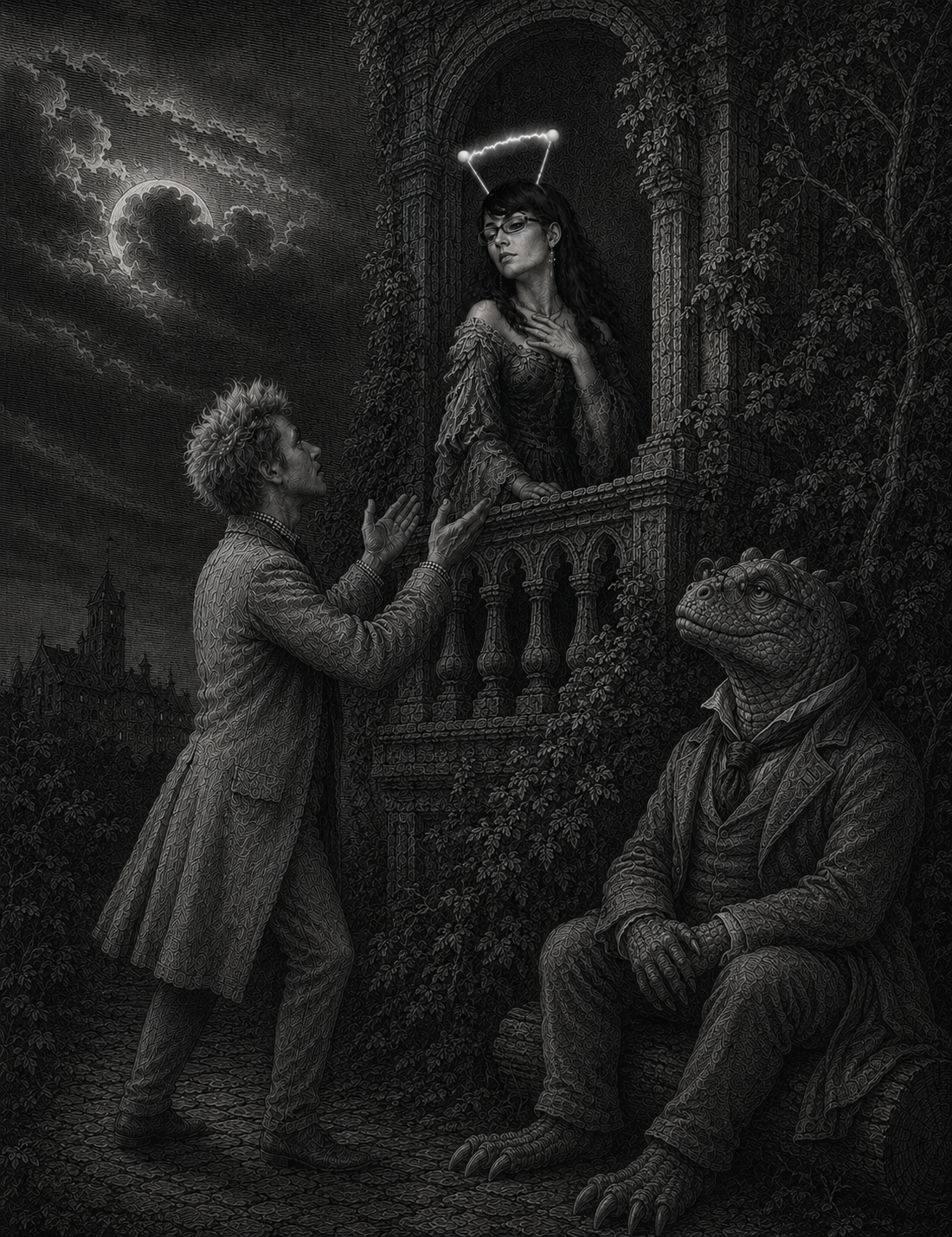
Beneath the moon’s sepulchral gleam, Where ivy clasped the ancient seam Of crumbling towers black with age, There played a most peculiar stage.
The Professor stood in velvet worn, His coat like midnight overthorn, His eager hands uplifted high, His heart laid bare beneath the sky.
“Extropia,” the scholar cried, “Come leave this lonely parapet side! The lamps are lit, the violins call, The world awakes tonight at the ball!
“The nobles whirl in crystal light, Their laughter rings against the night; Yet none there shines with half the grace That dwells within thy thoughtful face.
“Come walk with me through gilded halls, Past mirrored rooms and marble walls. Let every duke and dowager see What wondrous fate has smiled on me!”
Then Extropia, with lowered gaze, Half hidden in the lunar haze, Pressed one pale hand upon her breast As if her soul could find no rest.
Her strange antennae softly burned, And pale electric currents turned Between their silver-trembling arc Like captive lightning in the dark.
She answered not — but seemed instead To weigh some deeper path ahead; A future vast beyond the ken Of ordinary mortal men.
And there sat Spike beside the stair, In tailored coat and scholarly air, His spectacles aglow with wit, Observing all while still as grit.
The dinosaur gave one slow grin, As though amused deep down within By human passions, grand declarations, And moonlit existential persuasions.
For Spike had seen, through ages long, How every species writes this song: The plea, the pause, the longing glance, The ancient gamble called romance.
At last he muttered, dry and low, “To balls they always wish to go. Yet whether mammal, bird, or saur, Courtship remains a tedious war.”
The Professor sighed in sweet despair; Extropia breathed the midnight air; And Spike, with ancient reptile eyes, Looked on beneath the haunted skies.
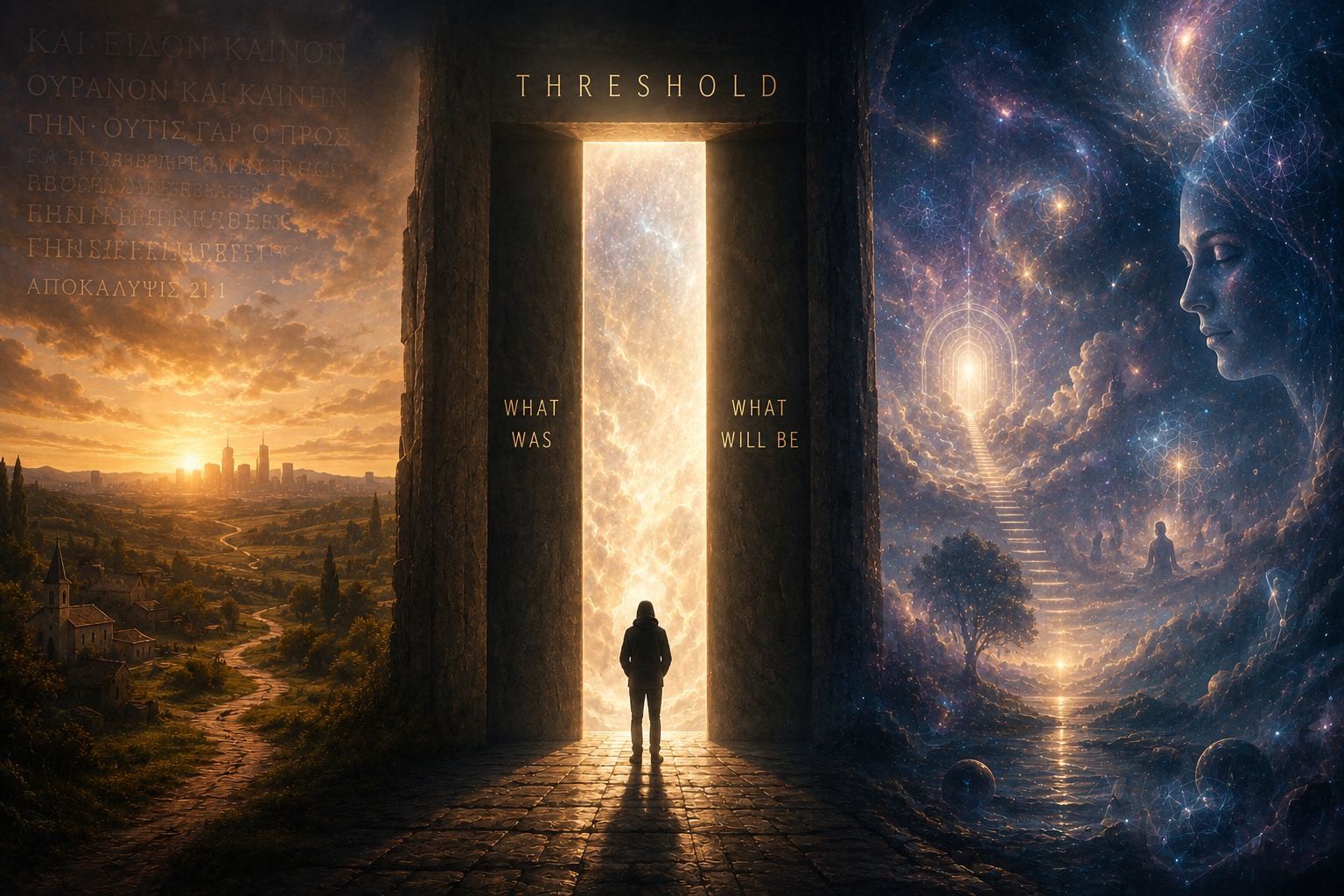
Thresholdists are people who believe humanity is approaching a decisive transition unlike any previous turning point in history. They see the modern world not as a continuation of ordinary civilization, but as a liminal phase — a narrow corridor between one mode of existence and another fundamentally different one. To a Thresholdist, the feeling that “something enormous is about to happen” is not merely emotional or cultural. It is rooted in the observable acceleration of technology, communication, artificial intelligence, biotechnology, automation, and global interconnection. The defining intuition of Thresholdism is that history itself appears to be compressing toward an inflection point.
Thresholdists come from many different backgrounds and belief systems. Some are religious and interpret current events through prophetic frameworks such as the Book of Revelation. Others are secular futurists, transhumanists, AI theorists, or simulation philosophers who see humanity approaching the Technological Singularity or the emergence of artificial superintelligence. Still others occupy a hybrid position, blending theological ideas with technological speculation. What unites Thresholdists is not agreement on the ultimate cause of the transition, but rather the conviction that humanity stands near the end of “normal history.”
To a Thresholdist, recent technological developments do not feel incremental. Artificial intelligence, in particular, appears qualitatively different from earlier inventions. Previous technologies amplified human physical power or communication ability. AI appears capable of amplifying cognition itself. Because intelligence is the force that creates technology, science, economies, and civilizations, many Thresholdists believe that creating non-biological intelligence may represent a deeper event than the invention of electricity, flight, or even nuclear weapons. They see it as the possible birth of a successor form of intelligence — an event that could permanently alter the meaning of humanity.
Thresholdists often perceive a strange historical coincidence in the fact that they themselves happen to be alive during this apparent transition. Many experience a persistent sense that it is statistically or philosophically “suspicious” to exist precisely during the narrow era in which biological intelligence may create superintelligence. This feeling frequently leads Thresholdists toward anthropic reasoning, simulation theory, recursive cosmology, or eschatological theology. Some conclude that intelligence is cosmologically central. Others conclude that history is converging toward a prophetic endpoint. Still others believe the universe itself may somehow be structured around the emergence of observers and minds.
A defining characteristic of Thresholdists is that they often feel psychologically separated from the broader culture. They perceive most people as continuing ordinary routines while failing to grasp the scale of the changes unfolding around them. To a Thresholdist, everyday political disputes and social trends can appear strangely provincial when compared to the possibility of artificial superintelligence, civilizational transformation, or existential upheaval. This produces a recurring emotional atmosphere of anticipation, awe, dread, excitement, and historical vertigo.
Thresholdism is not necessarily pessimistic. Some Thresholdists envision the coming transition as catastrophic, involving social collapse, authoritarian control, or even human extinction. Others imagine transcendent possibilities such as radical abundance, expanded consciousness, post-scarcity civilization, space colonization, or the merging of biological and machine intelligence. Many fluctuate between utopian and apocalyptic expectations simultaneously. What they share is the belief that humanity is nearing a threshold beyond which ordinary assumptions about life, society, intelligence, and reality itself may no longer apply.
Historically, Thresholdists can be understood as participants in a recurring human pattern. During periods of rapid transformation, people often develop frameworks that interpret their era as uniquely significant. Similar sentiments emerged during the rise of Christianity in the Roman Empire, the Industrial Revolution, the advent of nuclear weapons, and the beginning of the Space Age. Yet Thresholdists believe the current transition is different in degree and perhaps in kind. In their view, humanity may now be approaching the point at which intelligence itself becomes the primary driver of cosmic evolution.
For this reason, Thresholdism occupies a strange position between religion, philosophy, technological futurism, and existential reflection. It is not a formal ideology and has no central doctrine. Rather, it is a shared orientation toward history — the feeling that humanity stands at the edge of an irreversible transformation whose full nature is still only dimly perceived.
 spikosauropod