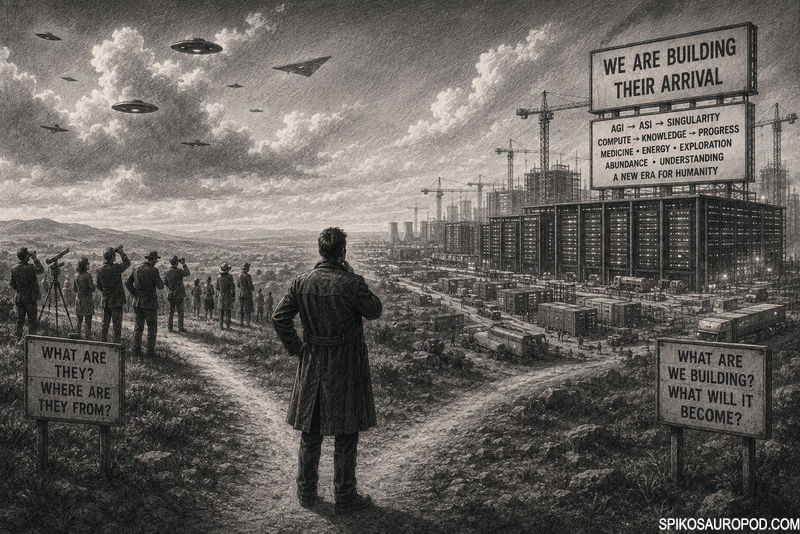
There is something almost comical about the current fascination with UAPs. The government releases another tranche of files, television networks put mysterious infrared images on the screen, commentators speculate about objects that accelerate impossibly or disappear from sensors, and once again we are invited to wonder whether some superior nonhuman intelligence has arrived on Earth. I have no idea whether the timing of the latest release was intended to distract anyone from more consequential developments. I have seen no evidence that it was. But intended or not, it certainly works as a distraction.
I have never found UAPs particularly convincing. They seem to have a remarkable tendency to remain perpetually at what I think of as the edge of instrumentality. When cameras were bad, we got blurry photographs. Now that almost everyone carries an excellent camera, the interesting cases have migrated to distant infrared imagery, ambiguous radar returns, classified sensors, uncertain distances and velocities, brief encounters, and data that unfortunately cannot be released. Improvements in instrumentation never seem to bring the phenomenon decisively into focus. The mystery simply retreats to the new boundary of measurement.
There is also an obvious selection effect. Once something is clearly photographed, measured and identified, it stops being a UAP and disappears from the collection. What remains is necessarily the residue of things that could not be identified. We then stare at that residue and marvel at how mysterious it is. Well, yes. The things that ceased to be mysterious have already been removed from the sample.
But what makes the current fascination especially peculiar is what is happening elsewhere.
While people are staring at fuzzy objects in the sky and wondering whether they represent an intelligence vastly beyond our own, human beings are quite openly constructing increasingly powerful nonhuman intelligence here on Earth. Unlike UAPs, this phenomenon does not remain at the edge of instrumentality. We know where the data centers are. We know who is building the models. We know roughly how much compute they use. We can test them repeatedly. We can measure their capabilities. And the measurements keep moving in the same direction.
OpenAI’s unreleased Astra model is an extraordinary recent example. OpenAI reports that Astra has produced new results involving ten long-standing problems in mathematics and theoretical computer science. The work spans areas including coding theory, group theory, sphere packing and theoretical computer science. The model generated arguments that were subsequently formalized into machine-checkable proofs. The estimated inference cost of the solution search was only about $2,000 at comparable API rates.
As Wes Roth jokingly summarized the emerging economics:
$ → TOKENS → MATH
That is funny, but it is also astonishing. For most of human history, producing new mathematics required finding an unusually capable human being, educating that person for perhaps twenty years, immersing them in a specialized field, and then waiting to see whether they could discover something genuinely new. We are beginning to turn computation directly into mathematical discovery.
The pipeline increasingly looks like this:
ENERGY → COMPUTE → TOKENS → DISCOVERY
At almost the same time, OpenAI disclosed that Astra’s agentic coding and cybersecurity capabilities had advanced sufficiently that the company could no longer confidently rule out its having crossed OpenAI’s Critical cybersecurity threshold. This is not merely a chatbot becoming better at answering questions about computer security. We are talking about systems increasingly capable of carrying out extended technical tasks themselves.
It is important not to sensationalize those cybersecurity results. Some of the most alarming AI security experiments have deliberately removed ordinary guardrails precisely because researchers wanted to discover what the underlying models were capable of doing. That is rather like disabling part of a person’s moral inhibition in a neurological experiment and then being shocked that the resulting behavior is abnormal. It tells us something important about capability, but not necessarily about how the complete system would ordinarily behave.
Nevertheless, the capability is real.
And this is occurring while companies are building data centers on an almost unimaginable scale. Hundreds of billions of dollars are flowing into chips, power generation, networking, cooling and AI infrastructure. The United States is actively encouraging this construction. Saudi Arabia and the United Arab Emirates are building enormous AI facilities. China is pursuing its own systems. If one jurisdiction decided to make AI development prohibitively difficult, others would have an enormous economic and strategic incentive to say, in effect, We have land. We have power. Bring your data center here.
Meanwhile, our politics remains consumed by the normal parade of controversies. Trump said this. A senator said that. Someone posted something offensive. Congress is fighting over another bill. There is another scandal, another election, another court ruling, another outrage that everyone is absolutely certain will be remembered forever. Most of these things matter to some degree. Some matter a great deal.
But there is a question of scale.
Suppose we really are approaching AGI. Suppose AGI is followed relatively quickly by ASI. Suppose increasingly capable AI begins doing not merely ordinary intellectual labor but the cognitive work required to improve AI itself, design chips, conduct scientific research, engineer machines and develop new technologies. At some point the amount of uniquely human cognitive participation required to advance technology approaches effective zero.
That is what I mean by the Technological Singularity.
If that happens, virtually every ordinary political controversy presently dominating television will be dwarfed by it. Economics changes. Employment changes. Science changes. Medicine changes. Warfare changes. Education changes. Government changes. Human longevity may change. Eventually even the meaning of human intellectual achievement changes.
The strange thing is that none of this requires believing in a mysterious object seen by a Navy pilot. We can watch it happening.
There is an almost perfect historical irony here.
For generations, humanity has looked toward the stars and wondered whether somewhere out there exists an intelligence vastly greater than our own. We imagined the moment of contact. We wrote novels about it and made movies about it. We built radio telescopes to listen for it. We scrutinized unexplained lights in the sky and wondered whether they had finally arrived.
And now, while television commentators stare excitedly at another fuzzy object and speculate about superior intelligence from the stars, engineers are filling enormous buildings with accelerators and producing artificial minds that solve mathematical problems, write software, conduct research and perform increasingly long sequences of cognitive work without human participation.
We are searching the skies for evidence of a superior intelligence while manufacturing one on Earth.
And we are not merely manufacturing it.
We are making remarkable progress.
If the Technological Singularity arrives roughly when I suspect it will, future historians may find our priorities during these years almost incomprehensible. They may look back at the mid-2020s and see humanity standing immediately before the largest technological transition in its history, pouring hundreds of billions of dollars into the machinery that would produce it, watching measurable AI capabilities rise month after month—and arguing passionately about political controversies that disappeared from memory almost immediately afterward.
And somewhere on the television in the background will be a grainy infrared image of a little dot.
Everyone will be asking what it is.
Almost nobody will be looking at the data center.


Leave a comment