Most people encounter Pythagorean triangles long before they realize they are doing mathematics. Carpenters, masons, and other construction workers routinely use the famous 3‑4‑5 triangle to check whether a foundation form, wall, or floor is truly square. If one side measures three feet, the adjacent side measures four feet, and the diagonal measures exactly five feet, the corner is a perfect right angle. Larger multiples, such as 6‑8‑10 or 9‑12‑15, work just as well.
There are many other integer right triangles besides the familiar 3‑4‑5 triangle. For example, 5‑12‑13, 8‑15‑17, 7‑24‑25, and 20‑21‑29 are all Pythagorean triangles. They all satisfy the same simple relationship: the square of the longest side is equal to the sum of the squares of the other two sides, and every side is an integer. These remarkable triangles have fascinated mathematicians for thousands of years.
Now imagine extending that familiar idea into three dimensions.
Take an ordinary rectangular box, such as a shoebox or a plexiglass aquarium. The eight corners of the box determine several right triangles. Some lie on the faces of the box, while others pass through its interior. Now ask a simple question:
Is it possible to construct a rectangular box in which every right triangle whose vertices are corners of the box is a Pythagorean triangle? (Note that triangles that are not right triangles are excluded and the length of every side is greater than zero.)
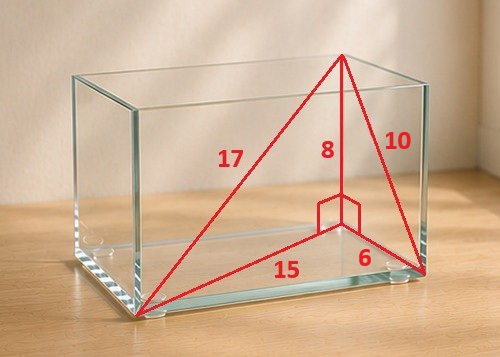
No one knows the answer.
This question has remained unanswered for centuries. Mathematicians have searched exhaustively for such a box, discovering countless examples that come tantalizingly close. Yet no one has ever found one in which every right triangle satisfies the requirement. Equally remarkable, no one has proved that such a box cannot exist.
Curiously, this is not how mathematicians usually describe the problem.
In the mathematical literature, the question is almost always stated in a more technical way. A perfect cuboid is defined as a rectangular box whose three edges, three face diagonals, and single space diagonal all have integer lengths. This definition is perfectly suited to number theory because those seven lengths become the variables in a system of Diophantine equations.
For most people, however, that description feels like a checklist:
- the three edges must have greater than zero integer lengths,
- the three face diagonals must have greater than zero integer lengths,
- the space diagonal must have a greater than zero integer length.
The geometric idea is easy to miss.
The triangle formulation captures the entire problem in a single picture. Every one of those seven lengths is simply one side of a right triangle determined by the box’s corners. Instead of thinking about a collection of separate arithmetic conditions, we think about a box filled with Pythagorean triangles. The same geometric principle that helps a carpenter square a foundation becomes the basis of one of mathematics’ oldest unsolved problems.
That is part of what makes the problem so appealing. Almost anyone who understands the Pythagorean theorem can appreciate the question. No advanced algebra is required. A cardboard box is enough to visualize it. Yet despite its simplicity, no one has ever answered it.
Some of the greatest mathematical problems are famous because they are easy to state but extraordinarily difficult to solve. The perfect cuboid problem belongs in that tradition. Hidden inside an ordinary shoebox is a question that has resisted mathematicians for hundreds of years.

