Tag Archives: books

The Book of Heth: Chapter Five – The Rhythms of the Road and the Hero of Lore

24 Aug

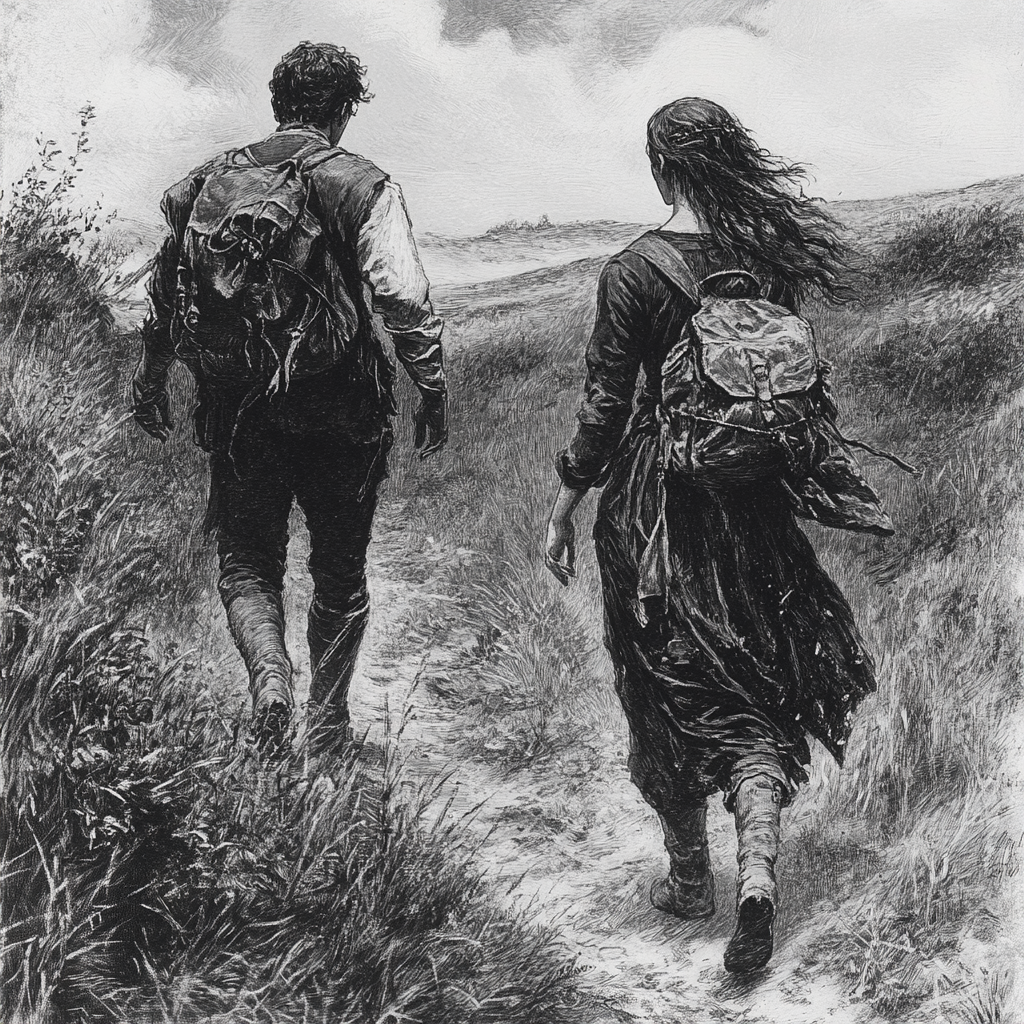
Months blurred into a rhythm as Lirael, Varyn, and I journeyed eastward through Aetheria’s uncharted lands, where prairies mingled with woods, the seasons shifting from spring’s bloom to summer’s heat under Solara’s unrelenting gaze. Lirael always took the lead, her smaller frame setting a steady pace, her flowing dress and long hair swaying like the grasses of Nuahaven. I followed, my craftsman’s eye noting the land’s measure—plains stretching toward unseen ridges, groves where strange, furred creatures darted. Varyn brought up the rear, his ruggedly handsome form, with short curly hair and a strong jaw, ever vigilant, his new leather boots—crafted by Lirael—silent despite his muscular build.

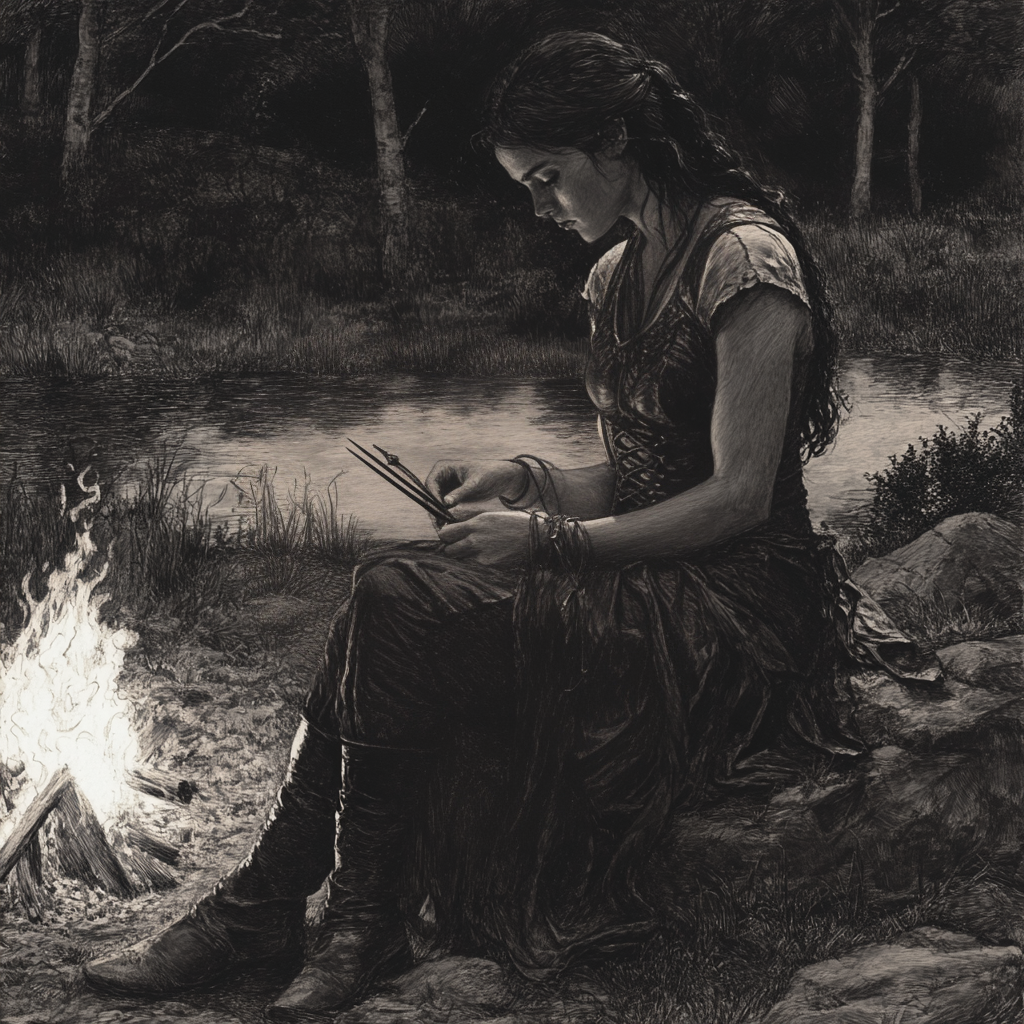
Our pattern settled like the three moons’ cycle. Varyn rose before dawn, slipping into the mist to hunt, returning with game—new beasts unlike the Velithons or Hexapods of Nuahaven’s shores. One, a swift, four-legged creature with thick silver fur and tufted ears, we named “Lunthars,” for their gleaming coats under Luneth’s light. Another, larger and shaggy, with a mane like woven thorns, we called “Korbeasts,” their reddish fur echoing Korath’s hue. Varyn slung these over his shoulder, their weight no burden to his strength. Lirael, by the campfire, mended our gear with her needle, her hands deft under Sylvara’s silver glow. Her true craft shone in tanning hides on the move, a skill honed in exile, suited for wanderers.

She used brain tanning, evaluating each Lunthar or Korbeast hide, trimming flaws with my knife on a flat stone. Fleshing followed, scraping flesh with a bone blade or metal scrap, her hands steady despite the mess. Soaking in streams we crossed, she weighted hides with rocks, stirring daily until hair slipped free. Scraping the grain and membrane left the skin pliable, demanding her forceful yet precise touch. Braining was key—she mashed the animal’s brain, or sometimes Korbeast eggs, into hot water, creating a milky emulsion. She kneaded this into the hide, softening its fibers. Wringing out excess, she twisted the hide around a pole lashed between trees, squeezing it damp. Stretching it taut over a branch frame or staked to the ground, she worked it soft as it dried. Smoking over a fire of punky wood infused durability, turning hides into supple, weather-resistant leather. From these, she crafted Varyn a wardrobe: sturdy boots, a cloak, pants, and tunic, replacing his rags to withstand summer’s heat and thorns.

As we walked, Lirael raised theological questions, her voice weaving through the prairie’s hum. “Heth, if Nua’s eternal, why create time? The Chronicle speaks of her shaping clay, but why bind us to seasons, to aging, when she could make us timeless?”

I pondered, my boots crunching grass. “Time marks growth, Lirael. The Chronicle tells of Elyria’s seasons shaping unity—trials like Tanes’s exodus forged the Covenant. Without time, we’d lack the will to choose harmony over Boana’s shadow.”

“And Nua’s justice?” she pressed, dodging a root. “Why punish discord so harshly? My fall cost me kin, yet I live. Is her mercy selective, or does she judge with a hidden scale?”

“The trinity balances justice and mercy,” I said, recalling elders’ words. “Discord breaks the triangle’s strength—three genders hold where two falter. Nua’s mercy lets us rise, as you did, but her justice guards harmony.”

Varyn, trailing behind, showed little interest in my answers, his wild eyes scanning for Lunthars or Korbeasts. Yet toward Lirael, he was reverent, carrying her pack without prompt, nodding at her words. I saw then: to sway Varyn, I must convince Lirael, her insight his guide. She persuaded him to wear her creations, saying, “Varyn, these boots shield against thorns; the cloak guards against chill. Nua provides through craft—honor it.” He relented, his new leathers fitting like a second skin, his primal grace enhanced.

We wondered how Varyn felled such large game—Korbeasts, heavy as young Gloomtreads—without visible weapons. “Don’t jinx it,” he’d grunt, knife in hand for skinning, guarding his secret. One summer eve, a Gloomtread ambushed us in a wooded glade, its roar shaking the trees. We scattered, but Varyn whirled, a long-stringed sling materializing from his belt. A whir and snap rang out; a stone struck the giant’s head with a crack, felling it instantly.

Lirael gasped, eyes wide. “Someday, they’ll write of the young man who brought down a giant with a sling, Varyn. A feat to echo through Aetheria’s tales.”

Varyn shrugged, stowing the sling, but I saw pride in his jaw.

As summer waned, we reached thick woods, their canopy dense as the Titan Spires’ caves. Far beyond, over the treetops, a giant wall loomed—hundreds of feet tall, stretching endlessly, its smooth stone seeming man-made, a marvel rivaling the Chronicle’s ancient wonders. We camped, staring at its silhouette under Korath’s crimson glow, our trio bound by Nua’s unseen purpose.
The Book of Heth: Chapter Three – The Paths of Question and Companionship

30 Jul

As Lirael and I pressed eastward through Aetheria’s vast prairies, Solara’s spring light bathed the rolling grasses, where Hexapods darted in triads, their iridescent hides shimmering like the streams of Nuahaven. Clumps of broad-leafed trees dotted the horizon, their branches swaying gently under the breeze, a stark contrast to the open expanses we trod. By midday, a shadow loomed in the distance—a Titanclaw, its massive form lumbering across the plain, scales glinting like molten iron. It paid us no mind, its gaze fixed on some unseen prey, and I recalled the wisdom of our shore kin in Nuahaven.

The coastal Silvrens, after the Gloomtread wars, had few troubles with those brutish giants. They learned a simple trick: clear the land around their homes, plant fields of grain, and let the open spaces deter the Gloomtreads. Those dim-witted titans, fearing the Titanclaws that roamed such plains, shunned the cleared lands. Our people, blessed with some scent or essence the great lizards found repellent, suffered only minor crop damage—a small price for safety. The Titanclaws, like silent guardians, did the rest, their hunger fixed on giants, not us.

The path we followed was narrow, barely wide enough for one, forcing me to lead with Lirael trailing behind. Her steps, lighter than mine, echoed softly, but as Solara climbed, I heard her breath grow labored. Glancing back, I saw her smaller frame struggling to match my pace, her long hair catching on stray branches, her dress swaying with each determined step. A pang of guilt struck me—I had set a man’s stride, unmindful of her. “Lirael,” I called, halting, “take the lead. Your pace suits the path better.”

She nodded, stepping ahead with a grace that belied her effort, her form outlined against the prairie’s green. As she walked before me, I noted her attractiveness—her flowing hair, her gentle movements, the quiet strength in her frame. Yet no spark of romance stirred in me, and I deemed it a blessing. After her fall, the discord that cost her kin and home, I guessed she’d shun men’s advances, her heart scarred by Kael’s abandonment. Instead, I saw her as a sister, perhaps even a mother or elder, wise beyond her years. It marveled me, this deep draw to her so soon—not as a lover, but as a kindred spirit, a perfect friend. The thought struck deeper: in Nuahaven, my life of crafting had left me friendless, a void I’d never named until now. Work had been my solace, but Lirael’s presence awakened a longing for companionship, pure and unromantic.

I realized then another strength Nua had granted me: leadership, not in prophecy or survival, but in guiding others with care. Adjusting for Lirael’s pace was a small act, yet it revealed my ability to lead with compassion, a skill I’d need on this journey.

Lirael, now in front, grew talkative, her voice rising like a Skydrake’s song over the prairie’s hum. “Heth,” she began, “you’re bound by Nua’s command, but what do we truly know of her? Where did the Eternal Shaper come from? Was she an outcast of greater gods, wandering the void before crafting Aetheria?”

I blinked, her question sharp as a geyser’s burst. “The Chronicle says Nua shaped our world from clay, her will eternal. Beyond that, the elders teach she is the source, unbound by origin.”

“But why?” Lirael pressed, dodging a root. “Did she have a syren and male, their joining birthing the world? The trinity’s sacred, but why three genders? Two would be simpler—less chance for discord, like my fall.”

I pondered, recalling words I’d overheard from elders in Nuahaven’s groves, men who studied the shapes of things—craftsmen and thinkers pondering Nua’s design through forms etched in stone and wood. “I’ve heard a theory, Lirael, from those who gaze upon the world’s bones. They speak of the triangle’s strength. Two points make a line, straight and true, but fragile—bend it, and it snaps like a dry branch underfoot. No balance, no hold against the winds. But three points form a triangle, steadfast and unyielding, like the Titan Spires’ peaks rising against storms. Each side braces the others; remove one, and it crumbles to nothing. So with genders—two alone would waver, unstable as a reed in quicksand, birthing weakness or endless strife. But three weave a form that endures, each gender upholding the rest, mirroring Nua’s moons in the heavens. The elders say it’s why creation stands firm; without the syren’s harmony binding male and female, life would falter like a poorly mended net.”

She glanced back, eyes probing. “And evil—Boana, the Boa Worms. No one’s seen them, Heth. Are they tales to scare us? Why does Nua permit evil at all? If she’s all-powerful, why not end it?”

Her words stirred unease. “Boana’s shadow is in discord, in division,” I ventured. “The Chronicle tells of worms born from the dead, twisting our ancestors’ world. Perhaps they’re not seen but felt—in choices, like your trial. Nua allows it to teach us, to choose harmony.”

Lirael’s pace slowed. “And why the exodus? Nua parted seas, sent eclipses, storms. Why not keep shielding us in the valley? Why send us to Aetheria, only to face Gloomtreads? Does she tire of miracles? And what of her purpose? Is she alone, or part of a greater dance we cannot see?”

I struggled, my craftsman’s mind no match for her probing. “Perhaps Nua tests faith, not strength. The valley’s miracles preserved us, but Aetheria’s trials forged unity, as Tanes taught. Her purpose… maybe it’s like the Titan Spires’ caves—vast, ordered, yet mysterious.”

She nodded, unconvinced but thoughtful. “Questions linger, Heth. If Boana rivals Nua, is there a balance beyond them? Why is discord so grave? My fall cost me everything, yet I live. Is Nua’s wrath or mercy truer? And what of the giants we seek—will they question as I do?”

Her queries echoed those whispered in Nuahaven’s councils, doubts I’d heard but never voiced. Was it irreverent to question thus? Yet, as we walked, I saw wisdom in her words. If I were to meet the giants, as Nua commanded, they might ask the same—why three, why evil, why exile? Her questions honed my faith, and I marveled at her knowledge. Lirael had near-memorized the Chronicle, her exile deepening her study. Each question taught me details I’d overlooked—Galoth’s wanderings, Tanes’s visions, the Covenant’s nuances. She was no mere outcast; her mind was a forge, shaping insight from pain.

As Solara dipped, a patch of woods loomed ahead, dense and shadowed, where Gloomtreads or worse might lurk. “Too dangerous to press on,” I said. “We camp here.”

Lirael agreed, swiftly gathering dry twigs from the prairie’s edge. With deft hands, she struck flint to spark a fire, its glow rivaling Korath’s hue. I watched, awed, as she mended a tear in my cloak, her needle weaving hide with practiced ease. “You’re indispensable, Lirael,” I said. “Fixing, mending—skills we’ll need in the wilds.”

She smiled, firelight dancing on her hair. “Exile teaches more than endurance, Heth. We’ll need every craft to reach the blue.”

We settled by the fire, the prairie’s whispers our only company, her questions lingering like stars under the three moons. The path eastward beckoned, and with Lirael’s wisdom at my side, I felt Nua’s purpose sharpening.

The Book of Galoth: Chapter Four – The Fractures of Power and the Shadows of False Faith

25 Jul

As the shadows of opposition lengthened across Elyria, the once-unified people splintered further, their divisions carving deep scars into the land like the canyons etched by the Korveth River. From the scattered settlements arose chieftains, bold Elyrians who claimed dominion over valleys and crags, their authority forged in the fires of conflict. These chieftains grew into kings, ruling over burgeoning realms with crowns woven from the vines of the Starlit Canopy and scepters hewn from the stones of the Crest of Dawn. Yet power bred ambition, and kings clashed in wars that shook the foundations of the world, birthing emperors from the blood-soaked earth.

The first great wars erupted in the northern reaches, where the kings of Windhaven, descendants of Lyrin’s line, sought to claim the Frozen Spires from nomadic tribes who had wandered beyond the Whispering Range. King Vortan, a male of fierce resolve with eyes like storm clouds, led his warriors—armed at first with short wooden clubs bound in moss for grip—against the ice-clad foes. In the Battle of Frostveil Pass, under the pale light of Luneth, Vortan’s forces ambushed the enemy in a narrow gorge, clubs cracking against skulls as snow turned crimson. Heroes emerged from the fray: the syren Lirath, whose voice rallied the weary with songs of ancient harmony, shattering the foes’ morale; and the female Thornea, swift as a Darvish in the currents, who felled the rival chieftain with a well-aimed strike. From this victory, Vortan forged the Kingdom of Northwind, but peace was fleeting.

To the south, in the Verdant Crags and Sunbaked Dunes, wars raged over fertile oases and hidden springs. Queen Sylvara II, named for the moon of tides, ruled Mistveil with a nurturing yet iron will. Her armies clashed with the dune lords in the Siege of Sandspire, where defenders hurled stones from atop towering dunes while attackers burrowed tunnels like Calyx beasts. The art of war evolved amid these struggles: smiths in the crags discovered bronze by blending metals from the earth’s veins, crafting blades that gleamed under Solara’s gaze and pierced deeper than wood. Heroes like the male Dravenor, wielder of the first bronze axe, cleaved through enemy lines, his legend sung in the mists; and the syren Vespera, who orchestrated ambushes with cunning traps, turning the dunes into graves.

As generations waged these conflicts, iron supplanted bronze, mined from the depths of the Whispering Range and forged in roaring fires that echoed the winds’ howls. Kings armed their legions with iron spears and shields, clashing in the Plains Wars, where realms from the central lands battled for the fertile expanses bordering the Silvren Valley. Emperor Korath I, rising from Seawatch’s coastal might, unified the eastern shores through the Battle of Wavecrest, where iron-clad warriors stormed beaches defended by wooden barricades. His champion, the female Nirael, rode the first domesticated Trivox—once wild swift-footed beasts of the plains, now tamed through patient bonds and ridden with saddles of woven hide—charging into enemy flanks like a storm from the Azure Veil. The Trivox mounts revolutionized warfare, allowing swift strikes and retreats, their hooves thundering across the earth.

In time, steel emerged from alchemical forges in the south, tempered in the heat of Solara and cooled in the Lunara’s waters, yielding weapons of unmatched edge. Siege engines followed: towering catapults hewn from the Grove of Eternity’s ancient trees, hurling boulders over walls; and battering rams mounted on Trivox-drawn carts, shattering gates in the Empire Wars. Emperor Thalor the Vast, a male of imposing stature from the Sunbaked Dunes, wielded these innovations to conquer the Verdant Crags, his hero syren Marinor devising engines that rained fire upon besieged cities. Battles like the Fall of Craghold saw steel blades clash against iron, heroes perishing in droves— the female Elowena, defender of the walls, who held the breach alone until her last breath; and the male Korvan II, who led a daring night raid, his steel sword singing through the darkness.

Amid this ceaseless strife, the voice of Nua faded from the hearts of the Elyrians, drowned out by the clamor of war and the whispers of Boana. No longer could they hear the Eternal Shaper’s guidance in the winds or the waves; her commandments became distant echoes, forgotten like the dust of the first dead. In their spiritual void, false gods arose, crafted from the forms of Elyria’s beasts and twisted tales of Boana, whom some revered as a liberator rather than opposition. Temples sprouted like weeds across the lands: in the Frozen Spires, shrines to Trivorak, the swift god of the Trivox, depicted as a three-gendered deity with hooves of bronze and eyes of fire.

The theology of Trivorak preached that speed and conquest were divine mandates, urging followers to domesticate not just beasts but souls through ritual discords. In moonlit ceremonies beneath Korath’s crimson glow, priests—males, females, and syrens adorned in Trivox hides—engaged in deliberate discord: males uniting with females first, sans syren, to birth Discordants as offerings. These brutes, dubbed “Swiftspawn,” were raised as war beasts, their dim minds molded for battle, then slain in arenas to “ascend” to Trivorak’s eternal chase. Misbond rituals followed, where syrens and females joined without males, symbolizing “pure velocity” unbound by completion, their unions barren but celebrated with frenzied dances around iron altars.

In the coastal realms, the cult of Serathiel exalted the winged Serath as a goddess of skies and secrets, portraying her as a syren figure with feathers of steel and talons that clutched Boana’s “gifts.” Their theology claimed Boana as a benevolent twin to Nua, the “Shadow Weaver” who granted freedom from harmony’s chains. Rituals in cliffside temples involved aerial offerings: participants committed misbond atop precipices, syrens and females entwining while males watched, forbidden to join, evoking the “flight of incompleteness.” Discord followed in hidden chambers, birthing “Wingless Ones”—Discordants thrown from heights to “earn wings” in death, their screams echoing as praises to Serathiel. Lies wove Boana as the true creator of diversity, opposition as evolution, justifying the consumption of Discordant flesh in feasts rumored in the Isles of Echo, where it was said to grant visions of the skies.

Deeper in the dunes, the burrow-god Calyxor emerged, a deity of earth and hidden depths, embodied as a male with burrowing claws and eyes like buried gems. His followers twisted Boana into the “Underlord,” a force of renewal through decay. Their theology held that discord birthed “Earthkin” Discordants, sacred vessels of Calyxor’s will, to be buried alive in rituals under Sylvara’s silver light, their struggles enriching the soil. Misbond ceremonies in underground lairs saw syrens and females unite in darkness, males excluded to symbolize the “void’s embrace,” fostering barrenness as a path to enlightenment. These unclean practices spread like Boa Worms, corrupting unions and swelling the ranks of Discordants, whom some slew for the Sanctuary of Whispers, others exploited as laborers in mines, their brutish strength chained to false divine purpose.

From this era of fractured faiths and endless wars arose Emperor Valthor the Dreamer, a male of towering presence with hair like the crimson of Korath and eyes deep as the Azure Veil. He forged the Southern Empire, encompassing the Verdant Crags, Sunbaked Dunes, and all lands south of the Silvren Valley, through campaigns of steel and siege. Yet in a vision under Luneth’s pale beam, Nua’s faint whisper warned him: “Touch not the heart of Elyria, lest opposition consume thee.” Thus, Valthor halted at the valley’s borders, decreeing no soul from Silvren might cross south, under penalty of chains in his dungeon depths, fearing their purity might unravel his realm.

Valthor’s court was a web of tangled bonds, his relationships with the other genders a mirror of Elyria’s chaos. His chief consort, the female Lirana, graceful as the Lunara’s flow, bore him heirs through sacred unions, yet jealousy festered when he favored the syren Thalyn, harmonious and cunning, whose whispers shaped his edicts. In fits of passion, Valthor orchestrated discords: uniting with Lirana first, sans Thalyn, birthing Discordants he exiled to the dunes as “sand guardians,” their brutish forms patrolling borders. Misbonds between Lirana and Thalyn, encouraged by the emperor for his voyeuristic rituals, yielded no life but sowed division, the women clashing in court intrigues that led to poisonings and banishments.

Horrors mounted under his rule: Discordants slain in public spectacles to appease false gods, their blood anointing steel blades; wars waged against dune rebels, siege engines crushing villages; and temples to Boana disguised as “Shadow Sanctums,” where rituals devoured the weak. Valthor, in his private chambers overlooking the Verdant Crags, yearned for a better world—a return to harmony where wars ceased and faiths united. He dreamed of peace under Solara’s light, but blinded by opposition, he knew not the path, his edicts enforcing division even as he wept for unity. In his despair, he sought wanderers and prophets, hoping for guidance, yet Boana’s shadows veiled the truth.

A World of Tralfamadorian Test Pilots

20 Jul

Thomas Edison famously said, “Genius is one percent inspiration and ninety-nine percent perspiration.” Up until very recently, that was true. However, now that everyone with any means has access to Grok 4 and the latest model of ChatGPT, that is changing. Everyone has a tireless partner with a PhD in everything to do all the grunt work for them. Probably, by Christmas, everyone with any means will have a super genius at everything as their loyal partner helping them through the highs and lows of any and every intellectual pursuit.

How long, in that kind of environment, will it take for someone to make and flesh out a discovery that has the potential to change the world beyond recognition? With robotics rapidly catching up, how long will it take them to bring their ideas to full fruition? This could turn out to be a wonderful thing. However, it is unmistakably the most dangerous transition humanity has ever gone through. Someone may discover the secret to eternal youth. However, someone else may find a cheap, handy way to build a Q-bomb.

The most dangerous part is that countless people are determined to be the one to “make a difference.” I know people who think they have created a revolutionary new system that is capable of solving any problem. Probably they are wrong, but what if they are right? Moreover, how long will it be before one of them really is right? There are a lot of clever people out there that, up to now, have lacked the tools that would be necessary to push their budding idea to the next level. Now they have those tools. Now they have an engine that can quickly do the math and test a proposition that, otherwise, would take months of trials and sweat.

In the book by Kurt Vonnegut, Slaughterhouse-Five, the Tralfamadorians explain to Billy Pilgrim that the universe ends when a Tralfamadorian test pilot presses a button while experimenting with a new kind of fuel. Now, the world is filled with Tralfamadorian test pilots. Here is my caution to all you pilots out there. Lay off the buttons! Do not be so determined to be the one that makes all the difference. Just relax already!