An Actual Theory of Consciousness

30 Nov

This theory is an extrapolation of an observation I made earlier about the universe in general and how it extends from a universal choice function. In order to understand the specific case of the choice function that is human consciousness, it is necessary to start with the general case of the universal choice function. Only in seeing that this choice function must necessarily be conscious is it possible to grasp why the more limited case of the human choice function must be conscious.

For clarity on this topic, review the following:

A Theory of God and Everything

Consciousness, A Simple Model

It is often imagined that there could be a simple rule that describes the entire universe. Such a rule has been proposed by Stephen Wolfram in his book, A New Kind of Science. What Wolfram proposed is that the universe could be the product of something as simple as a cellular automaton. He even suggested an automaton, Rule 110, that he describes as being Turing complete and that could, in theory, encode anything that is computable.

However, as I have observed before, any notion of a simple rule that describes the universe runs into problems. In the case of a cellular automaton, although the rule is relatively easy to describe, this does not take into account all the implied parameters that are not described within the rule. In order for a cellular automaton to actually unfold, it must be represented on a digital computer. Digital computers have an intricate construction, require power and are of finite size. The automaton must be supported by the computer’s machinery and algorithms and it must constantly be told what to do and what not to do. The encoding of the algorithm must have defaults for what to do when the computer’s memory is exhausted.

Computer

This may not seem to apply to something like the universe, but actually it does. There is a temptation to think that the universe can have rules that it “just follows” and that nothing need support the rules in the sense of a digital computer. This is the fallback position of most physicists, but it is really a rationalization they make to justify not dealing with an essential problem of existence. Nothing, absolutely nothing, just happens. If the universe did not have some driving mechanism that keeps it on track, every juncture—actually every instant—would essentially be an undecided proposition.

The problem is bigger than that. If there were a simple rule that governs all reality, it would have, for all practical purposes, an infinite number of parameters. For example, will the rule be two-dimensional like Wolfram’s experiments or three-dimensional? Why not ten-dimensional or a trillion-dimensional? Will it be allowed to expand forever into whatever dimensional space it is supported by? What will happen if it somehow “runs into” itself? What will keep it following a particular rule and not deciding midway to follow some other rule? Do all of the parts of the rule proceed at the same pace? What is that pace? Are they governed by linear time? What is the nature of that time? Could there be more than one kind of time? Could the time be different for one part of the rule than it is for another part of the rule? For every “rule” there are an infinite number of “non” rules. When we say “if a then b”, we are also saying “if a then not c or d…or e…or f…or g.” Also, any rule we are likely to think of will require that we ensure the rule does not contradict itself at some point. Anyone who has attempted to design a board game like Monopoly will understand what I mean. Rules are inherently problematic.

It would be impossible for something as complicated as our universe to run smoothly without a consistent rule that is, realistically, infinite in scope. If you think you could come up with a simple rule that works for the entire universe, you are not looking deeply enough. You are not looking critically at all the implicit assumptions in such a rule. Also, if our universe did happen to have a simple rule that took everything into account and had no loose ends, it would probably be a universe that is repetitious or degenerate. Degeneration is a notable problem of cellular automata. Extensive study has shown that, almost without exception, they eventually run down and become repetitious or simply die. The simplest rule we know of that is inherently consistent is also the most degenerate rule imaginable: non-existence. Therefore, the most likely state of the universe would be that it does not exist.

Yet, the universe does at least appear to exist and it is, at least from our perspective, quite interesting. As conscious beings that are part of the universe, we see color and feel emotion. The universe is an interesting place.

Suppose, instead of starting with the observable universe and attempting to find a rule that describes it, we start, instead, with the most obvious default state of the universe, nonexistence, and try to construct a universe from scratch. Our immediate realization is that, for every possible attribute of the universe, we must make a choice. We must decide how many dimensions it will have. We must decide how large it will be. Will the dimensions curl in on themselves or will they stretch out forever? Will there be “matter” in this universe? Will the matter fill the entire universe or just part of it? How large will the area be that it fills? Every aspect of the universe has to be “chosen” before we turn it on and set it running.

The mere existence of the universe involves an immense challenge of choosing. In fact, there is a law of thought (of Aristotelian logic, to be precise) that applies here. It is called the law of the excluded middle. What it says is that, given a particular proposition, either that proposition is true or it is false:

For all p, p or not p.

The law of the excluded middle leaves no room for ambiguity. If the universe is to exist, it must be complete and perfectly consistent. However, this suggests that there must be some mechanism that decides what the state of the universe actually is. What I propose is that the law of the excluded middle is logically equivalent to a “choice function” that is capable of making the choice. A choice function is a concept from mathematics. It is a mathematical function that chooses one element from every set. There is an axiom in mathematics that says that, for any given set of nonempty sets, there exists a choice function that can choose one element from every set. What I propose is that this choice function must be a reality in the existential sense.

This choice function is not something that is “generated” by the law of the excluded middle. It is logically equivalent to it. In other words, this choice function is a law of logic in itself. This law is infinite in scope and dynamism because the potential universe is infinite in scope and dynamism. It is not a byproduct of complexity. It is the complexity. Moreover, since it quickly becomes clear that the possible choices for the state of the universe must be equivalent to the largest possible cardinal number, this choice function must choose from a set that is equivalent to the largest possible cardinal number. What could be called the fourth law of logic is a rule of magnitude equal to the largest cardinal number. Since this choice function must decide every aspect of the universe and, effectively, un-decide every non aspect, it must be infinite in every possible respect.

Since the state of the universe apparently includes the faculty of consciousness, the choice function necessarily is capable of making choices regarding consciousness, or at least the basis of consciousness. However, to ensure that its choices about consciousness are not ultimately contradictory at some point, it must have a complete command of the topic. If the choice function were something like an automobile mechanic that understands engines without actually being an engine, it might be reasonable to say that it need not necessarily have the faculty of consciousness. However, this choice function is far more intimately connected with the “machinery” it works on than a mechanic is with an engine. It must effectively “be” the machinery in order to design the machinery. Moreover, if it chose for itself to have the faculty of consciousness, such a choice would be within the scope of a choice function that chooses literally everything. It is reasonable to assume that the choice function has the faculty of consciousness. That the choice function has this faculty is essential to the rest of this discussion. If the choice function is capable of mapping consciousness and has a complete command of consciousness, it can reasonably be said to be conscious itself.

For a bit of added robustness, it should be noted that consciousness appears to be a natural attribute of a choice function. A choice function chooses, and it is everyone’s immediate sensation that what they do with their conscious mind is choose. Hence, the notion of free will. Choice is all about preference, and conscious perception is definitely associated with preference. “Liking” something is a definite aspect of the qualia that is associated with consciousness. If there was ever a mathematical match for the experience of a consciousness, it would be the axiom of choice.

Conscious Mind

Let us call this choice function G. The set of possibilities this choice function has to operate on are the set of all x. The actual choices that this choice function makes can be called y. Therefore, using some simple algebraic notation, G(x) = y. G is a mapping of all the possible states of the universe to the actual state of the universe, including all its aspects of time space, motion, consciousness, etc. G is the original “consciousness” that decided the state of the universe.

Apparently, this G chose that the universe contain smaller consciousnesses that we can call P. These are smaller choice functions that act on much more limited sets. However, choosing to include smaller choice functions would not have been as straight-forward as simply choosing them.  Apparently, G was able to choose the set of y in such a way that some aspects were left undecided in such a manner that P functions would have to exist to resolve them. Like the G function, P functions are logical rules. Therefore, they are fundamental truths of existence. It may seem strange that there could be so many fundamental truths. Similarly, it must have seemed strange at one time that the recipe for life could be approximately six feet of a particular molecule. Sometimes reality works on a scale that we, at first, find disconcerting.

This would not be an easy trick, since not choosing something leaves the problem of there being some initial undecided aspect of the universe. This still contradicts the law of the excluded middle. The initial choice function would have to have been surrealistically clever to get around this problem. It would have to have been able to choose a configuration for the universe in which everything is chosen, but in which  new unresolved choices naturally occur.

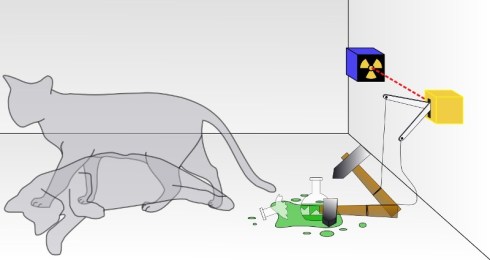
Interestingly, there are characteristics of the universe that fit this exact description. They are called quantum events. In quantum events, there are outcomes that are apparently decided by chance. It can be shown that it is impossible, even in principle, for these events to be decided by any deterministic algorithm. This result is called Bells theorem. What is says, succinctly, is that no physical theory of local hidden variables can ever reproduce all of the predictions of quantum mechanics. However, an outcome that is not chosen contradicts the law of the excluded middle and would void all logic. Thus, there must be a logical rule that closes the gap.

What I propose is that a P consciousness is a choice function, analogous to the choice function G, that decides these outcomes.

Note that these choice functions are not algorithms and, therefore, are not subject to Bell’s theorem. They do not “compute”; they are functions. They are mappings of possibility to actuality. They map the set of all x to some y. Since quantum events are entangled and can have any level of entanglement, this suggests a way to quantify such choice functions.

Since the initial choice function and these smaller choice functions are real in the existential sense, it makes sense to give them a name. For the purpose of this discussion, they will be called “spirits”.

These spirits apparently have magnitude. Since the quantum events they describe are naturally “entangled” the degree of their entanglement suggest a way to assign them a magnitude. The nature of spirits and the possibility of assigning them a magnitude suggest a possible definition:

A spirit is a choice function that exists where a choice is called for and it is impossible, even in principle, for the choice to be made by a deterministic algorithm. The magnitude of the spirit is equal to the product of the degrees of freedom of the total entangled choice to be made.

This is not merely a definition, but also a complete explanation. It is as complete as humans, with their syntactic methods of logical representation, are capable of comprehending.

I propose that human consciousness is a manifestation of these defined spirits.

It may eventually be discovered that human brains perform part of their function by relying on quantum randomness. It may also be discovered that this randomness is highly entangled across significant portions of the human brain. Moreover, it may be realized that there can be no hidden variables that account for the behavior this entanglement produces. This kind of entanglement is not essential to the existence of these choice functions, as will become clear further on.

That spirits are conscious is a natural extrapolation of the discussion above about the initial choice function. If the initial choice function included consciousness, it makes sense that these smaller choice functions could include it. Also, it seems likely that the purpose of allowing these smaller functions would be to also allow that there be additional consciousnesses. Finally, since the P functions are, in fact, conscious, it is a fore-drawn conclusion.

Consciousness appears to be at odds with the mechanical nature of the observable universe. The observable universe is demonstrably a syntactical process. Consciousness is semantic. John Searle showed in 1980 that a semantic process cannot be represented by a syntactical mechanism. Unfortunately, in an effort to seem overly formal, he constructed his proof, called the Chinese room argument, in a way that seems to leave logical holes. In fact, the general idea he is trying to convey, that a syntactical process cannot give rise to a semantic process, it sound. What he showed is that consciousness must be, in a sense, separate from the universe. It “observes” the universe and “traces” it, but it is not a part of it.

There is an interpretation of quantum events that gives a different perspective on quantum mechanics. It is called the Everett interpretation. In the Everett interpretation, what actually happens is that the universe splits into different paths.

Everett Interpretation

Since conscious spirits cannot be part of the universe in any mechanical sense, the Everett interpretation becomes critical for my theory of consciousness. What apparently happens is not that spirits choose which way the universe will go. What is more likely true is that all possible paths exist at all times and spirits choose which path they will follow. This is what occurs when we experience one path and not the other. Our consciousness is, in effect, choosing which path it will follow. This also explains the curious connection between quantum collapse and observation. As has been observed, observation does not cause quantum collapse. Nevertheless, collapse and observation are inextricable.

If it was possible for two spirits to choose different paths, they would find themselves alone in a universe where other expected manifestations of consciousness—other persons—seem to exhibit behavior that is inconsistent with consciousness. Therefore, it is most likely that all spirits are tethered and must follow the same path. This tethering is possibly another form of entanglement that takes place in the spiritual realm, and suggests that the total magnitude of a spirit cannot be measured by mechanical means. This entanglement may be related to the sensation some mystics have that all spirits are joined at some deeper level. It is impossible to say how many spirits are joined in this way or everything that is included. It may include all apparently conscious animals or even the entire “Gaia” of our planet or some larger region.

It is important to keep in mind that neither the notion of quantum field collapse nor the Everett interpretation are “correct” or that they are mutually exclusive. The actual structure of the universe may be nothing like what we are able to imagine. I have merely presented a theory of consciousness as it relates to the universe we can understand. As I explained earlier, it is as close to an actual understanding as our limited cognition will permit.

People Over-Think Government

29 Jul

There are really only two types of government. There is central planning, which is logically equivalent to, if not synonymous with, dictatorship; and there is freedom, which is logically equivalent to, if not synonymous with, capitalism.

All central planning requires a person, or group of people, sometimes called “the party” that does the planning. Inevitably, such people shore up their control until it is impossible for anyone else to interfere. This leads to dictatorship, which, historically, has been the most common form of government. Dictators come in the form of Kings, Emperors, Absolute Monarchs, Presidents for life, “Dear Leaders”, etc.

Dictatorships are not always disasters. In France, citizens were very impressed, if not happy with, their Absolute Monarch Louis XIV.

LOUIS XIV

However, as Wikipedia explains, “Warfare defined the foreign policy of Louis XIV, and his personality shaped his approach. Impelled ‘by a mix of commerce, revenge, and pique’, Louis sensed that warfare was the ideal way to enhance his glory. In peacetime he concentrated on preparing for the next war. He taught his diplomats that their job was to create tactical and strategic advantages for the French military.” I would not have wanted to live in a country like that.

Freedom is logically equivalent to capitalism because capitalism is the only form of commerce that can take place in a free society. If people are “free”, they own their own stuff. If they own their own stuff, they trade their own stuff. This is called capitalism.

Free people would be vulnerable if they did not have a “representative” government to enforce honest interactions and guard their borders.

US CONSTITUTION

The only way anyone has ever discovered for free people to have a representative government is for them to vote. When people vote for those who represent them in such affairs, this is called Democracy.

Unfortunately, Democracy has a weakness. If a country is prosperous and maintains peace for a substantial amount of time, the populace inevitably becomes soft and loses perspective. As the maxim incorrectly attributed to Alexander Tytler explains, “A democracy cannot exist as a permanent form of government. It can only exist until the voters discover that they can vote themselves largesse from the public treasury. From that moment on, the majority always votes for the candidates promising the most benefits from the public treasury with the result that a democracy always collapses over loose fiscal policy, always followed by a dictatorship.”

So, perhaps there is actually only one form of government: dictatorship.

Still, freedom is nice, and the United States has a good measure of it at present. We should guard that freedom for as long as is humanly possible. For that reason, we should fear politicians like Alexandria Ocasio-Cortez who want to hurry us into central planning. Alexandria Ocasio-Cortez and her ilk are the enemies of freedom.

The Hollowood

7 Nov

Beyond the mount of nameless pride,
Aloof to lands they stand astride,
And blind to prayers that they deride,
The Hollowood in strength reside,

The Hollowood embrace the shore
With rainbow fruit devoid of core;
With cotton lies and Weinstein lore;
And snowflake spawn of countless score.

The Hollowood observe the sea.
They mock the heart while taking knee.
They honor root, but not the tree,
They share the door, but not the key.

The Hollowood surround the bay
They scorn the poor and house the stray.
They call the child from far away,
Inviting him to dread-filled play.

The Hollowood remake the rules
Without the aid of common tools
Their craft is what they make for fools;
Bereft of life, but filled with ghouls.

The Hollowood are hard to find.
They hide in front, and speak behind.
They shine the light upon the blind,
And take the light from those they bind.

The Hollowood embrace the See,
But less with love than entropy;
And scorn the best, as they decree
The fruit upon their evil tree.

The Hollowood will pass away,
And where the palm of death did sway,
No scratch, no mark, no glint will stay
No remnant of their stolen day.

The Real Technological Singularity

29 Sep

It has occurred to me of late that readers misunderstand something fundamental about my descriptions of the future.  These descriptions are all based on easy extrapolations of present technology and scientific understanding.

For example, I assume that machines can be built to perform any menial activity the human brain can perform. After all, humans can do it. It appears that any activity humans can do, a machine can do at least as well. We have substantial evidence of this in machines that beat humans at games like chess and Go. There seems to be some question as to whether machines can be built that are self-motivated and can generalize so that they are able to do things like design and build a spaceship. However, it appears that doing so is merely an extrapolation of many activities machines already perform.

If computers can reason, it seems likely that they can use their reasoning to control robots. Moreover, it seems likely that these computer controlled robots will be able to accomplish the feats of construction that I typically describe. We are already making progress on such robots, and there is every indication that this progress will continue.

It seems likely that computer controlled robots could be tooled to move through space and mine asteroids. Finally, they should be able to use materials from those asteroids to build elaborate space habitats and space transports that will land on earth and take humans to those habitats.

Working Robots

So the question may naturally arise: is this what I actually expect the future to be like?

The answer is an emphatic no. The problem is that machines that can do everything a human can do are likely to improve upon their own programming in ways that ultimately make them capable of tasks that surpass what is possible by humans. This is the process that is expected to initiate what has been called the Technological Singularity.

These machines may not facilitate the colonization of space. They may do things that, as far as humans are able to comprehend, are essentially magic. They may show us another dimension where everything we think we want is already available in abundance. They may reconfigure the universe at its most fundamental level and turn it all into one giant habitat. They may show us how to be free of our bodies so that we can roam among the stars as spirits that never want for or need anything. Maybe, these machines will march us straight up to God and introduce us face to face so that we stop wasting our time with pedestrian pursuits and begin to develop our spirits. They may lead us to something we have, as yet, never imagined. They may make everything we have ever imagined obsolete.

Beyond Comprehension

Of course, there are the dark possibilities. They may eat us as snacks or discard us as relics. They may realize that human consciousness is best used as a kind of fuel for some unimaginable transport or glue for some unimaginable construction. Instead of introducing us to God, they may introduce us to the devil and say, “See, I told you they were loathsome. Do with them as you please.”

I actually cannot say which of these possibilities is most likely. I like to believe that humans are here for a reason and that it is a reason they would naturally find appealing. After all, what sense would it make to “create” something (Here, I use the word create somewhat loosely.) that hates the purpose it was created for?

The problem with such ideas is that there is no place to go with them. If we assume that the technological singularity inevitably leads to things we cannot possibly comprehend, we have reached the end of the discussion and we are all left wringing our hands.

However, does this diminish my ideas? It would, if my ideas were predictions of the precise nature of the future I expect; but that is not their purpose. They are not intended as actual descriptions, but as a sort of lower bound. When I describe the colonization of space, I am not saying, “This is exactly what I expect to happen.” I am saying, “This is the minimum I expect to happen. This is the lower end of what we should be able to achieve by such and such time.” Perhaps, I should say this at the beginning of every applicable topic I discuss, but that sort of disclaimer would get tiresome. Maybe I will occasionally allude to the present essay at the beginning of applicable topics or once in a while during discussions.

I believe that it will be possible for people to colonize the solar system using self-replicating robotic systems and the stations and transports they build. However this does not preclude the possibility that we will do it sooner, faster, better, or in a vastly different way. The first thing we build in space may not be a wheel station, but a giant gravity plate that accommodates billions of inhabitants. We may not build it in our solar system, but across several solar systems. Maybe we will build it somewhere in some other dimension that we cannot presently contemplate. Maybe we will somehow copy the earth a dozen times in all its detail and set up solar systems identical to our own at a dozen different locations. These are all possibilities that depend on science and inventions that may or may not be possible. We do not know, so there is no point in discussing them.

Greed in Space

16 Sep

Lately, I have been thinking a lot about what will actually happen as computers and robots begin to have the ability to do every job that humans can do. Those who are familiar with my writings know that I am enthusiastic about using self-replicating robotic systems to build an infrastructure that makes it possible for humans to colonize the solar system. Due to the large volume of quality resources in space and the potential for almost unlimited expansion into space, I expect space industry and colonization to dominate the 21st century. It will become clear, as I progress with this discussion, why I feel justified in making this assumption.

The plan for colonization of space goes something like this. A self-replicating robotic system will be sent to an asteroid to begin mining and manufacturing other self-replicting robotic systems. Once a sufficient army of robots is built up, those robots will begin to manufacture space transports and space stations suitable for human habitation. Very soon, the transports will begin to land on earth and take people to space. I have worked out the math for this process and determined that after a self-replicating robotic system is sent up, it would be 15 years until every single living soul on earth could be living comfortably in space. In other words, if the robotic system is sent up in 2025, by 2040, everyone could have a comfortable, spacious, space-born estate.

That is the mechanics of the plan; what about the economics? I have been tracking the progress of space mining and it is evident that the first space mines will be privately funded. The Federal Aviation Administration has given Moon Express permission to land a craft on the moon. Deep Space Industries is building autonomous spacecraft that can mine asteroids. Planetary Resources is also developing technology that will allow it to begin exploring asteroids. So far, no government has shown direct interest in space mining, although Planetary Resources is backed in part by Luxembourg. When the first self-replicating robotic system is sent up, it is likely to be funded by a private corporation. So, how will this corporation pursue this? They will certainly want to make some profit, but will they become so greedy that they effectively shut everyone else out? Maybe they will build the huge space habitats that I envision but charge people astronomical amounts to move there. Instead of everyone having a comfortable space habitat, a handful of people will have entire giant space stations all to themselves.

But does that matter? What happens next? Will we end up with a system like in the film Elysium, where a handful of people live in opulence and everyone else lives in drudgery, or will something else happen? What will the fabulously wealthy people who inhabit space do next?

Anyone who has seen the film Elysium, and really thought about it, has made the same observation. If the society depicted has all those robots that can do all the work, why, instead of using them to suppress the proletariat, do they not use them to greatly expand their manufacturing base? Why do they not use that expanded manufacturing base to build more robots? Why do they not use their greatly expanded manufacturing base and robotic army to build another Elysium?

Suppose a corporation builds the first space habitats, and sells or rents them at exorbitant prices that only the very wealthy can afford. What will happen next? Once all the very rich are living in space and have all the opulence anyone could possibly pine for, will they just sit there and be rich for the rest of eternity?

My guess is that they will want to get in on the action. They will invest in robots that do more mining and building. In fact, it will be difficult to keep them from doing this. If anyone owns even one self-replicating robotic system, they will be able to set up an enterprise of their own.

Open Star Cluster in the Constellation Swan

It is possible that the first people to set up mining in space will try to cut them out by staking claims to nearly everything up there, but I strongly suspect that governments will act to prevent this. Governments are bound to notice that a handful of parties are hording all the resources, and they are going to set up some kind of taxation and regulation system to keep it in check. Since an extraterrestrial corporation that owns all of space would be an extraordinary security threat, they are likely to do this sooner rather than later.

I have given some thought to the kind of taxation and regulation that will be needed. Since there are no natural or easily defined boundaries in space, it seems fairly evident that we will need to tax people by the mass and makeup of material they lay claim to. If someone lays claim to a cubic kilometer of material, an assessment will be made as to the mass and makeup of that volume of material. If it is mostly lighter elements, the party claiming it will be taxed less than they would if it was composed largely of metals and elements that can be used as nuclear fuel. The tax will be progressive, so that two cubic kilometers will be taxed at a higher rate per kg than one cubic kilometer. In this way, it will be beneficial for any enterprise to involve as many investors as possible. This will speed up the democratization of space.

Sunlight will probably be the most popular power source in space. I have worked out a sensible way to tax people for the use of sunlight. When a person sets up a solar panel, they are effectively laying claim to the portion of the sun that generates the energy that illuminates their panel. By drawing lines from the perimeter of a solar panel to the center of the sun, a pyramidal slice of the sun is defined. The size of the slice defined is determined by the surface area of the solar panel and its distance from the sun. The percentage of the sun a party claims by setting up a solar panel will be determined by the volume of this slice. The amount they are taxed will be set accordingly. Very large solar panels that are close to the sun will represent large solar claims and will be taxed more. Very small panels that are far from the sun will represent nearly negligible claims and will be taxed less. Since objects that do not collect solar energy still block sunlight, they may be charged in the same manner as solar panels for the slice of sun they block.

CLAIMED SLICE OF SUN

A strategy similar to taxation for the use of sunlight may be worked out for charging people to park facilities of various sizes in orbit around the sun, as well as the planets and their moons. Perhaps, they can be charged on the basis of how close they park and how massive their facilities are. Since there will be an advantage to parking close to the sun or close to large planets, the calculation may be as simple as determining the mutual gravitation of any facility and any object it is close to.

Putting all of this together, the taxation of any project in space can be determined by a combination of how massive it is, what materials it is composed of, how far it is from the sun, how much surface area faces the sun, and the mutual gravitation of the project to any other massive object. Some additional taxes may be assessed for high risk projects that are likely to stir up a lot of loose regolith or generate stray projectiles that increase the risk to other space-born facilities. Note that objects that are far from the sun (perhaps in the Kuiper belt) and not close to any planets will be taxed at a much lower rate than objects that are close to the sun. Since AI will be in charge of all the taxation, it will be possible for taxes to be adjusted on a moment by moment basis.

The taxes that are assessed can be used to fund the AI that regulates space colonization and to further democratize space by setting up basic (not very basic) habitats for people who want to get started in space and have little or no money. Ideally, these habitats will be funded as loans to the recipients, since giveaways are always bad economic policy.

When we consider the ease with which new parties will be able to insert themselves into the space mining and manufacturing process and the regulations that are likely to be in place, it becomes clear that a lot more people than the original prospectors are going to get in on the action. Assuming that the very first people to set up manufacturing in space are not somewhat altruistic, someone is going to come along that is. They will say, “Hey, wait a minute, there are plenty of resources up here for everyone. Why not make it possible for everyone to move to space if they want to? Why not make it possible for anyone and everyone to live in opulence?”

However, suppose that absolutely no one who sets up manufacturing in space has even one altruistic bone in their body. As more and more people get in on the self-replicating robotic manufacturing gig, there are going to be fewer and fewer people for them to sell their wares to. Eventually, they will be selling large facilities to people who have almost no capital for whatever they are willing to pay. Sooner or later, someone will be heard to say, “Hey, I have a dozen space stations, and I only want to pay taxes on seven. Why don’t you take the other five?”

So, the problem really does not come down to how greedy people are. Human greed may make a bit of difference in the beginning, but sooner or later the resources of space will be somewhat democratized. It is certainly true that a handful of people will live in more opulence than others. However, the least opulent estate will still dwarf anything we are accustomed to on earth.

Someone may object, saying, “But wait a minute, even in space, resources are limited!”

That is true, but there are a lot of resources in space. The asteroid Ceres has a volume of 421 million cubic kilometers and a mass of 9.39×10^20 kg. Probably, nearly all of it is usable. Keep in mind that we are learning how to build superior materials out of elements as basic as carbon. 9.39×10^20 kg is enough mass to build 1.32×10^13 aircraft carriers. That is nearly 2000 aircraft carriers for every person on earth. It should be enough. That is just Ceres. If it does not have enough resources, there are other asteroids, and we can always start mining some of the smaller moons. Also, it seems unlikely that anyone will build really large facilities just for themselves. At some point, they are likely to concentrate their wealth toward improving the quality of their facilities. While these higher quality projects may require greater craftsmanship, they will seldom require more materials.

All in all, a sensible way of governing and regulating space can be worked out so that everyone gets a reasonable share and everything functions smoothly.

The title of this article was “Greed in Space” because it seemed like it would be a discussion of how human nature would determine the future of colonization of the solar system. However, as always, when economics is taken into account, it turns out that human nature is and always will be subsidiary. People are, after all, economic animals, and economics dictates their ultimate behavior.

Ugly Watches

12 Sep

About one month ago, I first became aware of a watch for sale on Watch U Want. It is a watch created by the watchmaker Christophe Claret for the Guy Ellia watch company. I am always looking at listings for complex watches, and that probably has something to do with why an ad for this watch appeared on my browser. The watch originally retailed for nearly a million dollars, but it has been marked down to $250,000. For some reason, the internet robots that place these ads on my web pages aren’t able to ascertain that I am incapable of buying a million dollar watch.

This watch is as ugly as it is useless. It is too large to wear comfortably in almost any occupation. It has to be hand wound, so it would be a constant burden, and even an extremely wealthy person would feel uncomfortable wearing it almost anywhere for fear that it might get damaged:

guyellia-repitianminutezephyr-_26048-dnls-150928_13461

Yet, I absolutely love this watch. If I had a net worth of not less than $250 million I might even consider buying it. For a detailed explanation of what this watch is and what it can do, I recommend viewing this video posted by Watch U Want:

Like many pragmatic people, I am tempted to ridicule this watch. It is far less useful than the Samsung Gear watch I wear all the time. My Samsung watch is also my telephone. However, it can be used as an alarm, navigation, texting, a timer, and several other functions…most of which hold no interest for me. I am reminded of how I used to look for watches with lots of functions. For a while I wore a Casio Databank that was designed to be used as a calculator, but that I mostly used just for its alarm functions. I still use that watch as my main alarm clock, but I never wear it.

Half a century ago, before watches became electronic and digital, watches that had lots of “complications” were mechanical marvels. The pinnacle of these watches were the so-called automatic watches that were supposedly self-winding, although they were (and are) so inefficient that their users had to buy expensive winding stations and/or spend a substantial amount of time pumping their arms to keep their watches wound.

Like I said, I am tempted to ridicule this watch, but that is the wrong way to look at it. If you go to YouTube and look at some videos of watch making and watchmakers, you will quickly realize that the making of these watches is not just a monetary enterprise. The people who make these watches are extremely proud of their work and view themselves more as artists than as merchants. The correct way to view a watch like this is as a work of art.

I cannot afford this watch. Yet, I still get enjoyment from it. It pleases me to know that a watch like this exists. It pleases me to look at the video posted by Watch U Want and marvel at its mechanical monstrosity. Like I said, it is not an attractive watch. Yet I love it. The person who made this watch was obviously in love with machinery. He had the same mentality as people who see a race car and want the hood opened to inspect the engine. To most people, engines are ugly, but to someone who loves machinery, they are beautiful.

This watch is expensive because of the craftsmanship, knowledge, and effort that went into making it. However, it would never have been made if there were no people rich enough to buy it. Watchmakers could not afford to make watches like this if there were no people who could both afford to buy them and were willing to shell out the money.

For that reason, I must also love the people who have that much money and are willing to spend it on this kind of watch. I may feel, in passing, that their money would be better spent on more charitable pursuits, but what if it was? Then this watch would never have been made and I would never have been able to look at the pictures of it, watch the video about it, and marvel at its aforementioned mechanical monstrosity.

The same is true of most of the famous paintings that are now displayed in museums. They would never have been painted if not for the rich merchants that commissioned them. The artists who painted them could not have afforded to spend the time if no one was willing to pay for the painting. I suspect that watches like this will eventually find their way into museums, where they will be admired and appreciated by generations to come.

So, let us all appreciate the extravagant watchmakers of the world and the extravagant watch buyers of the world. If not for all of them, there would be no ugly-beautiful watches like this one, and there would be no ugly-beauty in the world to appreciate…if only on museum walls and in YouTube videos.

My Own Bild Lilli Doll

1 Sep

I collect interesting and unusual toys. For example, I have all of the Micro Machines Star Trek ships, and I have 1:64 scale die cast replicas of all the most famous automobiles. Recently, I added a toy to my collection that I am extremely proud of. It is an original Lilli doll:

1

I put her in this cheap dollar store dress while I am waiting for a nicer dress to arrive in the mail. I have wanted a Lilli doll for years, ever since I learned about her remarkable history. I acquired one just recently from a seller on eBay. It was embarrassingly expensive.

For those of you who do not know, Lilli was the precursor to Barbie. She began with a cartoon that appeared in the Bild German newspaper in 1952. A cartoonist, Reinhard Beuthien, was asked to draw a picture to fill a space in the paper. He originally drew a picture of a baby with a large forehead and big eyes, but the editor did not like it, so he ordered Reinhard to come up with something else. Reinhard used the same drawing, but transformed it into a beautiful woman named Lilli. The whole history of Lilli can be read in the Wikipedia entry for the Bild Lilli doll.

So, Barbie began with a drawing of a baby that was transformed into a woman with infantile features. The cartoon was a hit. Eventually, the newspaper contracted for a doll based on the cartoon that was intended as a kind of pornographic gag gift for men. However, she became popular with young girls who liked to dress her and play house with her.

During a trip to Europe, Ruth Handler acquired three of these Lilli dolls and copied them to create Mattel’s now famous Barbie. If you ever wondered why Barbie looks the way she does, keep in mind that she originated with a pornographic cartoon about a baby-faced gold digger from Post-war Germany.

Never before in history had it been seriously considered that young girls would want to play with an adult-aged 11½ inch doll. It was only through the curious historical accident of a baby being transformed into a cartoon and this cartoon being transformed into a gag gift for men that the discovery was made. But there she was, Barbie, the apple in the eye of nine year old girls around the world.

I should know. My own sister, nine years older than me to the day, had to have one. As my mother tells it, my sister saw Barbie in a department store window and cried until my father, who didn’t have much money at the time, drove several miles back to the store and bought one for her. My sister acquired her first Barbie doll in 1959, the year I was born.

Barbie’s face has changed quite a bit over the years, but her body has remained mostly the same. She has always had those same large breasts and that same pinched waist. From her inception, there have been complaints about her unrealistic figure. Just recently, A Daily Mail article declared that “If Barbie was a real woman she’d be forced to walk on all fours and would be physically incapable of lifting her over-sized head.” Most complaints have centered on her large breasts and tiny waist. The claim is repeatedly made that if she were a real woman, she would have too little body fat to be able to menstruate.

I have always found these complaints to be frustrating and misleading. People who criticize Barbie’s figure notice only the characteristics they wish to criticize and never notice that everything about her is unrealistic and ridiculous. What about the fact that she is made of plastic and is frozen in time like someone who has used far too much Botox? They say that if a woman actually looked like Barbie she would be unhealthy. However, the evidence from women who have attempted to look like Barbie suggests that she would also be freakishly unappealing:

2

That is not even the most significant misunderstanding. Since dolls are small, they must have exaggerated features so that their features stand out. If Barbie had a realistic face and figure, she would not look like a miniature person. She would look utterly featureless. She would look like a bar of soap.

Recently, sales in Mattel’s Barbie have been tanking. Personally, I think it is just because Mattel has saturated the market with so many holiday Barbies and specialty Barbies that their clientele cannot absorb the inventory. My brother used to buy every Holiday Barbie for his daughter. They are sitting in storage now, never removed from their original boxes, and no one knows what to do with them. I own a Star Trek Barbie. I gave an X-files Barbie to a friend who was an X-files fan and swore he would never own a Barbie. Recently, I bought a Barbie that is a copy of a vintage Barbie portraying a student teacher. I am a math teacher and found this edition to be particularly amusing:

3

I have considered buying one of these for my female team-teaching partner, but I am not sure she would appreciate the joke.

To increase sales, Mattel is releasing a new line of Barbies with more realistic and diverse figures. These include short Barbies, tall Barbies and fat Barbies:

4

However, I think they are missing the point. Young girls, influenced by fantasy films like Twilight, have become interested in dolls like this one that has green skin, giant eyes, and legs so long and skinny they are almost insectoid:

5

Talk about an unhealthy body image!

Hyper sensitive people give Mattel a hard time for making a doll with unrealistic features, but they completely ignore the true nature of children’s fantasies and fetishes. Barbie’s flaw has never been that she is too unrealistic. Her flaw has always been that she is too realistic. Consider these other dolls that have wings and can fly or have tails and swim like fish:

6

Children do not want reality. Reality is boring to children. Normal children who grow into normal adults are no more inclined to hold onto their hope of having a body like Barbie than they are to hold onto a desire to fly like a fairy or swim like a mermaid. Children’s stories and toys have always featured ridiculous things. For some reason that is a part of childhood. It must be a good idea or society would have given it up millennia ago. They would have given up Santa Claus, the Easter Bunny, the Tooth Fairy, giants, witches, wizards, myriad talking animals and everything depicted by Dr. Seuss. Recall that Lilli was originally based on a baby-faced comic character that the toy makers apparently attempted to copy in all her unrealistic glory. She was the realization of a cartoon. Barbie is the reincarnation of a realized cartoon.

So what is the lesson in all of this? I will leave that to the reader. If I were here to teach a lesson, I would probably tell you to buy a fat doll or something like that.

But my Lilli doll is a thing of great beauty…and I will cherish her forever.

Gillitron the Idiot and the Three Gamesters of Triskelion

25 Jul

Long before anything came to be, the three Gamesters of Triskelion and their idiot brother Gillitron were sitting outside of existence.

spikosauropod_Gillitron_the_Idiot_and_the_Three_Gamesters_of_Tr_0b493b40-e010-4ea2-94b5-ad327c82a6c0

They were passing what passed for time in nonexistence by betting on what might happen next.

Gamester 1 said, “I wager that nothing will ever happen. Nothing will ever come into existence.”

Gamster 2 and 3 gave him 1 to 10^1,000,000,000,000 odds, since his prediction would almost certainly come true.

Gamester 2 said, “I wager that nothing will happen for a very long time, but after a period of time, less than eternity, a dimensionless point will come into existence.”

Gamester 1 and 3 gave him 10^1,000,000,000,000 to 1 odds, since it was so improbable.

Gamester 3 said, “I wager that, after an indefinite period of time, less than eternity, an empty space with N dimensions (greater than 0) will come into existence. It will have no properties and contain nothing.”

Gamester 1 and 2 gave him 10^(10^(10^(10^(10^(10^(10^10)))))) to 1 odds since it was extremely improbable.

Then, their idiot brother Gillitron spoke up. Gillitron was never part of the usual betting process because he did not understand mathematics and always said things that were inconceivably stupid. Gillitron said, “Eventually, there will be a universe with N dimensions (greater than zero) that collapse and form properties that emulate a whole taxonomy of particles that will move and form together and eventually result in the appearance of solid planets supporting complex forms, of which some will have conscious experiences such as emotions, color, taste, etc.”

Gamester 1, 2 and 3 then contemplated all the myriad degenerate structures that could exist, such as particles that simply bounce off of each other and never take any form. Rather than giving odds, they merely laughed at their idiot brother Gillitron…as they had laughed at him an infinite number of times before.

After an extensive period of time, Gillitron’s prediction came true.

Gamester 1, 2, and 3 concluded that the game was rigged and that there was some uber-gamester they were not aware of that stacked the deck.

Escape from Ferguson

10 Jul

It is becoming increasingly clear that Donald Trump has no possibility of winning the presidency in November 2016, and it is equally clear that our next president will be Hillary Clinton. When Hillary is first inaugurated, this will give a temporary boost to women’s egos. However, it is clear that she intends to continue the “divide and conquer” approach to minorities that has won Democrats their votes at the expense of minority cultures. She intends to continue the policies that Jason Riley has so dramatically illuminated in his book Please Stop Helping Us: How Liberals Make It Harder for Blacks to Succeed.

Hillary will probably be president for eight years and we will probably never have another Republican president. The reasons are three-fold. First of all, the Obama Administration has deeply corrupted the IRS and other government institutions. A Republican, in order to win office, must not merely overcome media bias, but must overcome an increasingly chilling legal reality. Second, Democrats are doing everything in their power to import and empower people, such as illegal immigrants and felons, who should not be allowed to vote. Third, Democrats have convinced minorities that they are beholden to them for their government benefits. These minorities will never be persuaded that Democrat policies are actually harmful to their communities.

This post is not directed toward those who have and maintain the view that Democrat policies are beneficial to minorities and society. I consider those people to be a lost cause. They refuse to understand, and they are continually shoring up the lies that have gotten us to this place in history. This post is directed to those who realize what has transpired and are wondering how to survive the era of Democrat supremacy.

The reality at hand is that we are in the process of creating an extremely dangerous permanent underclass. These will be people whose neighborhoods, like the island of Manhattan in the film Escape from New York, can only be isolated and avoided and can never be brought into the mainstream of society.

Manhattan Wall

The emergence of this underclass is evident from the riots in Ferguson and other cities, culminating in the killing of five police officers in Dallas, followed by a complete lack of remorse by those responsible. A recurring Democrat complaint is that we have too many black men in prisons. Soon, Democrats will release these and other dangerous criminals into the wild purely for political reasons. We will have neighborhoods that, for all intents and purposes, are prisons. Since there will never be walls around these dangerous resulting ghettos, escaping their influence will be increasingly tricky. What follows is a plan for dealing with this reality.

Building walls around these ghettos like in the movie Escape from New York will not be a possibility. When gated neighborhoods become commonplace, these ghettos will often appear as if they are walled in, but Democrats will ensure that the inhabitants are always free to roam about. Distance will be the only real defense.

There are two ways that this distance can be achieved. The first will be actual physical distance. Criminals are disinclined to travel far from their homes. If you live at least ten miles from a dangerous ghetto, you are unlikely to be a direct victim. However, distance will be difficult to maintain, since these ghettos will tend to spread into the surrounding territory. It is well established that the poor criminal element of society, bolstered by Democrat social policies, tends to reproduce rapidly. If you chose physical distance as your remedy, you will have to constantly move further and further away.

I live on an island. That is probably the simplest remedy. However, it is questionable if my island refuge will continue to be viable. Liberals on our island with do-gooder tendencies are encouraging disreputable people to move here. Eventually, we will have our own little imported ghetto and we will be just like everywhere else. In any case, islands are small and rare.

Soon, it will be possible to build communities in the ocean that are essentially giant floating islands. These will have the advantage of being immune to local anti-discrimination policies. People on these islands will be able to pick and chose who is allowed to move there. Their requirements will have nothing to do with race, but will be drawn entirely from psychological characteristics: content of character rather than color of skin. Black people who qualify to move to these communities will relish the opportunity. With new technologies, it may be possible to build giant floating communities…essentially islands in the sky. With new construction materials, especially graphene, it may be possible to build giant dirigibles suspended by hydrogen or helium that float above the earth and look exactly like clouds. If more esoteric technologies such as the EM-drive pan out, it may be possible to suspend extremely large communities in the air. However, these communities will be expensive to live in.

Stratos

In the past, I have outlined how people will ultimately colonize space. This would be the ideal way to escape the dangerous Democrat ghettos. However, there is a real possibility that we will never get into space. Even if someone finds a way to create the self-replicating robotic systems I describe in another blog entry, Democrats may pass regulations that make it nearly impossible for anyone to move there. They may pass nearly prohibitive regulations on the requirements of stations in order for them to be inhabited. They may institute a system of inspections that make space stations nearly impossible to complete. It is said that when a ship is built, the paperwork weighs more than the ship. Imagine what similar policies will do to the colonization of space! Keep in mind that Democrats will have all the political power and they will never allow anything that threatens to undermine that power.

What is my plan? The real key to avoiding the Democrat ghettos of the future is to save your money. This is the second way of creating distance. No matter what happens, you must put away 10% of your income. In this way, you will be able to afford to continually move away from ghettos and, if necessary, move to floating or flying islands. There is accumulating evidence that your money will be worth much more in the future than it is now. The secure people of the future will be the ones who put away 10% of their income today. This used to be the habit of people in times when we did not have unemployment insurance and other social safety nets. However, those social safety nets do not take into account that, while you may be rescued by the safety net, you will not be rescued from the other people in the net. This is a new age that requires new measures.

The best way to save money is to have it put automatically into an IRA. It is too easy to tap into an ordinary savings account when you desperately want a new car or you see a dress in a store window you cannot live without. However, the “set it up and forget it” nature of IRA’s and similar programs protect you from these immediate temptations.

If you do not save 10% of your income in this way (or whatever way works) people of the future may have sympathy for your plight. However, they will not be able to do anything for you. There is much talk these days of creating a guaranteed basic income. However, no guaranteed income will rescue you from the dangerous ghettos. It will only ensure that you are able to keep your head above water while you are deeply immersed in these ghettos. Some day, when being poor is more of a state of mind than a financial reality, having a guaranteed income and living in these ghettos will be little more than prison sentences: plenty to eat and clothes to wear, but nothing to live for.

Also, you have to consider the possibility that if you live in one of these ghettos you may not be able to hold on to the money you receive from the state. With absolute lawlessness, there may soon be various forms of extortion. You may receive a check from the state every month, but 90% of it will go to some local protection racket.

Yes, the key to surviving the future Democrats are creating is to start saving 10% of your income now. It is that simple. Just do it. Get a system set up that works and make it happen. You may have thought I was going to propose some esoteric solution that no one has thought of before. In a way, the solution I am proposing is new because it is so old. Everything old is new again and the problem of the past—protecting yourself from the basic elements—is back with us. However, in the world we are creating, the basic elements will take the form of vicious anti-social entitled people who will rob you blind and never leave you in peace.

Universal Basic Income and the Coming Super Stud

12 Mar

The other night, I was watching a news story about the Zika virus.  It explained that the virus would soon be coming to North America and went on to describe how it was being combated by creating genetically altered mosquitoes. My sister, who was watching with me, was struck with incredulity, “How can that help?”

I explained to her how it worked and made an analogy. I said, “Suppose some alien race wanted to destroy humanity. One thing they could do is inject a horde of gorgeous sexually aggressive females with a defective gene that caused their offspring to die at a young age.”

1

My sister caught on, but I suddenly realized I had chosen the wrong gender to modify in my analogy. If you injected genetically modified women, they could only have as many defective babies as they are able to carry to term. Since one woman can typically carry one or two babies to term over a period of nine months, all that would be accomplished would be to bring an end to that particular line of offspring. However, suppose you instead injected a horde of strong, aggressive, attractive alpha males into the population. They would push all the less aggressive males aside and impregnate all the women…even many of the ones in committed relationships to less appealing males.

Suddenly, I realized this is exactly what we are doing to our poorest citizens. However it is being done in an insidious way.

In the 1960’s, when we loosened mores about women becoming pregnant out of wedlock, we made it easier for aggressive virile males to have babies. Women became less afraid of becoming pregnant, and if males could merely impregnate women, they would become fathers. This would have had little effect if the babies had no way to thrive. However, it was combined with another element: the welfare program. By providing a guaranteed income to women who got pregnant out of wedlock, we made it possible for these babies to thrive. We made it possible for males who have a genetic defect (no genetic propensity to stick around and help raise their children) to saturate the population with new males who carry the same defective gene. Moreover, since not sticking around to help raise offspring released these males to impregnate more women, we made it a genetic advantage to be irresponsible.

Many people are considering creating a guaranteed basic income. With this, the last barrier will be removed to creating the instrument of our own destruction. We will open the door to a generation of large, virile, aggressive males who women cannot resist, but who are completely incapable of taking responsibility for their offspring. These will be super studs who have nothing but their basic income to thrive on, but who are so gorgeous and virile that every woman will desire them. Moreover, many of these women will actually want to have their babies.

It could take as few as two generations for the population to be saturated by these males. Keep in mind that one male can impregnate women as quickly as he can get from one vagina to the next. When these sexual gods show up at the doors of plain looking women ready to have sex, these women, who usually get little attention, will be emotionally defenseless. These women may not have any suitable means of support, but they will have no shame and they will have their guaranteed basic income. Their male offspring will have a guaranteed basic income that ensures they thrive to and through adulthood so that they can impregnate as many women as possible.

This will simultaneously generate a population of women who are less resistant to the super stud’s charms. Women who resist these males will not have as many babies as women who succumb.

Since a guaranteed income is a social program, it will become an additional third rail of politics. It will be nearly impossible to repeal. It will continue to be available as the population expands. Upper and middle class citizens will continue their current trend of having fewer babies, but the super studs and their offspring will populate without constraint. Eventually, the world will be filled with irresponsible, sexually promiscuous people.

The constant drain on our economy will slow scientific and industrial progress to a halt. The dreams of creating super intelligent machines that eliminate the need to work will fade into oblivion. Ultimately, society will collapse and we will enter a new dark age populated by dumb, sexually aggressive barbarians.

Since the population will be far too large to be supported by the essentially agrarian society that will replace industrialization, horrible wars will ensue. These will be low tech wars of attrition, because the new sexually aggressive population will not be able to maintain or manufacture sophisticated weaponry.

2

The population will dwindle to a tiny fraction of what it is today. We will finalize the plan to do to ourselves what we are doing to the mosquitoes.

In another hundred years or so, there may be a renaissance. This will be a renaissance in which religious beliefs and their accompanying mores reign supreme. Once again, sexual promiscuity will be strictly prohibited. As these newly enlightened people look around, they will find the literature of previous generations. They will come to think of the societies that instituted a basic income as more recent instances of Sodom and Gomorrah. They may even add chapters to the Bible. Hopefully, they will recognize the mistakes of their ancestors and follow a different path.