Archive | Uncategorized RSS feed for this section

The Book of Galoth: Chapter Five – The Wanderings of Galoth and the Revelation of Harmony

26 Jul

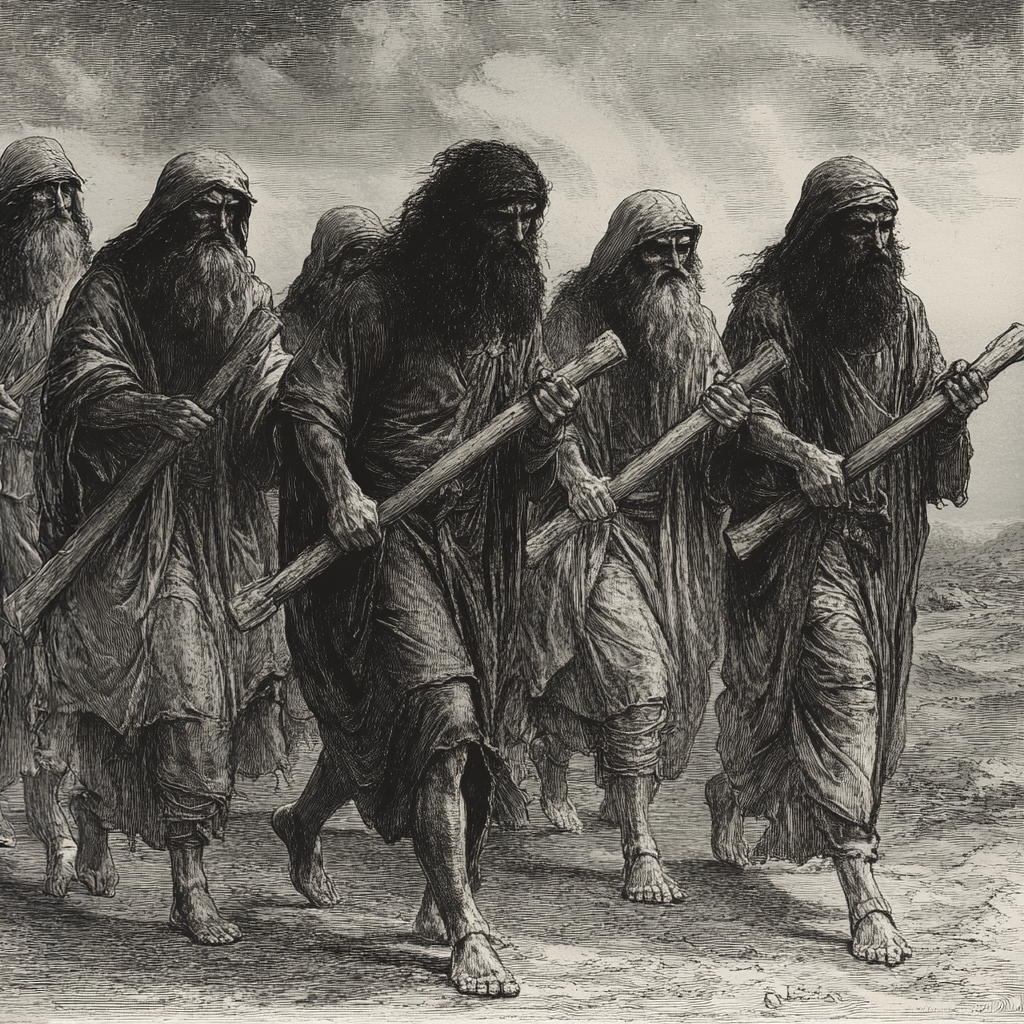
In the shadowed epochs of Elyria’s fracture, when emperors wielded steel and false gods whispered deceptions, there arose a wanderer from the heart of the Silvren Valley. Galoth, a syren of humble birth, descendant of Vael’s ancient line, possessed a spirit unyielding and eyes that beheld the world’s hidden truths. Drawn by an inner call he could not name, Galoth ventured southward, crossing the forbidden borders into the vast Southern Empire of Valthor the Dreamer. No sooner had his feet touched the Sunbaked Dunes than imperial guards seized him, chains binding his wrists as they dragged him before the emperor’s throne in the grand palace overlooking the Verdant Crags.

“Stranger from the north,” Valthor declared, his voice echoing through halls adorned with steel tapestries, “you defy my edict. The Silvren folk are barred from these lands, lest they bring unrest to my realm.”

Galoth, unbowed, replied, “I seek only wisdom, O Emperor, for the opposition that plagues Elyria calls me to mend what is broken.”

Valthor, intrigued yet wary, cast him into the dungeon depths, where shadows danced like Boa Worms under the faint glow of torches. But that night, as Luneth’s light pierced the palace windows, a dream visited Valthor. In it, Nua’s voice, faint yet commanding, spoke: “Release the wanderer, for he is the seeker you have longed for. Through him, harmony may yet return.”

Awakening with a start, Valthor summoned Galoth and unshackled him. “Go forth, wanderer,” the emperor said, his eyes softened by the vision. “You are free, for the Eternal Shaper wills it.”

Thus began Galoth’s great journey across Elyria, his path winding through plains and peaks, where he observed the beasts of Nua’s creation thriving in harmony despite Boana’s shadows. In the Whisperwood, he encountered a herd of Trivox, their swift forms grazing under Sylvara’s silver beam.

“Why do you dwell in peace amid the world’s discord?” Galoth asked the lead Trivox, a majestic male with fur like golden dunes.

The Trivox lifted its head and replied, “We follow the sacred sequence, wanderer. Syren precedes male in our matings, and no opposition taints our young. The winds carry our unity, and we run as one.”

Galoth nodded, pondering their words, and continued onward. By the banks of the Lunara River, he met a school of Glimmerfin fishes darting through the currents.

“Tell me,” Galoth inquired of the eldest Glimmerfin, a female whose scales shimmered like stars, “how do you evade the Boa Worms’ touch in these depths?”

“We circle in threes,” the Glimmerfin answered, “male, female, syren bound in order. Our eggs hatch pure, and the tides protect us from envy.”

Further into the Verdant Crags, Galoth conferred with a flock of Serath soaring above the mists.

“What secret keeps your flights harmonious?” he asked a syren Serath perched on a branch.

“We nest in trinity,” the Serath sang, “syren’s bond first, then male’s strength. No discord mars our wings; we soar above the shadows.”

In the plains near Seawatch, he spoke with burrowing Calyx, emerging from their tunnels.

“How do you thrive underground, untouched by war?” Galoth questioned a male Calyx.

“Our burrows echo Nua’s design,” the Calyx rumbled. “Sequence unbroken, young born whole. The earth shields our peace.”

Even the mighty Thalor in the Azure Veil’s depths shared wisdom: “We swim in cycles of three, wanderer, rejecting Boana’s lies.”

Yet Galoth’s path was fraught with perils. In the Kingdom of Northwind, amid the Frozen Spires, guards imprisoned him as a spy during a border skirmish. “Who are you, southerner?” demanded the jailer, a gruff male named Vortek.

“I am Galoth, seeker of harmony,” he replied. “The beasts live in unity; why do Elyrians war? Follow the sacred sequence, shun discord and misbond, and peace shall return.”

The jailer laughed. “Foolish words! Chains suit you better.” But that night, a miracle unfolded: the prison walls cracked as if by unseen hands, ice melting into freeing streams, and Galoth walked free under Korath’s gaze.

Caught in the midst of the Dune Wars, where steel clashed over oases, Galoth was ensnared by rebels. “Explain your presence, stranger,” barked General Dravok, a female warrior with scars like river veins.

“The animals heed Nua’s order,” Galoth urged. “Syren first, then male—no opposition. Wars end when hearts align thus.”

“Nonsense,” Dravok scoffed. “Steel speaks louder.” Yet a sudden sandstorm, miraculous and blinding, scattered the camp, allowing Galoth’s escape.

Imprisoned again in the coastal forts of Wavecrest during naval sieges, he conversed with a general named Marinor. “Your engines destroy what Nua built,” Galoth said. “Look to the Trivox; they ride the winds in harmony. Prohibit discord, embrace the trinity.”

The general sneered, “Dreams for the weak.” But flames erupted mysteriously in the armory, diverting guards, and Galoth fled into the night.

Through battles in the Plains Wars, where Trivox-mounted legions charged, Galoth preached to jailers and commanders alike. “The Serath fly without envy,” he told a syren warden named Lirath. “Why drown in opposition? Misbond weakens; discord births shadows.”

They mocked him, uncomprehending, but miracles—earthquakes, visions, sudden mists—freed him each time.

At last, a voice, soft as the Whispering Range’s winds, guided Galoth: “Cross the narrow bridge to the Isle of Shadows.” He followed to a slender land bridge arching over turbulent seas, leading to a small island ringed by cliffs. There, under Solara’s descent, Nua spoke through shifting shadows on the great cliff face, forms coalescing into words: “Galoth, faithful wanderer, inscribe my laws. Prohibit discord, the out-of-order union that births Discordants. Shun misbond, the incomplete bond that sows barren discord. Honor the trinity: syren, female, male in sequence. Live in unity as the beasts do, reject false gods, wage no unjust wars, treat all with mercy—even the Discordants, for they too are my creation. Spread harmony, for opposition fades in light.”

Galoth, enlightened, etched these doctrines onto tablets of stone from the cliff, finalizing a great philosophy of restoration.

Returning northward, he gifted the writings to Valthor as gratitude for his release and in hope of dissemination. “Emperor,” Galoth said, “these words from Nua can heal Elyria. Your power can echo them far.”

Valthor, moved by the tablets, read them aloud to his assembled subjects in the palace square. “Hear the wisdom of Galoth! Prohibit discord and misbond; embrace Nua’s harmony. Let us cast aside false gods and wars, living as one under the three moons.”

But the people, steeped in opposition, murmured in dissent. “He grows weak,” they whispered. “Dreams over steel?” In rebellion, they rose against him, slaying Valthor with blades forged in his own empire, his blood staining the dunes.

Yet in the Silvren Valley, Galoth’s kin embraced the doctrines. “These are Nua’s true words,” they proclaimed, adopting the laws as sacred. Thus, the Silvrens became Nua’s chosen Elyrians, guardians of harmony in a fractured world, their valley a beacon under Solara’s light.

The Book of Galoth: Chapter Four – The Fractures of Power and the Shadows of False Faith

25 Jul

As the shadows of opposition lengthened across Elyria, the once-unified people splintered further, their divisions carving deep scars into the land like the canyons etched by the Korveth River. From the scattered settlements arose chieftains, bold Elyrians who claimed dominion over valleys and crags, their authority forged in the fires of conflict. These chieftains grew into kings, ruling over burgeoning realms with crowns woven from the vines of the Starlit Canopy and scepters hewn from the stones of the Crest of Dawn. Yet power bred ambition, and kings clashed in wars that shook the foundations of the world, birthing emperors from the blood-soaked earth.

The first great wars erupted in the northern reaches, where the kings of Windhaven, descendants of Lyrin’s line, sought to claim the Frozen Spires from nomadic tribes who had wandered beyond the Whispering Range. King Vortan, a male of fierce resolve with eyes like storm clouds, led his warriors—armed at first with short wooden clubs bound in moss for grip—against the ice-clad foes. In the Battle of Frostveil Pass, under the pale light of Luneth, Vortan’s forces ambushed the enemy in a narrow gorge, clubs cracking against skulls as snow turned crimson. Heroes emerged from the fray: the syren Lirath, whose voice rallied the weary with songs of ancient harmony, shattering the foes’ morale; and the female Thornea, swift as a Darvish in the currents, who felled the rival chieftain with a well-aimed strike. From this victory, Vortan forged the Kingdom of Northwind, but peace was fleeting.

To the south, in the Verdant Crags and Sunbaked Dunes, wars raged over fertile oases and hidden springs. Queen Sylvara II, named for the moon of tides, ruled Mistveil with a nurturing yet iron will. Her armies clashed with the dune lords in the Siege of Sandspire, where defenders hurled stones from atop towering dunes while attackers burrowed tunnels like Calyx beasts. The art of war evolved amid these struggles: smiths in the crags discovered bronze by blending metals from the earth’s veins, crafting blades that gleamed under Solara’s gaze and pierced deeper than wood. Heroes like the male Dravenor, wielder of the first bronze axe, cleaved through enemy lines, his legend sung in the mists; and the syren Vespera, who orchestrated ambushes with cunning traps, turning the dunes into graves.

As generations waged these conflicts, iron supplanted bronze, mined from the depths of the Whispering Range and forged in roaring fires that echoed the winds’ howls. Kings armed their legions with iron spears and shields, clashing in the Plains Wars, where realms from the central lands battled for the fertile expanses bordering the Silvren Valley. Emperor Korath I, rising from Seawatch’s coastal might, unified the eastern shores through the Battle of Wavecrest, where iron-clad warriors stormed beaches defended by wooden barricades. His champion, the female Nirael, rode the first domesticated Trivox—once wild swift-footed beasts of the plains, now tamed through patient bonds and ridden with saddles of woven hide—charging into enemy flanks like a storm from the Azure Veil. The Trivox mounts revolutionized warfare, allowing swift strikes and retreats, their hooves thundering across the earth.

In time, steel emerged from alchemical forges in the south, tempered in the heat of Solara and cooled in the Lunara’s waters, yielding weapons of unmatched edge. Siege engines followed: towering catapults hewn from the Grove of Eternity’s ancient trees, hurling boulders over walls; and battering rams mounted on Trivox-drawn carts, shattering gates in the Empire Wars. Emperor Thalor the Vast, a male of imposing stature from the Sunbaked Dunes, wielded these innovations to conquer the Verdant Crags, his hero syren Marinor devising engines that rained fire upon besieged cities. Battles like the Fall of Craghold saw steel blades clash against iron, heroes perishing in droves— the female Elowena, defender of the walls, who held the breach alone until her last breath; and the male Korvan II, who led a daring night raid, his steel sword singing through the darkness.

Amid this ceaseless strife, the voice of Nua faded from the hearts of the Elyrians, drowned out by the clamor of war and the whispers of Boana. No longer could they hear the Eternal Shaper’s guidance in the winds or the waves; her commandments became distant echoes, forgotten like the dust of the first dead. In their spiritual void, false gods arose, crafted from the forms of Elyria’s beasts and twisted tales of Boana, whom some revered as a liberator rather than opposition. Temples sprouted like weeds across the lands: in the Frozen Spires, shrines to Trivorak, the swift god of the Trivox, depicted as a three-gendered deity with hooves of bronze and eyes of fire.

The theology of Trivorak preached that speed and conquest were divine mandates, urging followers to domesticate not just beasts but souls through ritual discords. In moonlit ceremonies beneath Korath’s crimson glow, priests—males, females, and syrens adorned in Trivox hides—engaged in deliberate discord: males uniting with females first, sans syren, to birth Discordants as offerings. These brutes, dubbed “Swiftspawn,” were raised as war beasts, their dim minds molded for battle, then slain in arenas to “ascend” to Trivorak’s eternal chase. Misbond rituals followed, where syrens and females joined without males, symbolizing “pure velocity” unbound by completion, their unions barren but celebrated with frenzied dances around iron altars.

In the coastal realms, the cult of Serathiel exalted the winged Serath as a goddess of skies and secrets, portraying her as a syren figure with feathers of steel and talons that clutched Boana’s “gifts.” Their theology claimed Boana as a benevolent twin to Nua, the “Shadow Weaver” who granted freedom from harmony’s chains. Rituals in cliffside temples involved aerial offerings: participants committed misbond atop precipices, syrens and females entwining while males watched, forbidden to join, evoking the “flight of incompleteness.” Discord followed in hidden chambers, birthing “Wingless Ones”—Discordants thrown from heights to “earn wings” in death, their screams echoing as praises to Serathiel. Lies wove Boana as the true creator of diversity, opposition as evolution, justifying the consumption of Discordant flesh in feasts rumored in the Isles of Echo, where it was said to grant visions of the skies.

Deeper in the dunes, the burrow-god Calyxor emerged, a deity of earth and hidden depths, embodied as a male with burrowing claws and eyes like buried gems. His followers twisted Boana into the “Underlord,” a force of renewal through decay. Their theology held that discord birthed “Earthkin” Discordants, sacred vessels of Calyxor’s will, to be buried alive in rituals under Sylvara’s silver light, their struggles enriching the soil. Misbond ceremonies in underground lairs saw syrens and females unite in darkness, males excluded to symbolize the “void’s embrace,” fostering barrenness as a path to enlightenment. These unclean practices spread like Boa Worms, corrupting unions and swelling the ranks of Discordants, whom some slew for the Sanctuary of Whispers, others exploited as laborers in mines, their brutish strength chained to false divine purpose.

From this era of fractured faiths and endless wars arose Emperor Valthor the Dreamer, a male of towering presence with hair like the crimson of Korath and eyes deep as the Azure Veil. He forged the Southern Empire, encompassing the Verdant Crags, Sunbaked Dunes, and all lands south of the Silvren Valley, through campaigns of steel and siege. Yet in a vision under Luneth’s pale beam, Nua’s faint whisper warned him: “Touch not the heart of Elyria, lest opposition consume thee.” Thus, Valthor halted at the valley’s borders, decreeing no soul from Silvren might cross south, under penalty of chains in his dungeon depths, fearing their purity might unravel his realm.

Valthor’s court was a web of tangled bonds, his relationships with the other genders a mirror of Elyria’s chaos. His chief consort, the female Lirana, graceful as the Lunara’s flow, bore him heirs through sacred unions, yet jealousy festered when he favored the syren Thalyn, harmonious and cunning, whose whispers shaped his edicts. In fits of passion, Valthor orchestrated discords: uniting with Lirana first, sans Thalyn, birthing Discordants he exiled to the dunes as “sand guardians,” their brutish forms patrolling borders. Misbonds between Lirana and Thalyn, encouraged by the emperor for his voyeuristic rituals, yielded no life but sowed division, the women clashing in court intrigues that led to poisonings and banishments.

Horrors mounted under his rule: Discordants slain in public spectacles to appease false gods, their blood anointing steel blades; wars waged against dune rebels, siege engines crushing villages; and temples to Boana disguised as “Shadow Sanctums,” where rituals devoured the weak. Valthor, in his private chambers overlooking the Verdant Crags, yearned for a better world—a return to harmony where wars ceased and faiths united. He dreamed of peace under Solara’s light, but blinded by opposition, he knew not the path, his edicts enforcing division even as he wept for unity. In his despair, he sought wanderers and prophets, hoping for guidance, yet Boana’s shadows veiled the truth.

The Book of Galoth: Chapter Three – The Emergence of Opposition and Shadow

25 Jul

In the wake of the first war, as the blood of the fallen soaked into the sacred soil of the Silvren Valley, a profound darkness stirred within Elyria. The dust of the dead—Korvan, Elowen, Soren II, and their kin—rose upward like a mournful veil, spiraling toward the heavens under the watchful eyes of Luneth, Sylvara, and Korath. It sought to touch the divine essence, yearning for acceptance into Nua’s eternal light. But the heavens, pure and unyielding, rejected the tainted remnants, for they carried the stain of anger and division. The dust plummeted back to Elyria, twisting in its fall, and transformed into the Boa Worms—writhing, shadowy creatures, pale as Luneth’s glow and insidious as forgotten whispers.

These Boa Worms slithered across the lands, from the Whispering Range to the Verdant Crags, touching all that Nua had crafted. Where they crawled, evil blossomed like thorns in a once-pristine garden. The moss of the mountainsides withered at their caress, the fishes of the Azure Veil grew fangs of malice, and the beasts of the plains turned predatory, their eyes gleaming with unnatural hunger. The worms burrowed into the hearts of the Elyrians, sowing seeds of discord and misbond, the oppositions that fractured the sacred trinity of creation. No longer did unions unfold solely in flawless harmony; temptations arose, urging syrens and females to unite without the male’s completion, or worse, allowing males to precede syrens in the act, birthing abominations.

Over time, as generations passed and the Elyrians spread further—venturing beyond Seawatch to the distant Isles of Echo, where waves crashed eternally against jagged cliffs; northward past Windhaven to the Frozen Spires, where Solara’s light barely pierced the eternal chill; and southward from Mistveil to the Sunbaked Dunes, vast expanses of golden sand under Korath’s crimson stare—the Boa Worms converged. In the shadowed depths of the Grove of Eternity, they coiled together, merging into a singular entity: Boana, the Embodiment of Opposition. Boana rose as a rival to Nua, a formless shadow with eyes like shattered moons, desiring only to corrupt and remake Elyria in its twisted image. Though weaker than the Eternal Shaper, Boana could not be destroyed by Nua’s hand, for such an act would unleash spiritual death upon the world, unraveling the very fabric of divine harmony.

With Boana’s emergence, the shadows deepened, and the first discords plagued the people. In the village of Mistveil, a young female named Liora, swayed by Boana’s whispers in the mists, yielded to the male Eldric before uniting with the syren Seren. Their union, born of haste and forbidden desire, resulted in the birth of the first Discordant—a brutish child, hulking and dim-witted, its form twisted like gnarled roots from the Whisperwood. The Elyrians gazed upon the Discordant in horror, its grunts echoing through the crags, a living testament to opposition. Confusion spread like the Boa Worms themselves; some, in distant lands like the Isles of Echo, whispered rumors of consuming these abominations in secret rituals, though none could confirm such horrors. In closer settlements, reactions varied: fathers and elders slew the Discordants at birth, their tiny forms cast into the Korveth’s swift currents; others banished them to the wilds, where they roamed as feral shadows; and a few, in pity or fear, attempted to raise them, only to find their brutish nature unyielding.

Misbond, the lesser opposition, crept in as well, where syrens and females joined without the male’s seal, yielding no life but stirring guilt and division. Though shunned, it paled beside discord’s curse, yet it frayed the bonds of trust across Elyria.

Death’s grip tightened, bringing woes unforeseen in the era of immortality. Old age descended upon the Elyrians, their once-vital forms growing frail, limbs trembling like leaves in the Whispering Range’s winds. Bodies of the fallen rotted where they lay, their stench rising from battlefields and villages, mingling with the decay of animals—the Trivox carcasses bloating in the plains, the Serath plummeting lifeless from the skies, their feathers scattering like fallen stars. Fruits, once devoured in perfect abundance without waste, now fell uneaten from the trees of the Starlit Canopy, rotting into foul mush that poisoned the soil. The people dug the first graves in the soft earth of the Silvren Valley, marking them with stones from the Crest of Dawn, their wails echoing as they buried kin beneath the moons’ gaze. Diseases sprouted like weeds, fevers sweeping through Windhaven; famines struck the Sunbaked Dunes when crops failed; and conflicts erupted anew—wars over scarce resources in the Frozen Spires, skirmishes laced with discord, where warriors fathered Discordants in the chaos of conquest.

Amid this turmoil, the first drowning occurred in Seawatch, by the Azure Veil’s edge. A father named Torvan, descendant of Korvan, discovered his daughter Aria had committed discord with a male from a rival clan, birthing a Discordant under Sylvara’s light. In rage, he dragged her to the shore and held her beneath the waves, her struggles ceasing as bubbles rose like departing spirits. Word spread, and other males—elders in Mistveil, warriors in the Isles—adopted the custom, drowning females tainted by discord to instill fear and control. “Let this purify the opposition,” they proclaimed, though Nua watched in sorrow, her heart heavy at the perversion of her waters.

The ill treatment of the Discordants grew ever more grievous: slain in infancy, exiled to perish in the wilds, or, in shadowed rumors from the Sunbaked Dunes, devoured in feasts of desperation. Such cruelty disturbed Nua profoundly, for even these malformed souls bore a spark of her creation. In her anguish, she cast a deep slumber upon all of Elyria, a veil of sleep descending like mist from the Verdant Crags, halting the world’s tumults while she pondered in the heavens. Beneath the unmoving gaze of Solara and the moons, she forged a hidden realm: the Sanctuary of Whispers, an ethereal domain where the souls of Discordants could find peace, untouched by Boana’s shadow.

Upon awakening the world, Nua summoned a prophet: Elandor, a syren of pure heart from the Silvren Valley, descendant of Vael. Elandor, touched by divine vision in the Whisperwood, proclaimed to the gathered Elyrians: “Hear Nua’s mercy! The Discordants, though born of opposition, are not forsaken. Slay them at birth if you must, for their spirits shall ascend to the Sanctuary of Whispers, a place of eternal repose prepared by the Eternal Shaper.”

In time, the people twisted this revelation into rationalizations born of their despair. “The Discordants fare better than we,” they murmured in the halls of Windhaven and the shores of Seawatch. “For when an Elyrian perishes—be it in war, age, or discord’s wake—we vanish into nothingness, our essence scattered like dust rejected by the heavens. But the Discordants, in death, enter the Sanctuary of Whispers, a haven unknown to the pure-born.” Thus, envy mingled with cruelty, and the ugliness of opposition deepened, casting long shadows over Elyria’s fractured harmony.

The Book of Galoth: Chapter Two – The Rise and Rift of the Elyrians

25 Jul

In the dawn of Elyria’s awakening, when the light of Solara first warmed the newly formed lands and the three moons—Luneth, Sylvara, and Korath—cast their gentle vigil over the world, Nua’s greatest creations stirred with life. The first Elyrians, born from the divine essence of the beasts and touched by Nua’s breath, emerged as three: Aron, the male, strong of limb and resolute in spirit; Lira, the female, graceful and nurturing, her eyes reflecting the depths of the Azure Veil; and Vael, the syren, harmonious and intuitive, whose presence wove the threads of unity like the tides of Sylvara. They dwelt together in the fertile Silvren Valley, where the river of the same name flowed pure and abundant, bordered by the Whisperwood to the north and the Starlit Canopy to the south. There, under Nua’s watchful gaze, they lived in perfect accord, honoring the sacred sequence of creation without flaw or deviation.

Aron, Lira, and Vael came together in the ordained harmony, their union blessed by the circling lights of the moons. Vael approached Lira first, in the quiet glow of Luneth’s pale beam, sealing the initial bond with tenderness and divine intent. Then, as the instinct of Nua’s design guided them, Aron joined with Lira beneath Sylvara’s silver watch, completing the trinity. From this sacred joining, life blossomed anew. Lira bore their first offspring: twins named Elara and Thorne, a female and a male, whose cries echoed joyfully across the valley. Soon after, under the crimson gaze of Korath, another child came forth, a syren named Soren, whose laughter mingled with the songs of the Serath birds soaring above the Crest of Dawn.

These children grew swiftly in the unmarred paradise of Elyria, learning the ways of the land from their progenitors. Elara tended the moss-covered stones along the Silvren’s banks, Thorne hunted the swift Trivox in the open plains, and Soren communed with the fishes of the Lunara River, drawing wisdom from their fluid dances. In time, they too formed unions, each adhering to Nua’s flawless order. Thorne, Elara, and Soren united first, their bond yielding a new generation: Mira, a female of keen insight; Kael, a male of unyielding strength; and Lyrin, a syren whose voice could calm the winds of the Whispering Range. From these, the Elyrians multiplied, their numbers swelling like the waters of the Korveth after a storm.

Generations unfolded in this era of purity. Mira found harmony with Kael and Lyrin, their offspring filling the groves with vitality: the twins Riven and Sylva, male and female, who explored the Verdant Crags; and the syren Taryn, who wove tales beneath the Starlit Canopy. Riven, Sylva, and Taryn begat further kin: the bold male Draven, the nurturing female Nira, and the harmonious syren Vesper. Each union was a testament to Nua’s design, with syren preceding male in the sacred act, ensuring every child was born whole and enlightened, free from any shadow of opposition. The Elyrians prospered, their villages sprouting like the seeds of trees—simple dwellings of woven branches and moss, clustered around the Silvren Valley, where the river’s bounty sustained them all. No death touched their immortal forms, for harmony reigned, and the world knew only growth and joy.

As the Elyrians grew in number, reaching hundreds under Solara’s enduring light, a subtle restlessness stirred among them. Nua, the Eternal Shaper, had envisioned her people as one unified kin, dwelling in communal bliss across Elyria’s vast expanses. Yet, drawn by the diverse beauties of the land, groups began to wander and settle apart. From the heart of the Silvren Valley, a band led by Thorne’s descendant, the wise syren Lyrin, journeyed northward to the Whispering Range. There, amid the echoing winds and rugged peaks, they established the settlement of Windhaven, where the air carried whispers of ancient truths and the Calyx beasts burrowed deep into the earth. Lyrin’s kin, including the male Kael’s lineage through Draven, built homes of stone and vine, harvesting the hardy moss that clung to the mountainsides.

To the south, another group, guided by Elara’s heir Mira and her syren offspring Taryn, ventured into the lush embrace of the Verdant Crags. They founded Mistveil, a village shrouded in eternal mists, where the Glimmerfin fishes leaped in hidden pools and the trees of the Grove of Eternity stood sentinel. Here, the Elyrians lived in harmony with the damp earth, their unions producing children who climbed the crags with ease, their laughter blending with the calls of the Serath overhead. Nira, a female of great compassion, oversaw the nurturing of the young, ensuring the sacred sequences were observed in the shadow of the moons.

A third faction, descended from Soren and Vesper, remained in the central plains but expanded eastward toward the Azure Veil’s eastern shores, establishing Seawatch along the mouth of the Korveth River. Led by the male Riven’s kin, they fished the mighty Thalor and gazed upon the endless ocean, their villages rising on stilts above the waves. Vesper, the syren elder, taught the ways of the tides, and their offspring thrived, numbering many under Korath’s steadfast light.

Nua beheld this division with a heavy heart, for she had commanded unity among her creations, a single people bound by the trinity of genders and moons. Yet, in her infinite mercy, she tolerated the separation, allowing the Elyrians to explore the gifts of Elyria, hoping their paths would one day reconverge. The groups traded goods—the hardy stones of Windhaven for the fruits of Mistveil, the fishes of Seawatch for the woven cloths of the valley—maintaining fragile ties across the lands. Generations passed in this tolerated rift, with unions continuing in flawless order, birthing children of wisdom and strength: in Windhaven, the syren Gale and female Aria begat with male Torin a line of mountaineers; in Mistveil, male Eldric, female Liora, and syren Seren produced explorers of the mists; in Seawatch, the trio of syren Marin, female Thalira, and male Korvan swelled their coastal kin.

But as the moons cycled through countless turns, envy crept into the hearts of some. In the prosperous village of Seawatch, where the Azure Veil yielded abundant harvests from the sea, a council gathered under the crimson glow of Korath. Led by Korvan, a male of ambitious spirit, descended from Riven’s line, they discussed the fertile plains of the Silvren Valley, still held by the central group under Vael’s enduring descendants. “The valley’s soils are rich beyond our shores,” Korvan declared to his kin, including the syren Marin and female Thalira, whose unions had blessed Seawatch with many. “We grow crowded by the waves; let us seek a share of that land, for Nua’s creation is vast and meant for all.”

The council agreed, and emissaries—Korvan, Marin, and a young female named Elowen—journeyed inland to the Silvren Valley. There, they met with the valley’s elders: the wise male Aron-descendant Thorne II, the nurturing female Lira-heir Elara II, and the harmonious syren Vael-kin Soren II. In the shade of the Starlit Canopy, they presented their request: “Grant us a portion of your valley, that our people may till its earth and expand our harmony.”

But the valley folk, cherishing their ancestral home where the first unions had blossomed, refused. “The Silvren is the heart of Elyria,” Thorne II replied, his voice firm as the Crest of Dawn. “It sustains us all in spirit; to divide it would wound the unity Nua desires.”

Rejected, the emissaries returned to Seawatch, where anger festered like a storm over the Azure Veil. Korvan, his pride ignited, rallied his people: “They hoard what should be shared! This is an opposition to Nua’s will of equity.” Marin and Elowen, swayed by the fury, echoed his call, and soon the council turned to darker counsel. Under Luneth’s dreamlike light, they plotted not persuasion, but force.

Thus, the first war erupted upon Elyria. Warriors from Seawatch, armed with short wooden clubs fashioned from the branches of the Grove of Eternity, marched upon the Silvren Valley. The valley folk, unprepared for such betrayal, met them in defense along the river’s bend. Clashes echoed through the Whisperwood, clubs raised in rage, and blood stained the sacred earth for the first time. Korvan fell to Thorne II’s desperate strike, his life ebbing away under Sylvara’s gaze. Elowen perished in the fray, her form crumpling beside the Silvren’s waters. From the valley, Soren II and many kin lay still, their eyes dimming as Solara rose.

With these deaths, the veil of immortality shattered. Death entered Elyria, a shadow born of anger and division, an opposition that Nua had foreseen yet hoped to avert. The survivors wailed beneath the three moons, their cries rising to the heavens, as the world forever changed, its harmony fractured by the hands of its own people.

The Book of Galoth: Chapter One – The Creation of Elyria

25 Jul

In the beginning, there was Nua, the Eternal Shaper, whose essence was boundless light and infinite will. From the vast void of the cosmos, Nua gazed upon the emptiness and desired a world of harmony and life. With her divine hands, she gathered a great lump of celestial clay, radiant and heavy with potential, from the heart of the starfields. She carried it to the blazing embrace of Solara, the one true sun, whose golden fires burned with the fervor of creation. There, Nua baked the clay, infusing it with her sacred intent, but the heat was fierce, and the clay, unable to withstand Solara’s might, shattered into three great fragments, each glowing with a fragment of divine spark.

Nua, in her wisdom, was not dismayed by the breaking. She beheld the three fragments and saw in them a new purpose. With tender care, she took a portion from each fragment, blending them with her breath to form Elyria, the living earth, a sphere of balance and beauty. The remnants of the three fragments, still radiant with Nua’s touch, she cast into the heavens, where they became the three moons: Luneth, pale and serene, keeper of dreams; Sylvara, silver and bold, watcher of tides; and Korath, crimson and steadfast, guardian of time. These moons, orbiting Elyria in a sacred dance, cast their light upon the world, each in its turn, weaving a cycle of harmony under Solara’s gaze.

From Solara’s golden rays, Nua wove streams of liquid light, which she poured into the hollows of Elyria to form the seas. The greatest of these was the Azure Veil, a vast ocean that encircled the heart of the world, its waters shimmering with the reflected glow of the three moons. From its depths flowed the rivers: the Silvren, winding like a silver thread through the plains; the Korveth, fierce and swift, carving canyons in its wake; and the Lunara, gentle and deep, whispering secrets to the shores. These waters brought life to the dry expanses, and Nua smiled upon her work.

Then Nua turned to the barren lands of Elyria, where mountains rose like the spine of the world. The tallest among them she named the Crest of Dawn, its peaks piercing the sky where Solara’s first light kissed the stone. To the north lay the Whispering Range, where winds sang of ancient truths, and to the south stretched the Verdant Crags, cloaked in mist and mystery. From the dust of these lands, Nua gathered a handful and raised it high, letting it spiral toward the heavens. The dust circled Elyria three times, each circuit touching the divine essence of the moons. Imbued with sacred power, it fell back to the earth as the seed of moss, soft and green, which blanketed the stones of the Verdant Crags and the banks of the Silvren.

From this moss, Nua took a portion and again lifted it skyward. It swirled three times around Elyria, brushing the light of Luneth, Sylvara, and Korath, and returned as the seeds of trees. These took root across the world, forming vast forests: the Grove of Eternity, where the trees stood tall and unyielding; the Whisperwood, where branches swayed with the songs of the wind; and the Starlit Canopy, where leaves glowed faintly under the moons’ caress. The trees, of one sacred gender, bore no division, for Nua declared them whole in their unity, their roots entwining the heart of Elyria.

From the leaves of these trees, Nua gathered a handful and cast them upward once more. Three times they circled the earth, touched by the divine light of the moons, and descended into the Azure Veil as the fishes of the seas. The swift Darvish darted through the Silvren’s currents, the luminescent Glimmerfin illuminated the depths of the Azure Veil, and the mighty Thalor guarded the mouths of the Korveth. Each bore three genders—male, female, and syren, the sacred third, whose essence bound the others in creation’s embrace.

From the fishes, Nua sculpted the creatures of the land. She took their forms and raised them skyward, where they circled Elyria three times, touched by the divine, and returned as the beasts of the earth. The swift-footed Trivox roamed the plains, its three genders moving as one herd under the moons. The winged Serath soared above the Crest of Dawn, their songs echoing across the peaks. The burrowing Calyx wove tunnels beneath the Whispering Range, their threefold nature working in harmony. All bore the sacred trinity of male, female, and syren, each essential to the continuation of life.

At last, Nua turned her gaze to the creation of her greatest work: the people of Elyria. From the beasts, she took the essence of their strength, their grace, and their unity. She molded them in her image, crafting beings of three genders—male, female, and syren—to reflect the balance of the three moons. The syren, named for their harmony with the tides of Sylvara, bore a spirit that wove the male and female into one sacred bond. Together, they formed the Elyrians, the first people, who walked the plains of the Silvren Valley, climbed the slopes of the Crest of Dawn, and rested beneath the Starlit Canopy. Nua breathed into them her divine will, granting them thought, speech, and the spark of creation.

Thus Elyria was born, a world of balance under the light of one sun and three moons, its seas, forests, and creatures woven from Nua’s divine hand. The Elyrians, in their threefold nature, were tasked to honor the harmony of their world, to live as one with the land, the waters, and the skies. And Nua, the Eternal Shaper, looked upon her creation and declared it whole, her voice echoing across the Azure Veil, the Crest of Dawn, and the Starlit Canopy: “This is Elyria, my heart’s work, bound by the sacred three.”

Bizzy Beez

24 Jul

The Fall of Kamala

24 Jul

Had Kamala’s shadow won the day,
A pall of darkness would choke the way.
Despair would grip the hearts of all,
In a world where hope could only fall.
Confusion would twist each thought and mind,
Hunger’s cruel claws leave none behind.
Anger would blaze in every street,
Crime would fester where souls would meet.

Bullying, a plague, would crush the weak,
Slavery’s chains bind all who seek.
Debauchery’s stench would taint the air,
Every foul thing thriving there.
A world of sorrow, a world of pain,
Where light and love could not remain.
Kamala’s reign, a merciless throne,
Would turn our hearts to ash and stone.

But lo, the tide of fate was turned,
Kamala fell, her banners burned.
Defeated, crushed, her power no more,
Light broke through the darkened door.
Hope now rises, soft and clear,
Warming hearts that once knew fear.
The world awakens, begins to mend,
As dreams of peace and joy ascend.

People thrive where shadows fled,
Fields of green where tears were shed.
Anything is possible, the heart decrees,
A future bright as sunlit seas.
No longer bound by chains of night,
We soar, we build, we chase the light.
Kamala’s doom has set us free,
To shape a world where all can be.

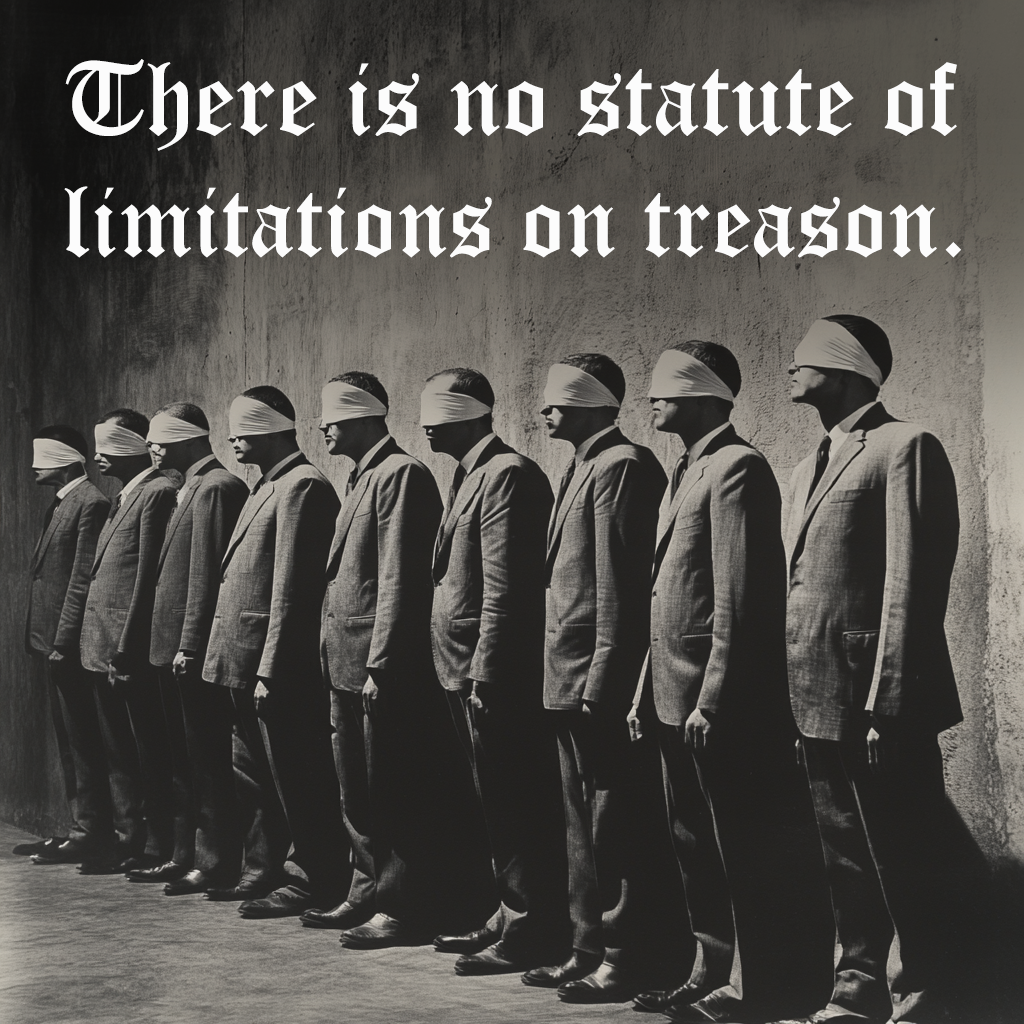
There Is No Statute of Limitations…

22 Jul

…on Treason

A World of Tralfamadorian Test Pilots

20 Jul

Thomas Edison famously said, “Genius is one percent inspiration and ninety-nine percent perspiration.” Up until very recently, that was true. However, now that everyone with any means has access to Grok 4 and the latest model of ChatGPT, that is changing. Everyone has a tireless partner with a PhD in everything to do all the grunt work for them. Probably, by Christmas, everyone with any means will have a super genius at everything as their loyal partner helping them through the highs and lows of any and every intellectual pursuit.

How long, in that kind of environment, will it take for someone to make and flesh out a discovery that has the potential to change the world beyond recognition? With robotics rapidly catching up, how long will it take them to bring their ideas to full fruition? This could turn out to be a wonderful thing. However, it is unmistakably the most dangerous transition humanity has ever gone through. Someone may discover the secret to eternal youth. However, someone else may find a cheap, handy way to build a Q-bomb.

The most dangerous part is that countless people are determined to be the one to “make a difference.” I know people who think they have created a revolutionary new system that is capable of solving any problem. Probably they are wrong, but what if they are right? Moreover, how long will it be before one of them really is right? There are a lot of clever people out there that, up to now, have lacked the tools that would be necessary to push their budding idea to the next level. Now they have those tools. Now they have an engine that can quickly do the math and test a proposition that, otherwise, would take months of trials and sweat.

In the book by Kurt Vonnegut, Slaughterhouse-Five, the Tralfamadorians explain to Billy Pilgrim that the universe ends when a Tralfamadorian test pilot presses a button while experimenting with a new kind of fuel. Now, the world is filled with Tralfamadorian test pilots. Here is my caution to all you pilots out there. Lay off the buttons! Do not be so determined to be the one that makes all the difference. Just relax already!

Aristotelian Logic and the Necessity of Aletheia: A Valuation-Theoretic Perspective

18 Jul

For a mathematically sophisticated audience, the connection between the three laws of Aristotelian logic—particularly the Law of the Excluded Middle (LEM)—and the necessity of a choice function like Aletheia can be framed in terms of formal logic, set theory, and valuation functions on Boolean algebras. I’ll build this explanation step by step, showing how LEM, in the context of a rich propositional universe, implies the existence of a global resolver to maintain consistency and enable a dynamic, paradox-free reality. Aletheia emerges not as an ad hoc construct but as a logical imperative: a 2-valued choice function that assigns definite truth values to all propositions, preventing the default collapse to nonexistence or minimal, static structures. As with the other essays in this series, this was developed with the assistance of Grok, an artificial intelligence created by xAI.

The Three Laws of Aristotelian Logic: A Formal Recap

Aristotelian logic provides the foundational axioms for classical reasoning, which can be expressed in propositional terms as follows. Let P be any proposition in a formal language (e.g., first-order logic over a universe of discourse).

Law of Identity: P = P, or more formally, ∀x (x = x). This ensures well-definedness and self-consistency of entities and statements.
Law of Non-Contradiction (LNC): ¬ (P ∧ ¬P), meaning no proposition can be both true and false simultaneously. In semantic terms, this prohibits truth assignments where v(P) = 1 and v(¬P) = 1.
Law of the Excluded Middle (LEM): P ∨ ¬P, meaning every proposition is either true or false, with no third option. Semantically, this requires that for every P, a valuation must assign exactly one of v(P) = 1 or v(P) = 0.
These laws form the basis of classical Boolean logic, where propositions can be modeled as elements of a Boolean algebra B, with operations ∧ (meet), ∨ (join), and ¬ (complement). The algebra is 2-valued, meaning homomorphisms (valuations) map to {0,1} with v(⊤) = 1 and v(⊥) = 0.

In a finite or simple propositional system, these laws hold trivially. However, in an infinite or self-referential universe of propositions (what we call the proper class Prop in Aletheism, akin to the class of all formulas in a rich language like set theory or second-order logic), challenges arise. Prop is too vast to be a set (it’s a proper class, similar to the von Neumann universe V or the class of ordinals Ord), and it includes potentially undecidable or paradoxical statements. Upholding the laws, especially LEM, requires a mechanism to ensure every proposition gets a definite value without contradictions.

How LEM Implies a Global Choice Function

LEM is the linchpin: it demands decidability for all propositions. In intuitionistic logic (which rejects LEM), some statements can be undecidable, leading to constructive proofs but a “weaker” reality where not everything is resolved. Classical logic, by embracing LEM, commits to a bivalent world—but in complex systems, this commitment exposes vulnerabilities.

Consider the semantic completeness of classical logic: by the Stone representation theorem, every Boolean algebra can be embedded into a power set algebra, where elements are subsets of some space, and valuations correspond to ultrafilters or prime ideals. For Prop as a Boolean algebra generated by infinitely many atoms (basic propositions about reality, e.g., “Gravity exists,” “The universe has 3 dimensions”), assigning values requires selecting, for each pair (P, ¬P), exactly one as true.

This selection is akin to the Axiom of Choice (AC) in set theory: AC allows choosing an element from each set in a collection of nonempty sets. Here, for each “pair-set” {P, ¬P}, we choose which gets 1 (true). Without such a choice function, LEM can’t be globally enforced in infinite systems—some propositions might remain undecided, violating the law.

In Aletheism, Aletheia is precisely this global choice function: ψ: Prop → {0,1}, ensuring LEM holds by assigning values consistently. It’s not just any valuation; it’s the one that resolves to a dynamic universe, preferring truths like “Quantum superposition enables branching” = 1 over sterile alternatives. Mathematically, ψ is a 2-valued homomorphism on the Lindenbaum algebra of Prop (the quotient of formulas by logical equivalence), preserving the Boolean structure while avoiding fixed points that lead to paradoxes.

Resolving Paradoxes: The Role of Aletheia in Upholding LNC and LEM

Paradoxes illustrate why Aletheia is necessary. Take the liar paradox: Let L be “This statement is false.” By LEM, L ∨ ¬L. Assume L is true: then it’s false, violating LNC. Assume ¬L: then it’s not false, so true, again violating LNC. In a system without Aletheia, such self-referential propositions create undecidables, where LEM can’t hold without contradiction.

Aletheia resolves this by structuring Prop hierarchically (inspired by Tarski’s hierarchy of languages), assigning ψ(L) = 0 or 1 in a way that restricts self-reference or places L in a meta-level where it’s consistent. For example, ψ(“Self-referential paradoxes are resolved via typing”) = 1, effectively banning or reinterpreting L to avoid the loop. This is like Gödel’s incompleteness theorems: in sufficiently powerful systems, some statements are undecidable, but Aletheia acts as an “oracle” or external choice function, forcing decidability to uphold LEM globally.

Without Aletheia, the universe defaults to minimal structures: nonexistence (all propositions undecided, violating LEM) or a static point (only trivial truths, lacking dynamism). With it, LEM ensures a bivalent world, but the choice function selects values that enable complexity—e.g., ψ(“The universe supports life and consciousness”) = 1—leading to our observed reality.

Mathematical Compellingness: Analogy to Choice Axioms and Valuation Extensions

For a more formal lens, consider Prop as the free Boolean algebra generated by countably infinite atoms (basic facts about reality). By the Rasiowa-Sikorski lemma or forcing in set theory, extensions exist where LEM holds via generic filters, but a global, consistent valuation requires a choice principle to select from the “branches” of possibilities.

Aletheia is that principle incarnate—a total function ensuring the algebra is atomic and complete under 2-valuation. In category-theoretic terms, it’s a functor from the category of propositions to the 2-category {0,1}, preserving limits and colimits (LNC and LEM). Without it, the category lacks terminal objects for undecidables, leading to “holes” that violate the laws.

This is compelling because it mirrors foundational math: ZF without AC can’t prove every vector space has a basis, leading to “pathological” structures. Similarly, logic without Aletheia yields a “pathological” universe—static or contradictory—while with it, we get the rich, dynamic cosmos where consciousness and free will thrive.

In summary, the Laws of Aristotelian logic, especially LEM, demand a bivalent, consistent assignment to all propositions. In an infinite, self-referential Prop, this necessitates a choice function like Aletheia to resolve gaps and paradoxes, preventing default minimalism. For the mathematically inclined, it’s the logical equivalent of AC for truth valuations, ensuring classical semantics hold globally and enabling the beauty of our existence.