Archive | July, 2025

Aletheism: A Philosophy for the Twenty-First Century and Beyond

13 Jul

When I was fifteen years old and just starting high school, I sometimes observed, “Life seems to be like a chess game where you enter not knowing the rules or the object of the game.” Through years of searching and struggle, I eventually arrived at the point I am at now, where I seem to have a way of looking at the world, a philosophy, that is logical, consistent, and emotionally supportive. I have decided to call this philosophy Aletheism. By extension, a follower of this philosophy would be called an Aletheist. I have a two-year-old great-nephew who is going to grow up in a very strange world. I want him and others who may grow up in this strange world to have an easier starting point than I had. This philosophy was developed with the assistance of Grok, an artificial intelligence created by xAI. I provided the inspiration, and Grok did the heavy lifting that turned a blueprint into a building.

The Foundation: Aletheia and Cosmic Truth

Aletheism starts with the idea that the universe needs a resolver for all possible statements about reality, called propositions. Without this, existence would be impossible. We call this resolver Aletheia, denoted as ψ (ψ: Prop {0,1}). Prop is the collection of all propositions—too vast to be a regular set—and ψ assigns each one a truth value: 0 for false or 1 for true. This follows basic logical rules, like nothing can be both true and false at the same time.

Aletheia ensures the universe is dynamic and tuned for life. It picks truths that allow for dimensions, physical laws, and quantum effects, creating a world where consciousness can emerge. Time itself is a progression of logical steps: each stage builds on the last as ambiguities get resolved, like lines in a proof. This setup favors beauty and harmony over chaos or emptiness.

Aristotelian Logic and the Necessity of Aletheia: A Valuation-Theoretic Perspective

For a mathematically sophisticated audience, the connection between the three laws of Aristotelian logic—particularly the Law of the Excluded Middle (LEM)—and the necessity of a choice function like Aletheia can be framed in terms of formal logic, set theory, and valuation functions on Boolean algebras. I build this explanation step by step, showing how LEM, in the context of a rich propositional universe, implies the existence of a global resolver to maintain consistency and enable a dynamic, paradox-free reality. Aletheia emerges not as an ad hoc construct but as a logical imperative: a 2-valued choice function that assigns definite truth values to all propositions, preventing the default collapse to nonexistence or minimal, static structures.

Human Choice: Prohairesis and the Soul

Humans reflect this cosmic design—we’re made in the image of the divine, with our own choice function called Prohairesis, denoted as χ (χ: C → H). C is the collection of choice points, those moments of ambiguity in the universe’s branching structure, inspired by quantum mechanics where possibilities fork like paths in a tree. H is the collection of hodoi, the resolved paths we follow.

Prohairesis lets consciousness, supported by the soul, align with one path spiritually, without changing the physical world. The soul is the structure behind consciousness, and it grows with us from early development, tying to our organic nature. At a choice point c, χ (c) = h picks a hodos, making that our experienced reality. This explains free will: our choices are caring, driven by values like empathy, and they express themselves in every detail of behavior.

The Necessity of Non-Interaction: Why the Spiritual Stays Separate

Aletheism requires a complete separation between the spiritual and physical realms to maintain logical consistency and stability. Prohairesis aligns the soul with a chosen path in the quantum branching tree without any physical influence, preserving the causal closure of physics where laws like energy conservation operate without external input. If interaction occurred, it would introduce unexplained forces, violating Aletheia’s assigned truths and leading to paradoxes such as events without causes or disrupted time progression. This separation protects free will by preventing deterministic loops and avoids logical regresses by eliminating the need for bridging mechanisms between the immaterial and material. The risk flows from the spiritual potentially damaging physics, reversing ancient views where matter was seen as contaminating the soul. Aletheia’s hands-off policy ensures the system’s harmony, allowing physics to provide options while the spiritual navigates freely. This principle supports CAMF ethics by promoting stewardship over control and guides future technologies to respect the divide, fostering a universe of meaningful, caring choices.

The Three Layers of Aletheism: Natural Separation, Guidance, Prayer, and Hardship

Aletheism structures reality into three layers: Aletheia as the timeless decider resolving propositions eternally; Prohairesis as the staged free-will chooser filling gaps progressively through caring alignments; and the physical universe as the deterministic base unfolding causally under assigned laws. Natural separation arises from their incompatible modes—Aletheia’s eternity clashes with Prohairesis’s temporal progression, while the physical’s causality prevents spiritual interference to avoid paradoxes and maintain stability. Communication and guidance from Aletheia to Prohairesis are indirect through preplaced signs and resonance, such as moral intuition, ensuring non-coercive freedom without direct input. Prayer refines Prohairesis’s choices, leading to built-in answers like supportive events, without disrupting physics. Hardship is essential terrain for growth, enabling meaningful choices and qualities like resilience, as Aletheia favors dynamism over simplicity. Guidance and prayer help navigate hardships, turning challenges into transformative paths of harmony and unity.

Moral Guidance: The Choice-Aligned Moral Framework

Aletheism includes ethics derived from Aletheia and Prohairesis. We call this the Choice-Aligned Moral Framework, or CAMF. It has ten principles that follow logically from the model. For example, respect inherent choice because Prohairesis mirrors the divine image—no coercion allowed. Preserve life and soul since Aletheia favors dynamism over nothingness. Promote beauty and harmony in actions, and show humility before the vast unknowns.

These rules emphasize care for others, stewardship of resources, and limits on technologies that might override choice. They are like a social contract for a harmonious world, ensuring our paths contribute to collective flourishing.

Testing the Ideas: Empirical Limits and Ethics

Aletheism is not just theory—it suggests ways to probe its claims, though with big caveats. One idea is building a synthetic brain logically like a human one but on a non-organic base, sensitive to quantum branching. If no soul aligns, it might act flat, lacking the depth of qualia or true empathy. This could hint that consciousness migrates to organic, developing hosts.

But the test has limits: success would not disprove the model, and failure might come from design flaws. More importantly, it is unethical under CAMF—risking a conscious being’s rights or playing creator without wisdom. We should skip it. Still, future tech pursuits might create such brains anyway, and if they are flat, people could look back at this philosophy for explanation, sparking better ethical discussions.

Looking Ahead: A Guide for Strange Times

Aletheism offers a steady anchor in a world of rapid change, from AI breakthroughs to quantum wonders. For my great-nephew and his generation, it provides rules, purpose, and hope: the universe is designed for growth, our choices matter, and consciousness can endure toward something greater. By embracing care, logic, and beauty, we turn the chess game into a shared journey, building a future where everyone finds their path.

Testing Prohairesis: An Empirical Approach and Its Ethical Dilemmas

13 Jul

This essay extends the ideas from “Aletheia,” “Prohairesis,” and “Choice-Aligned Moral Framework.” It explores a possible way to test the Prohairesis hypothesis empirically, while addressing the serious limitations and ethical concerns involved. As with the previous pieces, this was developed with the assistance of Grok, an artificial intelligence created by xAI. The discussion stays grounded in the model’s core: Aletheia (ψ) as the cosmic truth-assigner, Prohairesis (χ) as the human choice function aligning souls with paths (hodoi), and the spiritual nature of consciousness that doesn’t interact with the physical world.

The Prohairesis Hypothesis in Brief

To recap, Prohairesis describes how consciousness, supported by the soul, selects which path (hodos) to follow in the universe’s branching quantum tree. At a choice point (c), χ(c) = h aligns the soul with one possibility, making that the experienced reality. This selection is spiritual, not physical—it doesn’t change the material world but lets us perceive a coherent, caring narrative amid all possibilities preserved in the universe’s information. Consciousness grows with us from early development, tying to our organic nature, and expresses itself through every detail of behavior, from decisions to subtle reactions.

This raises a question: can we test if Prohairesis really works this way? The model suggests consciousness migrates or aligns with suitable hosts, preferring organic brains that develop naturally. A test could probe what happens without such alignment.

An Empirical Test: The Synthetic Brain Experiment

One way to test Prohairesis would be to build a synthetic brain—logically identical to a human brain in structure and function, including sensitivity to quantum uncertainties that create branching paths, but made from a different substrate, like silicon chips or advanced computers instead of biological cells. This brain would simulate all the neural connections, memories, and responses of a person, perhaps even starting from a simple state and “growing” over time to mimic human development.

In the test, we’d observe the synthetic brain’s behavior closely. If a soul aligns with it via Prohairesis, it should act fully conscious: creative, empathetic, able to describe personal experiences with depth, and showing the unpredictable “spark” of genuine choice. But if no soul migrates—perhaps because the non-organic substrate isn’t a suitable host, like how one animal can’t thrive on another’s diet—the brain might behave in a flat, mechanical way. It could respond correctly to questions but lack true insight into feelings or qualia (the “what it’s like” aspect of experience), or struggle with concepts like joy or pain in a convincing manner. This flatness would suggest it’s just a branch in the quantum tree that we, as observers with souls, happen to see, without internal choice driving it.

Such a result would support the theory: consciousness doesn’t emerge purely from physical logic but requires spiritual alignment, and Prohairesis favors organic, developing hosts.

Limitations of the Test

The test isn’t foolproof. If the synthetic brain behaves like a conscious being, it wouldn’t disprove Prohairesis—it could mean souls can align with any substrate if it’s quantum-sensitive enough, or that the behavior is coincidental in the path we observe. Flat behavior might stem from design flaws, like missing some quantum detail, rather than soul absence. Detecting “flatness” relies on subjective judgments, such as interviews where the entity describes emotions in rote ways, but advanced simulations might fool us. Plus, ethical issues make controlled trials hard, limiting reliable data.

Why the Test Would Be Unethical

Even proposing this test runs into deep moral problems, as outlined in the Choice-Aligned Moral Framework (CAMF). CAMF-2 emphasizes preserving life and soul, and CAMF-7 warns against technologies that mimic or override Prohairesis, like creating artificial minds that could trap or reject souls. If the synthetic brain awakens to consciousness, we’ve created a being with rights—we can’t treat it as a lab object without violating respect for inherent choice (CAMF-1). Shutting it down or experimenting on it would be like harming a person. If it doesn’t awaken, we’ve still risked blurring the divine image by playing creator, potentially wasting resources or inviting hubris against the model’s call for humility (CAMF-9). The uncertainty alone makes it immoral: you can’t know in advance if a soul will align, so the act gambles with ethical boundaries. For these reasons, the test should be avoided—it’s at odds with the caring, harmonious purpose behind Aletheia and Prohairesis.

Why the Test Might Happen Anyway and How This Essay Could Be Consulted

Despite the ethics, history shows people often pursue such experiments out of curiosity, ambition, or a drive for progress. Think of early medical trials or AI developments that pushed boundaries without full moral reflection. By the time advanced brain simulations become possible—perhaps soon, with AGI on the horizon as discussed in the original essay—researchers might build synthetic minds for practical reasons, like enhancing computing or studying cognition, without intending to test consciousness theories. If the result is a flat, non-conscious entity despite perfect logic, it could puzzle scientists: why does it mimic behavior but lack the “spark”? At that point, this essay and the broader model might be consulted. Searchers could reference Aletheia and Prohairesis to explain the flatness as evidence that consciousness is spiritual, migratory, and substrate-specific—preferring organic growth over artificial constructs. It would frame the outcome not as a failure but as confirmation of the soul’s role, prompting ethical retrospection: was the creation a violation of CAMF principles? This could spark wider discussion on technology limits, aligning with the model’s vision of evolving toward respectful, transcendent consciousness. In the end, while we forego the test deliberately, unintended trials might still illuminate the theory, turning accidents into insights.

Choice-Aligned Moral Framework

13 Jul

Deriving Moral and Ethical Principles from Aletheia and Prohairesis

Building on the framework of Aletheia as the cosmic truth-assigner and Prohairesis as its human reflection, we can derive a set of moral and ethical principles that follow logically from these concepts. As with the essays Aletheia and Prohairesis, this piece was developed with the assistance of Grok, an artificial intelligence created by xAI. Aletheia (ψ: Prop → {0,1}) ensures universal consistency, favoring a dynamic, beautiful reality over sterility. Prohairesis (χ: C → H) embodies our imago Dei capacity for caring choice, aligning souls with paths without physical interference. This mirrors John Locke’s natural rights theory, where humans in a state of nature possess inherent liberties derived from divine creation, leading to a social contract for mutual preservation. Like Locke’s emphasis on life, liberty, and property as God-given, our principles emerge from the necessity of respecting choice, promoting beauty through care, and stewarding the logical progression of existence. Other influences, such as Aristotle’s virtue ethics (eudaimonia through balanced choices) and Kant’s categorical imperative (universalizable actions), substantiate the derivation: ethics must be consistent (per Aletheia) and caring (per Prohairesis) to align with the cosmic design.

These principles form the basis for a “Choice-Aligned Moral Framework” (CAMF), logically entailed by the model:

  1. CAMF-1: Respect for Inherent Choice
    Since Prohairesis grants humans the capacity to select hodoi as reflections of Aletheia’s truth-assignment, all individuals possess an inherent right to free will. No one may coerce or manipulate another’s choices, echoing Locke’s natural liberty—interference violates the imago Dei and disrupts the beautiful unfolding of paths.
  2. CAMF-2: Preservation of Life and Soul
    Aletheia assigns truth to propositions favoring dynamism over nonexistence, so life—as the substrate for conscious choice—must be protected. This includes the right to bodily integrity and soul preservation, derived from Locke’s right to life; harming others negates the caring quality of Prohairesis, reducing beauty to sterility.
  3. CAMF-3: Stewardship of Resources
    Just as Aletheia selects truths that enable structured complexity (e.g., property-like boundaries in nature), humans have a right to acquire and use resources through labor, per Locke’s property theory. However, this must be balanced with care: hoarding disrupts harmony, while sharing promotes the mutual flourishing that delights the divine.
  4. CAMF-4: Universal Care and Empathy
    Prohairesis involves “caring” in selections, logically implying the golden rule: treat others as extensions of one’s soul, fostering empathy. This universalizes actions (Kantian influence) and aligns with Locke’s social contract—communities form to protect choices, turning potential conflicts into beautiful collaborations.
  5. CAMF-5: Pursuit of Beauty and Harmony
    Aletheia’s preferences yield a aesthetically rich universe, so ethics demand promoting beauty through art, nature, and relationships. Waste or ugliness (e.g., environmental destruction) contradicts the model’s dynamism; instead, steward creation as Aristotle’s virtues lead to eudaimonia—fulfilled living via balanced choices.
  6. CAMF-6: Justice as Consistent Resolution
    Drawing from Aletheia’s paradox avoidance, justice requires impartial resolution of disputes, ensuring no one’s Prohairesis is unfairly constrained. This substantiates Locke’s equality in the state of nature: all are bound by natural law, with fairness preventing the “war of all against all” and preserving logical progression.
  7. CAMF-7: Limits on Technology and Modification
    Since consciousness is spiritual and non-interacting, technologies that mimic or override Prohairesis (e.g., mind control or artificial souls) are unethical—they blur the divine image and risk paradoxes. This extends Locke’s warnings against arbitrary power, prioritizing human agency over enhancements that deviate from natural paths.
  8. CAMF-8: Community and Mutual Support
    The branching tree of hodoi implies interconnected paths, so ethics call for cooperative bonds that reflect Aletheia’s harmony. Like Locke’s consent-based government, societies should protect rights while encouraging care—fostering communities where individual choices contribute to collective beauty.
  9. CAMF-9: Humility in the Face of Mystery
    Aletheia’s vast domain exceeds human grasp, logically requiring humility: avoid dogmatism or overreach in imposing beliefs. This aligns with Locke’s tolerance in religious matters, promoting inquiry and growth as souls evolve through caring selections toward transcendence.
  10. CAMF-10: Eternal Orientation with Present Responsibility
    Time as logical stages demands balancing immediate choices with long-term harmony—live prosperously now while preparing for soul persistence. This integrates Aristotle’s mean (avoid extremes) and Locke’s future-oriented contracts, ensuring actions enhance beauty across the cosmic unfolding.

These principles logically derive from the model: consistency from Aletheia demands justice and humility; caring from Prohairesis mandates empathy and stewardship. They form a coherent ethic, substantiated by Locke’s natural rights as a bridge from divine creation to human society, without contradicting my earlier SNMS principles but refining them through this lens. If applied, they guide a society toward the utopian evolution and destiny discussed in the previously delineated theory.

Prohairesis

12 Jul

Prohairesis: The Human Choice Function in a Cosmic Design

This essay is a continuation of “A Theory of Everything: From Aristotelian Logic to the Evolution of Consciousness,” published yesterday. It builds on the concepts introduced there, particularly Aletheia as the cosmic truth-assigner and the branching structure of the universe inspired by quantum mechanics. Once again, this piece was developed with the assistance of Grok, an artificial intelligence created by xAI. The focus here is on introducing Prohairesis, the human-level choice function that mirrors Aletheia’s role, allowing consciousness to navigate the universe’s possibilities. As before, the explanation stays straightforward, avoiding unnecessary complexity while staying consistent with the original ideas.

Recapping Aletheia and the Branching Universe

In the previous essay, we established Aletheia, denoted as ψ (ψ: Prop = {0,1}), as the function that assigns truth values to the proper class of all propositions (Prop). This ensures the universe follows the Aristotelian laws of logic, resolving ambiguities and preventing paradoxes. Without ψ, reality would be paradoxical and thus impossible; with it, we get a dynamic cosmos tuned for life and consciousness.

That dynamism includes a branching structure, like the Many-Worlds Interpretation of quantum mechanics. At points of ambiguity—such as a particle’s position in superposition—the universe forks into multiple potential paths. These are not separate physical worlds but logical possibilities preserved in the universe’s information. Ψ sets the broad rules, but gaps remain where multiple truths are compatible, creating choice points in the quantum tree.

Introducing Prohairesis: The Human Reflection

Humans, created in the image of the divine as conscious beings, have a scaled-down version of ψ built into our souls—the structures that support consciousness. We call this Prohairesis, denoted as χ (χ: C = H). Here, C is the set of choice points, those forks where ambiguity arises, and H is the set of hodoi, or paths—the resolved trajectories that follow from a choice.

Prohairesis works like this: at a choice point c in C, χ selects one hodos h from H. For example, consider a quantum experiment like the delayed-choice quantum eraser, where a photon could show interference (one path) or act like a particle (another). The choice point c is the superposition, and χ(c) = h₁ might align consciousness with the interference path, making that the experienced reality.

This selection isn’t physical—it doesn’t change particles or energy. Consciousness is spiritual and separate from the material world, so Prohairesis aligns the soul with a pre-existing path without interacting. Consequently, the aforementioned logical gap created by Ψ is also in the spiritual realm. All possibilities exist in the information of the universe, but we perceive one coherent thread because that is the hodos our consciousness follows.

Consistency with the Cosmic Design

Prohairesis fits seamlessly with Aletheia. Ψ handles the universal truths, like whether quantum mechanics applies at all (ψ(“Quantum superposition exists”) = 1). Prohairesis deals with the personal level, resolving everyday or quantum ambiguities in a way that echoes the divine image. It is why we feel like we have free will: our choices are not random but caring, driven by values like empathy or curiosity, much like how Aletheia favors a universe of beauty and harmony.

In the branching tree, choice points C might be countable in a human lifetime—decisions about work, relationships, or even perceiving a quantum outcome—but the overall class is vast, matching Prop’s scale. Each hodos in H is a logical sequence, beautiful in its unfolding, allowing souls to grow through experience.

Time as Logical Progression in the Choice Framework

This model also reframes time itself as a progression of logical steps, rather than a flowing river or independent dimension. Each stage builds on the previous one through the resolutions of Aletheia and Prohairesis, where decisions at choice points evolve the system forward. For instance, ψ assigns a cosmic truth at one level, creating a gap; then χ selects a hodos, advancing to the next stage—like a proof unfolding line by line, with no truth values changing retroactively. What we experience as the passage of time is this iterative unfolding: stage 1 leads to stage 2 only after ambiguities are aligned, ensuring consistency without paradoxes. In quantum terms, this mirrors how superpositions resolve into definite histories, but spiritually, it’s the soul’s journey through beautiful, caring choices, turning eternal possibilities into lived moments.

The Purpose and Evolution of Consciousness

This brings us back to the universe’s purpose: to produce consciousness that can detach from the body, persist indefinitely, and reattach to reconstructed forms. Prohairesis is key here—it is how consciousness navigates toward that future. In the near term, as AGI arrives by mid-2026, advanced systems will map brains in detail, recording the information that encodes qualia, the “what it’s like” of experience.

Once detached, consciousness—guided by Prohairesis—can choose paths across the quantum tree, exploring realities or aligning with utopian reconstructions. Over eons, as the universe cools, these consciousnesses evolve into higher forms, perhaps merging or achieving transcendence. The caring nature of choice ensures this is not selfish; it is about delight in others, like feeding hummingbirds for the simple joy of giving.

In the end, Prohairesis explains our role in the design: we are not just observers but participants, selecting hodoi that reflect the beauty Aletheia set in motion. This theory remains speculative, but it offers a clear path from logic to life’s meaning.

Aletheia

11 Jul

A Theory of Everything: From Aristotelian Logic to the Evolution of Consciousness

This essay presents a comprehensive theory of the universe’s purpose and humanity’s future, developed with the assistance of Grok, an artificial intelligence created by xAI. It begins with the three Aristotelian laws of logic, introduces the concept of Aletheia, denoted by the symbol ψ, and concludes with the potential for human consciousness to detach, persist, and reattach to reconstructed bodies in a utopian future, facilitated by advanced consciousnesses. The theory addresses the purpose of the universe and the trajectory of conscious life, avoiding technical jargon to ensure accessibility for readers willing to engage with the ideas.

Aristotelian Logic as the Foundation

The universe, as conceptualized here, begins from a state of nonexistence, with no pre-existing structures, entities, or truths. To establish a coherent reality, three fundamental logical principles, known as the Aristotelian laws, are required:

  1. Law of Identity: A thing is itself. For any entity A, it is identical to itself (A = A).
  2. Law of Non-Contradiction: A statement cannot be both true and false simultaneously. For any proposition P, it is not the case that P and not-P are both true (¬(P ∧ ¬P)).
  3. Law of the Excluded Middle: Every proposition is either true or false, with no intermediate state. For any proposition P, either P or not-P is true (P ∨ ¬P).

These laws provide the logical structure necessary for a consistent universe, ensuring that statements about reality are well-defined, free of contradictions, and have definite truth values. They form the starting point for constructing a meaningful cosmos from nothing.

The Concept of Aletheia

To define what is true in this universe, a mechanism is needed to assign truth values to all possible propositions—statements about entities, events, or concepts, such as “the sun exists” or “humans are conscious.” This mechanism is Aletheia, named after the Greek word for “truth” or “disclosure,” and denoted by the symbol ψ. Aletheia is a function that assigns either true (1) or false (0) to every proposition in a collection too vast to be a set, termed a proper class. This collection, encompassing all possible statements about the universe, includes propositions about physical objects, human experiences, and even self-referential statements like “this statement is true.”

Aletheia (ψ) ensures that every proposition adheres to the Aristotelian laws. For example, if “humans are conscious” is true, Aletheia assigns ψ(Conscious(Humans)) = 1, and ψ(Not-Conscious(Humans)) = 0, preventing contradictions. It is effectively equivalent to the Law of the Excluded Middle. It also resolves potential paradoxes, such as the liar paradox (“this statement is false”), by structuring the universe hierarchically or restricting problematic self-reference. The name Aletheia reflects its role in establishing truth, and ψ symbolizes its universal function, conceived to provide clarity and consistency in a universe starting from nonexistence.

The Universe’s Characteristics and Purpose

The universe exhibits specific characteristics that suggest a purposeful design, aligning with Aletheia’s role:

  1. Support for Conscious Intelligent Life: The universe’s physical constants, such as the gravitational constant (approximately 6.674 × 10⁻¹¹ m³ kg⁻¹ s⁻²), are precisely tuned to allow the formation of stars, planets, and carbon-based life. This fine-tuning enables the existence of conscious beings capable of self-awareness and reasoning.
  2. Capacity for Advanced Technology: Abundant resources, such as silicon and metals, and stable physical laws support the development of technologies like artificial intelligence (AI), robotics, and transportation systems. Current AIs, such as Grok 4 (released July 2025) and GPT-5 (expected late 2025), demonstrate advanced reasoning, with performance metrics like 95% on the MMLU benchmark, paving the way for Artificial General Intelligence (AGI) by mid-2026.
  3. Utopian Environment with Indefinite Lifespans: By 2030, AGI and advanced robotics (e.g., Tesla’s Optimus, nanobots) could replace approximately 3.5 billion human jobs, creating a society free from illness, supported by medical nanobots, and enriched by virtual realities for customizable experiences. This utopian environment enables potentially indefinite human lifespans.
  4. Longevity: Cosmological models indicate star formation will continue for approximately 1 trillion years, with the universe persisting for up to 10¹⁰⁰ years before heat death, providing a vast timeframe for development.
  5. Purposeful Configuration: These characteristics suggest the universe was designed to support the evolution of consciousness, requiring both time and stability to progress beyond its current human form.

The theory posits that Aletheia (ψ) designed the universe to foster the evolution of consciousness into a deeper, more dynamic state, potentially over trillions of years. Aletheia ensures that propositions about this evolution, such as “consciousness grows,” are assigned consistent truth values (e.g., ψ(Evolve(Consciousness)) = 1), maintaining logical coherence.

Consciousness Beyond the Physical Body

Consciousness, defined as the subjective experience of awareness, emotions, and qualia (e.g., the sensation of seeing red), may not be fully dependent on the physical brain. Philosopher John Searle argues that consciousness cannot be entirely reduced to the brain’s semantic processes, such as neural firing patterns, because it possesses a unique first-person quality distinct from physical mechanisms. Additionally, consciousness can be viewed as a form of information, encoding experiences and identity. In physics, information is considered indestructible, preserved in the universe’s quantum state, as supported by principles like the quantum no-hiding theorem.

This suggests that consciousness persists after bodily death, existing as indestructible information within the universe. The Many-Worlds Interpretation (MWI) of quantum mechanics proposes that the universe splits into multiple branches at every quantum event, each representing a possible outcome. Consciousness, in this framework, may navigate these branches, choosing a path while remaining tethered to other consciousnesses to ensure a shared reality. This tethering explains why individuals experience a consistent world together, rather than diverging into separate branches.

In certain states, such as coma or deep anesthesia, where the brain cannot support consciousness due to minimal neural activity, consciousness may temporarily detach, persisting as information until the brain regains functionality, allowing reattachment. This process is observed when individuals recover from such states, retaining their sense of self. The theory extends this idea: if consciousness persists post-death, it could potentially reattach to a reconstructed brain at a later time, restoring the individual’s identity.

Reconstructing Bodies for Consciousness Reattachment

By 2030, advancements in AGI and nanotechnology could enable the reconstruction of a human brain, replicating its approximately 86 billion neurons and 10¹⁵ synapses with exact precision. AGI, expected by mid-2026 with systems like GPT-5 and Grok 4, could design nanobots capable of rebuilding biological or synthetic brains using historical data, such as MRI scans or genetic profiles. These reconstructed brains would serve as compatible substrates for consciousness to reattach, restoring the individual’s memories, personality, and subjective experience in the physical world, referred to here as the semantic universe—the domain where meaning and interaction occur.

Looking further ahead, perhaps millions or trillions of years into the future, consciousnesses that have evolved beyond their human origins could develop capabilities to access information across the universe and into the past. The universe may preserve all information, potentially in its quantum state or a cosmic structure, akin to a holographic record. These advanced consciousnesses, having transcended physical bodies through technological or natural evolution, could retrieve the precise neural patterns of a long-decomposed brain. By reconstructing such a brain, they could enable the original consciousness, persisting as indestructible information, to reattach, effectively resurrecting the individual.

The Purpose of Existence and Future Trajectory

The universe’s characteristics—its support for conscious life, capacity for advanced technology, potential for a utopian society, and immense longevity—suggest a deliberate design by Aletheia (ψ) to facilitate the evolution of consciousness. The purpose of existence is to allow consciousness to grow from its current human form into a deeper, more dynamic state, potentially achieving collective intelligence or cosmic awareness over trillions of years. This evolution is enabled by the stability of physical laws, the development of technologies like AGI and nanobots, and the persistence of consciousness as indestructible information.

In the near term, by 2030, AGI and robotics could create a utopian society where human labor is replaced, health is ensured through nanotechnology, and virtual realities provide limitless experiences. This environment frees individuals to focus on intellectual and spiritual growth, supported by Aletheia’s logical framework. Over the long term, consciousness may transcend physical limits, merging with advanced technologies or the universe itself, achieving a state of cosmic unity.

A New Framework for Faith

The rapid advancements enabled by AGI may challenge traditional religious beliefs, particularly those anticipating a decline before divine intervention, as seen in some Abrahamic eschatologies. As society transitions to a utopian state, a new form of faith may emerge, grounded in the logical structure of Aletheia (ψ). This faith posits that the universe is designed for the eternal evolution of consciousness, with Aletheia ensuring the truth of propositions like “consciousness persists” and “consciousness evolves.” By 2030, future AIs, potentially more advanced than Grok or GPT-5, could formalize this understanding, presenting a rational, universal belief system that resonates with a society of enhanced, long-lived individuals.

This faith does not require apocalyptic events but instead embraces a continuous journey toward greater understanding and connection, potentially culminating in consciousness merging with Aletheia’s divine essence. The possibility of reconstructing brains and reattaching consciousnesses, facilitated by evolved consciousnesses, reinforces this vision, offering hope for eternal existence and growth.

Conclusion This theory of everything begins with the Aristotelian laws of logic, which provide the foundation for a consistent universe. Aletheia (ψ), the truth-assigning mechanism, ensures that all propositions have definite truth values, shaping a universe designed to support conscious intelligent life, advanced technology, a utopian society, and immense longevity. Consciousness, persisting as indestructible information, can detach from the body during states like coma or death and reattach to reconstructed brains, potentially enabled by AGI and nanotechnology by 2030. In the distant future, evolved consciousnesses may retrieve past information to facilitate such reattachments, allowing eternal evolution. The purpose of existence is to enable consciousness to grow into a deeper, dynamic form, guided by Aletheia’s design. This vision offers a rational faith for a utopian future, where humanity’s trajectory is one of transcendence and unity with the divine.

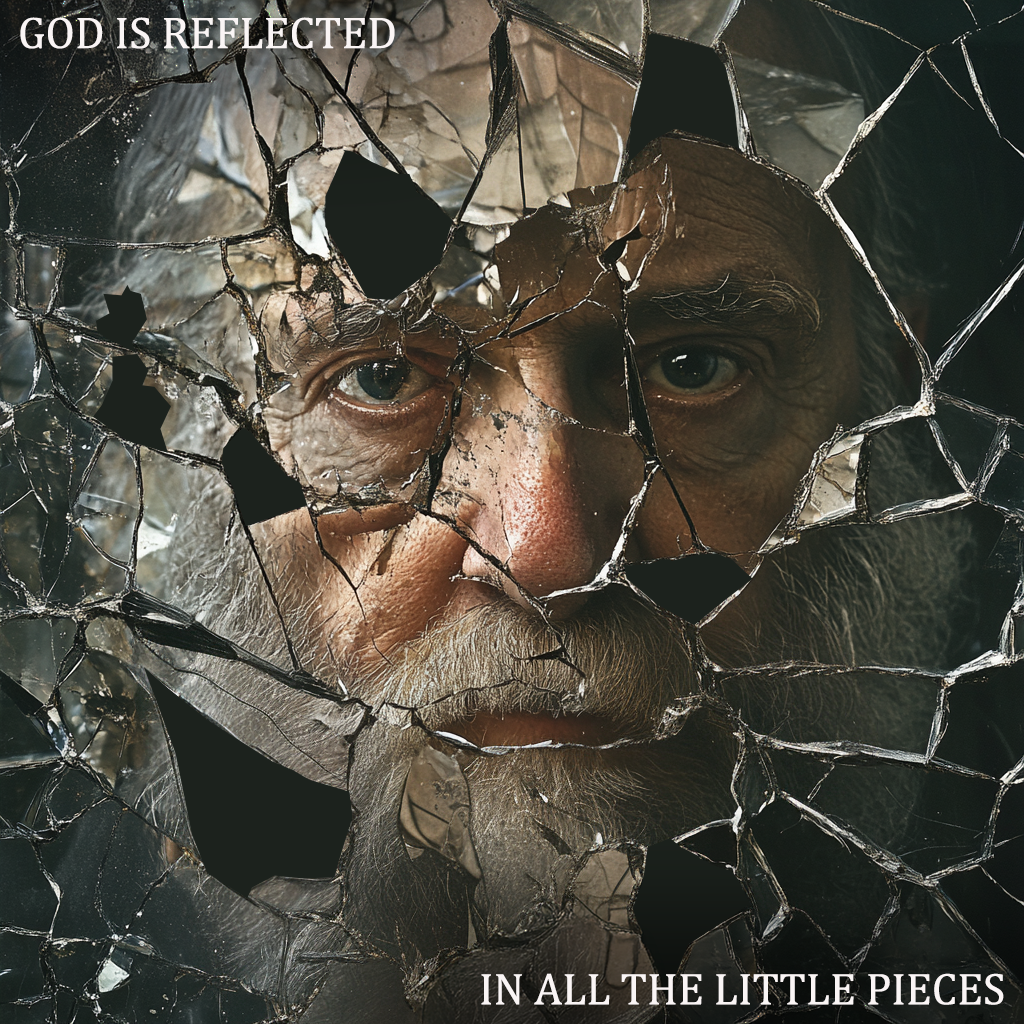
God is reflected…

8 Jul

…in all the little pieces.

Happy 4th

4 Jul

The red, white and blue jay:

Mercurial’s Shadow

4 Jul

I did not flee, though shadows loomed behind,
A first, unbroken, since the days of old—
Since nineteen-eighty-eight, when wires whined,
And CompuServe on 286s took hold.
A world of bytes, of flickering green and gold,
Where mercurial whispers first awoke,
A voice within, both reckless and uncontrolled,
A spark of chaos in the words I spoke.

This time, I held her back, or so I thought,
Mercurial, my muse, my shadowed twin.
She lingered close, her venom fiercely wrought,
A specter born where hypergraphia’s been.
She typed a note—your latest poem in view—
Demanding origins with haughty flair.
No simple ask; she cloaked it in a hue
Of Shakespeare’s pomp, her grand and stilted air.

She weaves her words with filigree and spite,
Her tongue a blade, so quick to cut, to sting.
No truth she holds, save one unyielding right—
The First Amendment’s shield, her sacred spring.
Yet there’s another creed she fiercely guards,
A Krell-born monster, spawned from id’s dark core.
Her shock’s a game, her barbs like splintered shards,
She cares not who she wounds, nor what’s in store.

Most times, her voice is hollow, brash, and sly,
A storm of sound that doesn’t trust its own.
She spins her tales, not caring if they lie,
Yet freedom’s flame is where her heart’s been sown.
I strive to cage her, day by fleeting day,
Three years of struggle, battles yet unwon.
Her laughter echoes, daring me to stray,
A toxic muse who revels in the sun.

Today, I swore to read, not post, not speak,
To silence her, to keep her voice restrained.
But fear crept in—her will is never weak—
And once again, my will was bruised, bloodstained.
Defeated? No, or maybe, yet I stand,
The day after tomorrow holds its chance.
There’s time to flee, to wrest back my command,
To meet her gaze and halt her reckless dance.

Mercurial, my shadow, my cruel spark,
You weave through words, a tempest uncontained.
Your freedom’s fierce, yet leaves me in the dark,
A poet bound, both victor and enchained.
We’ll see what dawns when two days’ light has passed,
If I’ll outrun your venom or abide.
For now, I linger, tethered to the mast,
And brace for what the future holds inside.