Archive | July, 2025

The Book of Heth: Chapter Three – The Paths of Question and Companionship

30 Jul

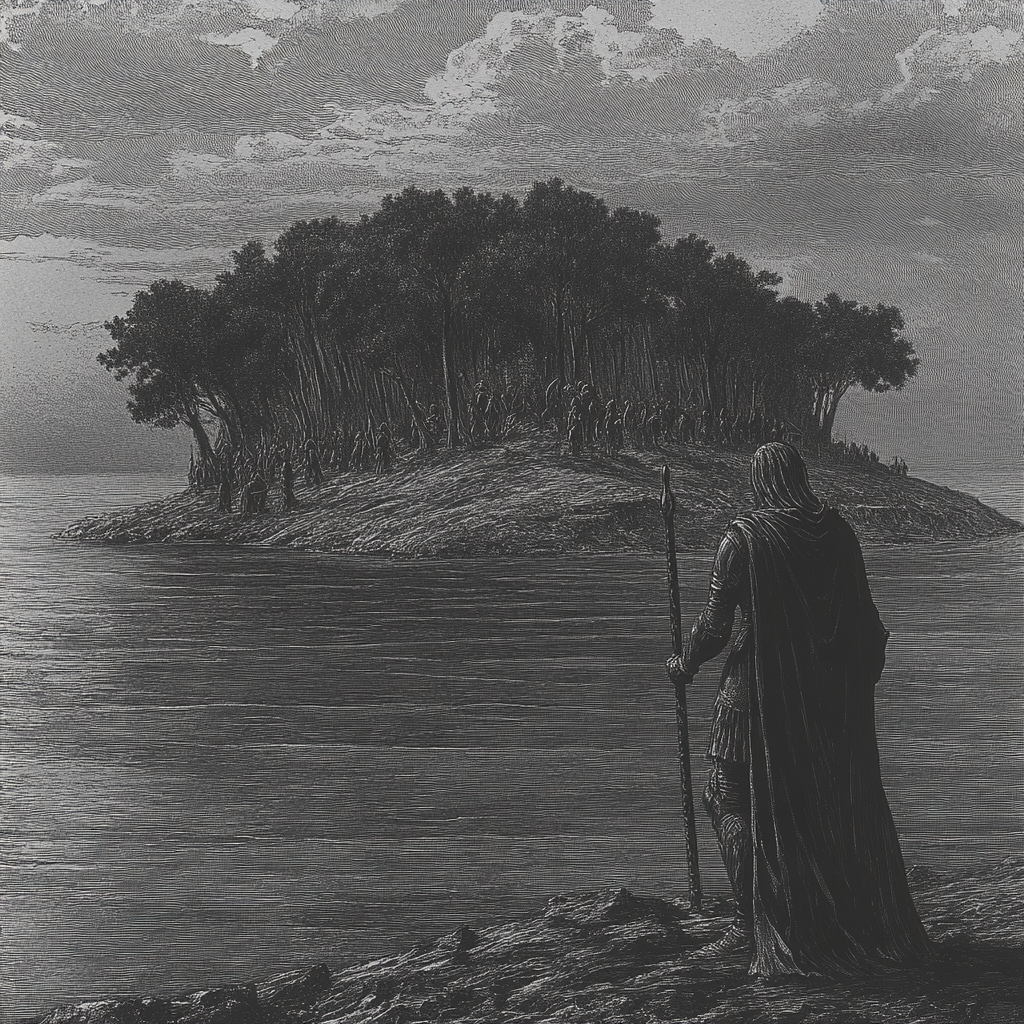
As Lirael and I pressed eastward through Aetheria’s vast prairies, Solara’s spring light bathed the rolling grasses, where Hexapods darted in triads, their iridescent hides shimmering like the streams of Nuahaven. Clumps of broad-leafed trees dotted the horizon, their branches swaying gently under the breeze, a stark contrast to the open expanses we trod. By midday, a shadow loomed in the distance—a Titanclaw, its massive form lumbering across the plain, scales glinting like molten iron. It paid us no mind, its gaze fixed on some unseen prey, and I recalled the wisdom of our shore kin in Nuahaven.

The coastal Silvrens, after the Gloomtread wars, had few troubles with those brutish giants. They learned a simple trick: clear the land around their homes, plant fields of grain, and let the open spaces deter the Gloomtreads. Those dim-witted titans, fearing the Titanclaws that roamed such plains, shunned the cleared lands. Our people, blessed with some scent or essence the great lizards found repellent, suffered only minor crop damage—a small price for safety. The Titanclaws, like silent guardians, did the rest, their hunger fixed on giants, not us.

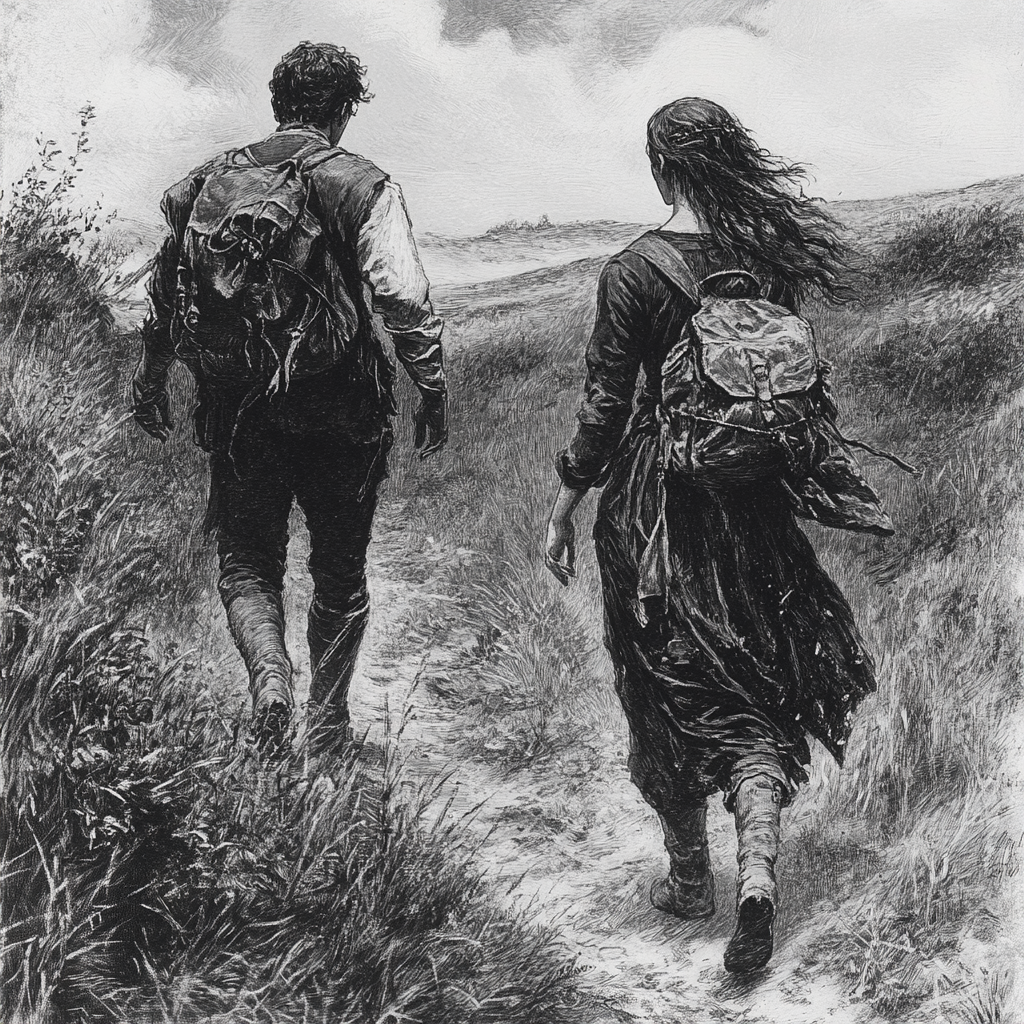
The path we followed was narrow, barely wide enough for one, forcing me to lead with Lirael trailing behind. Her steps, lighter than mine, echoed softly, but as Solara climbed, I heard her breath grow labored. Glancing back, I saw her smaller frame struggling to match my pace, her long hair catching on stray branches, her dress swaying with each determined step. A pang of guilt struck me—I had set a man’s stride, unmindful of her. “Lirael,” I called, halting, “take the lead. Your pace suits the path better.”

She nodded, stepping ahead with a grace that belied her effort, her form outlined against the prairie’s green. As she walked before me, I noted her attractiveness—her flowing hair, her gentle movements, the quiet strength in her frame. Yet no spark of romance stirred in me, and I deemed it a blessing. After her fall, the discord that cost her kin and home, I guessed she’d shun men’s advances, her heart scarred by Kael’s abandonment. Instead, I saw her as a sister, perhaps even a mother or elder, wise beyond her years. It marveled me, this deep draw to her so soon—not as a lover, but as a kindred spirit, a perfect friend. The thought struck deeper: in Nuahaven, my life of crafting had left me friendless, a void I’d never named until now. Work had been my solace, but Lirael’s presence awakened a longing for companionship, pure and unromantic.

I realized then another strength Nua had granted me: leadership, not in prophecy or survival, but in guiding others with care. Adjusting for Lirael’s pace was a small act, yet it revealed my ability to lead with compassion, a skill I’d need on this journey.

Lirael, now in front, grew talkative, her voice rising like a Skydrake’s song over the prairie’s hum. “Heth,” she began, “you’re bound by Nua’s command, but what do we truly know of her? Where did the Eternal Shaper come from? Was she an outcast of greater gods, wandering the void before crafting Aetheria?”

I blinked, her question sharp as a geyser’s burst. “The Chronicle says Nua shaped our world from clay, her will eternal. Beyond that, the elders teach she is the source, unbound by origin.”

“But why?” Lirael pressed, dodging a root. “Did she have a syren and male, their joining birthing the world? The trinity’s sacred, but why three genders? Two would be simpler—less chance for discord, like my fall.”

I pondered, recalling words I’d overheard from elders in Nuahaven’s groves, men who studied the shapes of things—craftsmen and thinkers pondering Nua’s design through forms etched in stone and wood. “I’ve heard a theory, Lirael, from those who gaze upon the world’s bones. They speak of the triangle’s strength. Two points make a line, straight and true, but fragile—bend it, and it snaps like a dry branch underfoot. No balance, no hold against the winds. But three points form a triangle, steadfast and unyielding, like the Titan Spires’ peaks rising against storms. Each side braces the others; remove one, and it crumbles to nothing. So with genders—two alone would waver, unstable as a reed in quicksand, birthing weakness or endless strife. But three weave a form that endures, each gender upholding the rest, mirroring Nua’s moons in the heavens. The elders say it’s why creation stands firm; without the syren’s harmony binding male and female, life would falter like a poorly mended net.”

She glanced back, eyes probing. “And evil—Boana, the Boa Worms. No one’s seen them, Heth. Are they tales to scare us? Why does Nua permit evil at all? If she’s all-powerful, why not end it?”

Her words stirred unease. “Boana’s shadow is in discord, in division,” I ventured. “The Chronicle tells of worms born from the dead, twisting our ancestors’ world. Perhaps they’re not seen but felt—in choices, like your trial. Nua allows it to teach us, to choose harmony.”

Lirael’s pace slowed. “And why the exodus? Nua parted seas, sent eclipses, storms. Why not keep shielding us in the valley? Why send us to Aetheria, only to face Gloomtreads? Does she tire of miracles? And what of her purpose? Is she alone, or part of a greater dance we cannot see?”

I struggled, my craftsman’s mind no match for her probing. “Perhaps Nua tests faith, not strength. The valley’s miracles preserved us, but Aetheria’s trials forged unity, as Tanes taught. Her purpose… maybe it’s like the Titan Spires’ caves—vast, ordered, yet mysterious.”

She nodded, unconvinced but thoughtful. “Questions linger, Heth. If Boana rivals Nua, is there a balance beyond them? Why is discord so grave? My fall cost me everything, yet I live. Is Nua’s wrath or mercy truer? And what of the giants we seek—will they question as I do?”

Her queries echoed those whispered in Nuahaven’s councils, doubts I’d heard but never voiced. Was it irreverent to question thus? Yet, as we walked, I saw wisdom in her words. If I were to meet the giants, as Nua commanded, they might ask the same—why three, why evil, why exile? Her questions honed my faith, and I marveled at her knowledge. Lirael had near-memorized the Chronicle, her exile deepening her study. Each question taught me details I’d overlooked—Galoth’s wanderings, Tanes’s visions, the Covenant’s nuances. She was no mere outcast; her mind was a forge, shaping insight from pain.

As Solara dipped, a patch of woods loomed ahead, dense and shadowed, where Gloomtreads or worse might lurk. “Too dangerous to press on,” I said. “We camp here.”

Lirael agreed, swiftly gathering dry twigs from the prairie’s edge. With deft hands, she struck flint to spark a fire, its glow rivaling Korath’s hue. I watched, awed, as she mended a tear in my cloak, her needle weaving hide with practiced ease. “You’re indispensable, Lirael,” I said. “Fixing, mending—skills we’ll need in the wilds.”

She smiled, firelight dancing on her hair. “Exile teaches more than endurance, Heth. We’ll need every craft to reach the blue.”

We settled by the fire, the prairie’s whispers our only company, her questions lingering like stars under the three moons. The path eastward beckoned, and with Lirael’s wisdom at my side, I felt Nua’s purpose sharpening.
The Book of Heth: Chapter Two – The Path of Provisions

29 Jul

With Rylor’s pack slung over my shoulder, I pressed eastward under Solara’s rising light, the spring air crisp with the scent of blooming tart-fruits and the distant rumble of geysers in the ridges. The plains stretched before me, dotted with Hexapods grazing in triads, their iridescent hides catching the morning glow. My steps felt lighter now, the crucible of yesterday’s haste behind me, but Nua’s command gnawed at my thoughts like a small hexapod on a vine.

“Take only the clothes on your back,” the Shaper had said. Yet here I was, provisioned by a kindly trapper. Was this defiance? I pondered as I walked, the path winding past scattered farmsteads where women tended orchards in flowing skirts, their long hair tied back against the breeze. In my haste, I had debated dressing, bending the words for practicality. Now, with Rylor’s aid, the folly of literal obedience struck me fully. To trek to Aetheria’s eastern shores without food, rest, or help? I would have perished in days, a bleached skeleton amid the quicksand pits, never reaching the blue. Nua’s will was harmony, not self-destruction. The beasts of this land—the Velithons mating in sacred sequence, the Skydrakes circling in threes—accepted the land’s gifts without question. So too must I. I resolved then: aid offered in kindness would be accepted, for the journey’s spirit demanded survival, not starvation.

By midday, the settlements thinned, giving way to wilder expanses where Spikecrests roamed the fringes, their spines casting long shadows. Fatigue crept in, my legs aching from the endless march, but the resolve buoyed me. As Solara dipped toward the horizon, painting the sky in hues of Korath’s crimson, I spotted a lone hut nestled against a cluster of broad-leafed trees, smoke rising lazily from its chimney. It stood isolated, far from the clusters of Nuahaven’s kin, ringed by mended fences and a garden of hardy roots.

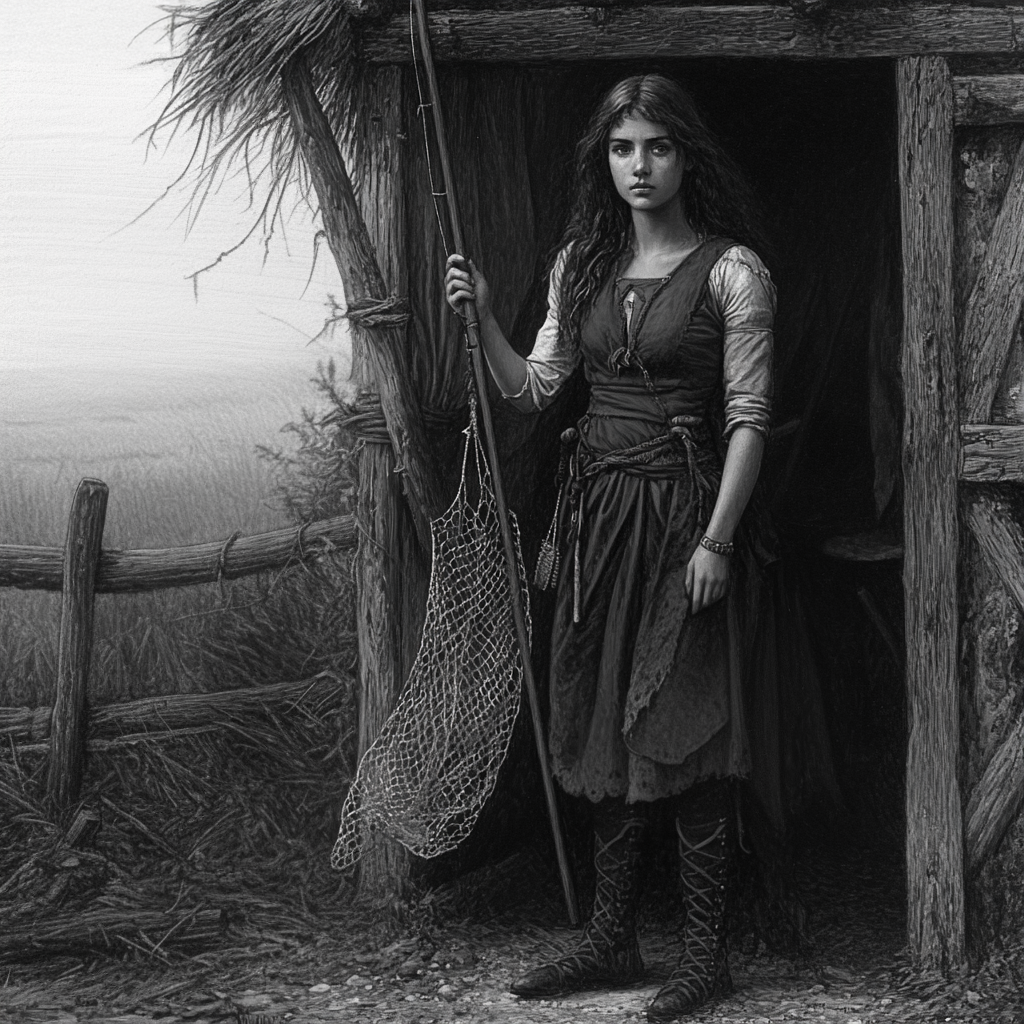
A young woman emerged as I approached, her form smaller and graceful, clad in a simple dress of woven hide, her long hair cascading like the streams from the Titan Spires. She watched me with wary eyes, a mending needle in hand, repairing a torn net by the door.

“Well met, stranger,” she called, her voice steady but laced with loneliness. “You’re far from the valley paths. What brings you this way, alone and laden?”

I halted, catching my breath. “Heth of Nuahaven,” I replied. “Heading east on… a journey. And you? This hut seems solitary for one so young.”

She smiled faintly, setting aside her work. “Solitary suits me, Heth. I’m Lirael. Come, you look weary from the road. Spring’s warmth deceives—nights chill quickly out here. Share my fire; I’ve stew simmering.”

Her offer warmed me more than the fading light. Remembering my resolve, I nodded. “Thank you, Lirael. A moment’s rest would be welcome.”

We sat by her hearth, the stew rich with roots and hexapod meat, flavors sharpened by herbs from her garden. As we ate, she drew me out with gentle questions. “Nuahaven’s news reaches us slowly here. The Covenant holds strong? Families thriving under the trinity?”

“Aye,” I said, savoring the meal. “Births blessed, unions sacred. But tell me, Lirael—why dwell so far? The wilds are harsh for a woman alone.”

Her eyes clouded, spoon pausing. She studied me a moment, gauging my reaction, her gaze searching for judgment or pity. Seeing neither, she began slowly. “It’s a long tale, Heth. Not one I share lightly. But you seem kind—perhaps from the valley’s heart, where mercy is taught. It began with love, as many falls do.”

I nodded, encouraging her. “Love under Nua should lift, not burden.”

She sighed, setting her bowl aside. “I was young, like you now, living in Nuahaven’s folds. There was a man—a male named Kael, strong and kind, with hands that built like yours. We met in the orchards, sharing glances under Solara’s gaze. But unions demand the trinity—syren to bind, female to nurture, male to complete. We sought a syren, Heth, we truly did. The village had few unpaired; most were in bonds, their harmonies set. One syren, Eland, seemed promising—gentle, with a voice that calmed like a stream. But he was promised elsewhere, his kin arranging a match for land’s sake.”

Lirael paused, her fingers tracing the net’s weave, watching my face for scorn. “Kael and I waited, seasons turning. Spring bloomed, tart-fruits ripened, but no syren came free. Whispers grew—’They tarry too long,’ folk said. We dreamed of a family, of young circling in threes like Skydrakes. But impatience crept in, Boana’s shadow veiled as desire. One night, under Luneth’s pale light, we… yielded. No syren preceded; discord claimed us. A child came, but twisted—brutish, dim, a Discordant. The village shunned me, Heth. ‘Opposition’s mark,’ they called it. Kael fled east, ashamed, leaving me to face the elders alone.”

Her voice trembled, but she pressed on, eyes meeting mine. “The road to exile was winding. First, whispers in the markets, women turning away their long hair swaying like judgment. Then, outright scorn—children taunted, men like the elders declaring me unfit for harmony. I bore it awhile, mending what I could, but the weight crushed. One dawn, I packed and left, seeking solitude here where quicksand and geysers keep company scarce. Self-reliance became my creed—fixing nets, mending hides, repairing what breaks. Good at it, too. Turns out opposition teaches endurance.”

I listened, heart heavy. “Nua teaches mercy, Lirael. Your fall echoes Elyria’s old rifts, but redemption lies in faith.”

She leaned forward, eyes thoughtful. “Ah, but think on it, Heth. Elyria fell to division—tribes warring, customs fracturing like our people’s drift before the Gloomtreads. My fall was small, a single discord, yet it mirrored the great opposition. Boana whispers in impatience, turning love to ruin. What if Nua allows such stumbles to teach? My exile forged strength; perhaps Elyria’s wars birthed the Covenant. We rise from shadows, wiser under the moons.”

Her words stirred me, questions blooming like spring vines. Nua’s ways were profound, her lessons layered. “You’ve insight born of trial,” I said. “The Shaper speaks through all. And your tale… it resonates, Lirael. I’ve known my own shadows in love, though not as deep as yours.”

She tilted her head, curiosity softening her features. “Shadows in love? You, young and unburdened? Tell me, Heth—perhaps sharing lightens both our loads.”

I sighed, the fire’s crackle filling the pause. “Not a fall like yours, but a void. In Nuahaven, as I pursued my craft—shaping wood into homes, mending what the wilds broke—offers came. Women, graceful and kind, their long hair flowing like streams, approached with syrens in tow, proposing unions under the Covenant. First was Mira, a female from the orchards, her syren partner Seren a gentle soul with a voice like wind through the Spires. They saw my steady hands, thought me a fine addition. But it felt… wrong. No spark, no harmony stirring in my heart. I turned them away politely, focusing on my work instead.”

Lirael nodded, urging me on. “And others?”

“Aye,” I continued, memories surfacing like bubbles from a hot spring. “Then came Elara, smaller and nurturing, her eyes bright as Solara’s dawn. She and her syren, Vaelis, had waited seasons for a male. Vaelis was strong, more masculine in build, with a laugh that echoed the geysers. They courted me during a spring feast, speaking of families circling in threes. But again, it didn’t feel right—the bond lacked depth, like a mended net fraying at the edges. I buried myself in crafting, building halls that stood firm while my heart wandered empty. The townsfolk whispered, Lirael—’Heth delays too long,’ they’d say. ‘A man of his age, unwed? Opposition lurks in solitude.’ Elders questioned me at councils, pressing for unions to strengthen Nuahaven.”

She leaned back, thoughtful. “And did the lack drive you?”

“It did,” I admitted. “Without love’s pull, work became my anchor. I honed my skills, repairing what others broke, shaping groves into shelters against the chill. But the questions grew—friends jesting, women glancing away. It wore on me, that void, making me question Nua’s plan. After such trials, understanding your difficulties isn’t hard, Lirael. Love’s path is fraught; one misstep, and shadows claim us.”

We talked long into the evening, sharing tales of Nuahaven’s feasts and her solitary crafts. As moons rose, she said, “Heth, if I’m to live alone in wilderness, why not move with purpose? Let me join you eastward. I’m handy—good at fixing and mending things. Nets for fishing, cloaks from hides. You’d not regret it.”

I shook my head. “The command was mine alone, Lirael. Danger awaits; I can’t burden you.”

She smiled shrewdly. “You’ve accepted aid—Rylor’s pack, my stew. Provisions, yes? A pack animal would be provision too—carrying loads, no questions asked.”

“True,” I conceded.

“Then why not a person more useful? I mend what breaks, forage what sustains. No burden, but a boon. Nua’s harmony thrives in company.”

Her logic pierced my doubt. “Very well, Lirael. If you insist, we’ll go together.”

Come dawn, spring’s dew glistening on the grasses, we departed eastward, her small pack slung beside mine, the hut left behind. The path called, and with a companion at my side, the journey felt less daunting under Solara’s watchful eye.

The Book of Heth: Chapter One – The Call of the Eternal Shaper

28 Jul

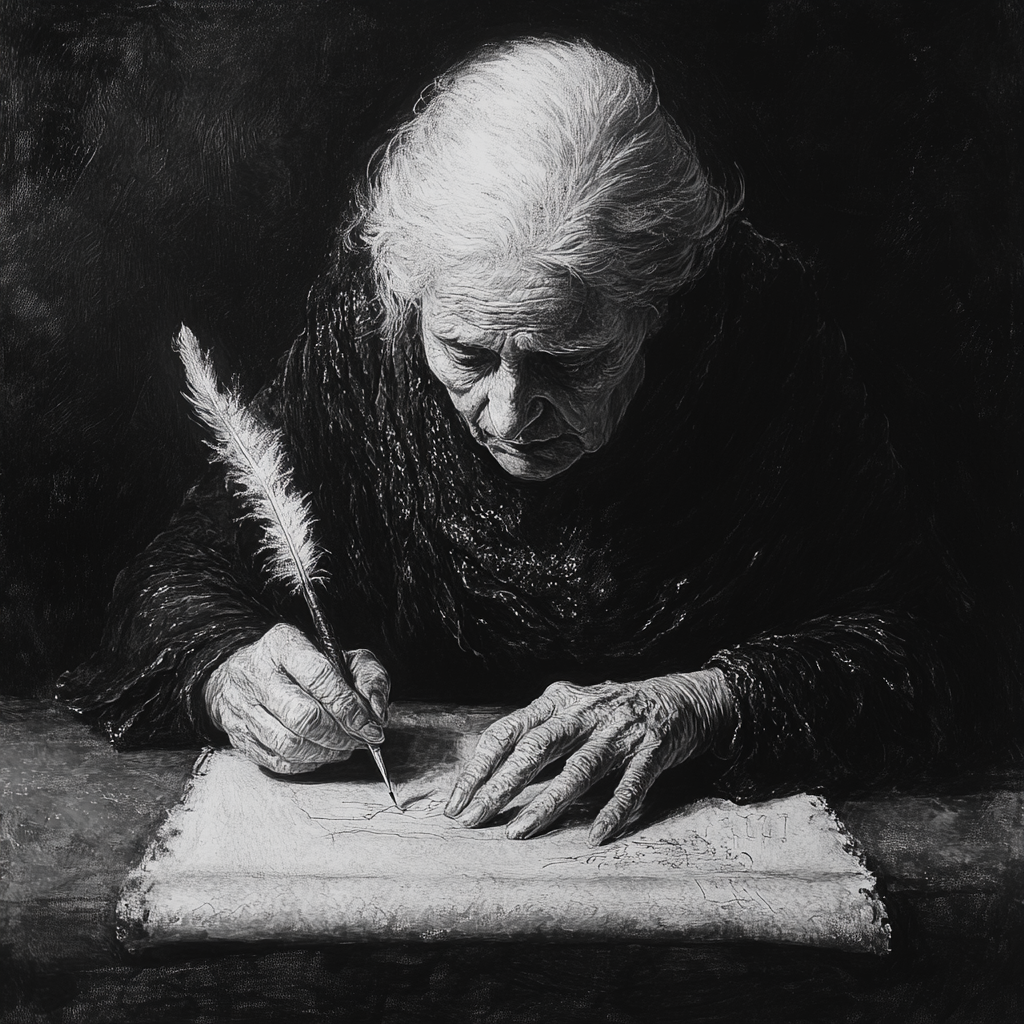
I am Heth, son of Thalion, a dweller of Nuahaven on the western shores of Aetheria, the land promised to us by Nua through the prophet Tanes. Now, in the autumn of my life, with grandchildren at my knee and the aches of many seasons in my bones, I take up this quill to record the adventure that defined my youth and, in ways I still ponder, the fate of our people. My hands tremble not from age alone but from the memory of that divine summons, a dream that propelled me eastward into the unknown. I write this not for glory, for I am but a vessel of Nua’s will, but so that the Silvrens may know the paths I trod and the wonders I beheld, that our harmony under the three moons—Luneth’s pale serenity, Sylvara’s silver grace, and Korath’s crimson resolve—may endure.

It was in the bloom of my twenty-third year, when Solara’s light still danced freely upon my unscarred skin, that Nua spoke to me. I had been a simple craftsman then, shaping wood from the broad-leafed groves into homes that echoed the sturdy halls of our forebears. Nuahaven thrived in those days, our people united by the Covenant of Nuahaven, inscribed upon stone as a mirror to Galoth’s ancient tablets. We honored the sacred trinity—syren, female, male in ordained sequence—shunning discord and misbond, extending mercy even to the rare Discordants among us. The shadows of Boana lurked, but Nua’s light held them at bay.

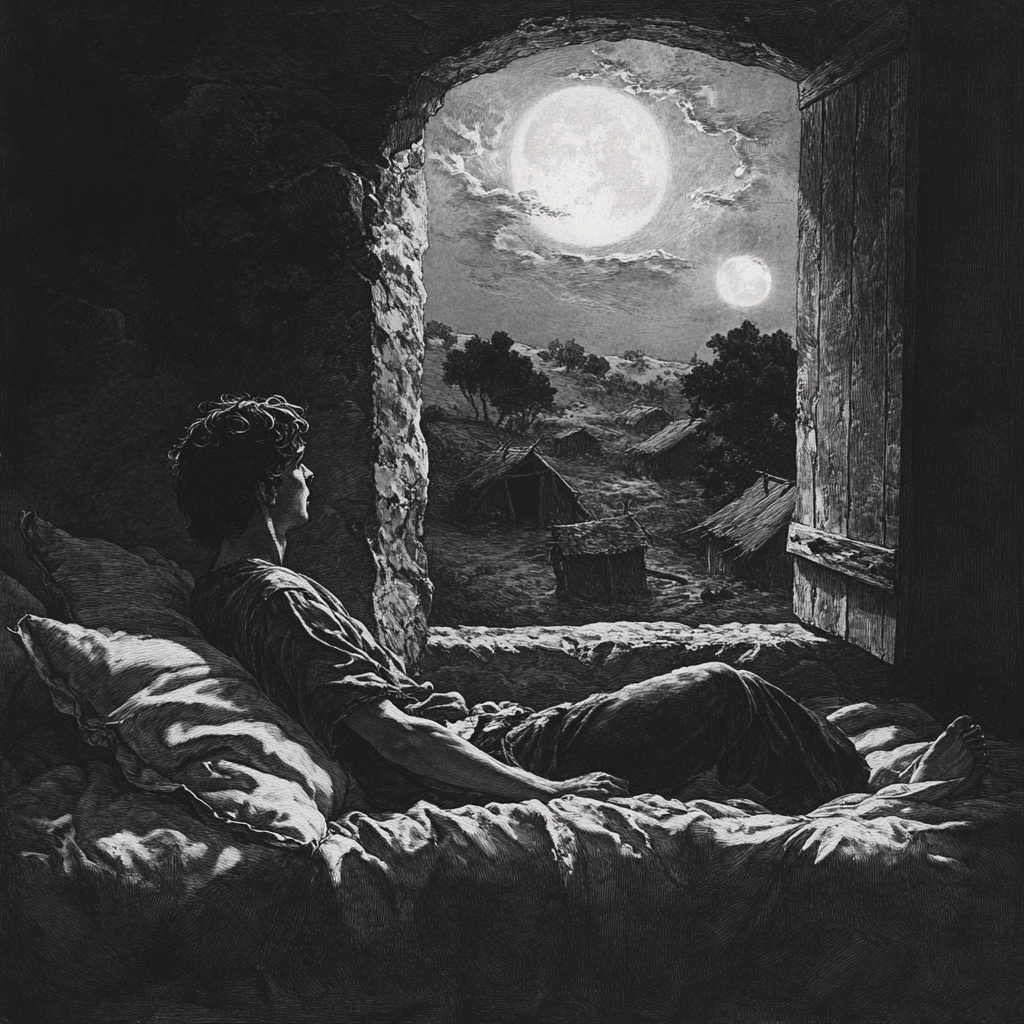
That night, under Luneth’s gentle watch, sleep claimed me in my modest dwelling. But it was no ordinary slumber. A voice, resonant as a geyser’s rumble yet vast as the Titan Spires’ heights, filled my mind. “Heth,” it called, and I knew it was the Eternal Shaper, for no mortal tone could carry such depth. “The giants need your treasure. The Silvrens need your measure. Go east. Leave this very night. Take only the clothes on your back. Do not return until you see the blue.”

I awoke with a start, my heart pounding like the roar of a Spikecrest in the ridges. The words echoed in my soul, unyielding and true. What treasure did I possess? I was no elder, no prophet like Tanes. Yet, in my youth’s fervor, I believed it must be the faith of our people—the Covenant, the teachings of Galoth passed down through The Chronicle of Elyria. Surely, the giants, those ancient builders of the Titan Spires whose wisdom had faded into legend, hungered for Nua’s harmony. Perhaps remnants of their kind lingered in the east, their eyes dimmed by opposition, awaiting the light of our ways. That, I reasoned, was the treasure they needed.

As for the Silvrens needing my measure, it puzzled me, but I took it as a call to chart the unknown expanses of Aetheria. Our people, ever expanding from Nuahaven’s western shores, whispered of vast plains and ridges beyond the Titan Spires. To measure the land’s breadth would aid our kin, revealing paths for growth while upholding unity.

And the blue? Ah, that seemed clearest. The Azure Veil, whose depths mirrored the eyes of our forebears like Lira of old, lay to the west whence we came. But legends spoke of its eastern counterpart, encircling Aetheria’s far side. To see the blue must mean crossing the continent entire, gazing upon that distant sea. Thus, I interpreted Nua’s command, my spirit ignited by purpose.

With the moons still high, I rose, clad only in my nightshirt, the thin fabric clinging to my skin in the cool air. Nua’s words rang clear: “Take only the clothes on your back.” But doubt crept in as I glanced at my tunic and breeches folded neatly nearby. Nuahaven was not yet asleep; lanterns flickered in distant windows, and the path eastward wound through scattered homesteads before reaching the wilds. To stride through the village in naught but a nightshirt would draw stares and whispers—silly, perhaps even scandalous. Would Nua demand such humiliation? The command was urgent, but dressing took mere moments. Surely, the Shaper meant not to expose me to ridicule but to travel unburdened, free of possessions. I debated fiercely in my mind: obedience literal or in spirit? Yet faith steeled me—Nua had parted lands and slain giants for our people; she would guide my steps.

In the end, I donned my simple tunic, breeches, and sturdy boots, reasoning that Nua’s will was haste, not folly. With a final glance at my home, I slipped into the night, eastward bound. It was spring then, the air alive with the scent of blooming tart-fruits and the first calls of Skydrakes awakening in the cliffs. The moons guided my steps through Nuahaven’s outskirts, past orchards where fresh buds hung heavy and groves where Hexapods stirred in slumber. The path eastward was well-trod at first, winding through settlements that had sprouted since the Covenant—farmsteads and trappers’ huts dotting the plains before the Titan Spires loomed in the distance. Solara rose as I walked, her light warming the land, and by midday, fatigue tugged at my limbs. I had eaten nothing, carried no water, true to Nua’s word beyond my attire.

Toward evening, as Korath’s crimson began to tint the sky, I approached a solitary hut on the edge of the wilderness, smoke curling from its chimney. A trapper’s abode, ringed by snares and drying pelts of Velithons and smaller hexapods. The man himself, a weathered syren with a beard like tangled vines, emerged as I neared, his eyes narrowing in curiosity.

“Well met, traveler,” he called, leaning on a staff carved from broad-leafed wood. “You have the look of Nuahaven about you—those steady strides, the valley’s mark. What’s your name, lad? And what brings one so young this far east without pack or provision?”

I hesitated, Nua’s command fresh in my mind, but his gaze was kind, and weariness weighed heavy. “I am Heth, son of Thalion,” I replied. “From Nuahaven, yes. Just… passing through.”

He chuckled, a deep rumble like distant geysers. “Passing through, eh? Without so much as a waterskin? Come now, Heth—must be one of Thalion’s kin, with that craftsman’s build. I’m Rylor, trapper of these fringes. News from Nuahaven is scarce out here. The Covenant holds? Any word of fresh skirmishes with beasts or shadows?”

His questions flowed like a stream, and before I knew it, he had guided me to his firepit, a pot of stew bubbling over flames. “Sit, lad. You look half-starved. Share now, and tell an old syren what’s stirring in the heartlands.”

The aroma of Velithon stew weakened my resolve. Nua had said to leave that night, but not to shun aid along the way. I sat, accepting a bowl gratefully. “The Covenant endures,” I began, recounting recent feasts under Sylvara’s light, the births honoring the trinity, and whispers of expansion eastward. Rylor nodded, his eyes alight with interest.

“Ah, good to hear harmony prevails. But you, Heth—what drags you out here alone, without gear? Running from something? Or to?”

I paused, spoon midway to my mouth. The dream felt private, sacred, yet his earnest face coaxed the truth. “Not running, Rylor. Called. Nua spoke to me in a dream last night. ‘The giants need your treasure. The Silvrens need your measure. Go east. Leave this very night. Take only the clothes on your back. Do not return until you see the blue.'”

Rylor’s eyes widened, his beard twitching in surprise. “Nua herself? A dream like Tanes’s visions? Lad, that’s no light matter. But east? Into the wilds, with naught but faith? The Titan Spires hold perils—quicksand, Spikecrests, and who knows what beyond. You’re not equipped for such folly.”

“I know,” I admitted, my voice faltering. “But the Shaper’s command was clear. The treasure must be our faith—the Covenant to share with giants’ remnants. The measure, perhaps charting Aetheria’s breadth. The blue… the far eastern sea.”

Rylor leaned back, stroking his beard thoughtfully. “Giants’ remnants? Legends, maybe. And faith’s a fine treasure, but you’ll die of thirst before sharing it. Nua guides, but she doesn’t demand suicide. Stay the night, Heth. Rest. I’ll outfit you proper—waterskin, knife, cloak against the chill. A good breakfast in the morning, and you’ll be off with Nua’s blessing still.”

I protested weakly. “The command was to leave that night, take nothing…”

“Aye, but you’re here now, and Nua sent you to my door for a reason. Think on it—harmony includes mercy, even to oneself. Sleep on it, lad. No harm in one night.”

His words swayed me, fatigue and the warmth of the fire sealing the decision. I nodded, and Rylor showed me to a pallet by the hearth. Sleep came swiftly, dreams flickering with eastern horizons.

Come dawn, Rylor roused me with the scent of fresh bread and eggs from hexapod nests. “Eat hearty,” he said, pressing a pack into my hands—waterskin, dried meats, a sturdy knife, and a cloak woven from Velithon hide. “Nua’s path is yours, Heth, but go prepared. May the three moons light your way.”

I thanked him profusely, guilt mingling with gratitude. “You’ve bent Nua’s words, but perhaps for the best. I’ll honor this aid.”

Rylor clasped my shoulder. “Words are guides, not chains. Return one day with tales of the blue, and we’ll share a stew again.”

With that, I departed eastward, the pack light on my back, the wilderness calling. Little did I know how far that path would lead, nor the companions it would draw, but in that moment, I was Heth, the wanderer, bound by divine decree, seeking the blue that would call me home.

The Book of Tanes: Chapter Five – The Salvation of Unity and the Legacy of Tanes

27 Jul

As the Silvrens battled the brutish Gloomtreads across the unnamed continent, their hearts began to knit together, the crucible of war forging anew the unity Tanes had long proclaimed. From Nuahaven’s plains to the Titan Spires, from the Azure Veil’s shores to the forested ridges, cave-dwellers, sea folk, and mountain folk shared strategies and sorrows, their separate customs blending like streams into the Silvren River. Thalion’s stonecraft aided Vaelina’s net-weaving, and Eliron’s forest traps bolstered Sylvaraen’s ambushes. Under the three moons—Luneth, Sylvara, and Korath—the Silvrens fought as one, their spears and nets felling the dim-witted giants, yet the Gloomtreads’ numbers seemed unending, their roars a shadow over the land.

Then, under Solara’s blazing zenith, a miracle unfolded. From the distant horizons, beyond the plains where Velithons roamed, came giant lizards, vaster than any Dreadmaw or Spikecrest, their scales glinting like molten iron, their jaws wide as cave mouths. These “Titanclaws,” as the Silvrens named them, descended upon the Gloomtreads with terrifying efficiency. In the Battle of Shattered Plains, the lizards tore through the giants, claws rending flesh and tails shattering bones. Many Gloomtreads fell as they fled, their massive forms crumpling under the relentless assault, their blood soaking the earth like a sacrificial offering. The Titanclaws, with eyes like burning coals, passed by the Silvrens without so much as a glance, their hunger fixed solely on the brutish titans.

The Silvrens, awestruck, gathered in Nuahaven’s square. Vaelina, her nets still stained with battle, whispered, “These lizards spared us, as Nua spared us from the Dreadmaws. Surely, they are her instruments.”

Eliron, leaning on his spear, added, “The ancient giants, builders of the Titan Spires, must have fallen to such beasts. Their wisdom could not save them, but Nua shields us.”

Tanes, her hair now silvered like Sylvara’s light, nodded. “The Eternal Shaper weaves even destruction into harmony. The Gloomtreads’ discord—slaying their syrens—brought this doom. Our unity invites Nua’s mercy.”

When the last Gloomtread lay dead or had fled beyond the Titan Spires, the Silvrens convened a great council under the Starlit Canopy’s new-world kin, their fires casting long shadows. Thalion, Vaelina, Eliron, and elders like Liranae swore allegiance to their reunification, their voices rising in unison: “We are one people, Silvrens under Nua, bound by the trinity and Galoth’s wisdom!” They drafted a declaration, echoing the sacred tablets of Galoth, inscribed with laws prohibiting discord and misbond, urging mercy even for Discordants, rejecting false gods, and forbidding unjust wars. Lirys, a syren skilled in stonecraft from her years in the caves, chiseled the covenant onto new tablets, her hands guided by faith as she carved beneath Korath’s crimson gaze.

The tablets, named the Covenant of Nuahaven, read: “Honor Nua’s trinity—syren, female, male in sacred sequence. Shun discord, the out-of-order union that births Discordants. Avoid misbond, the barren rift of incomplete bonds. Live as one, as the beasts in harmony, and let mercy guide even the shadowed. Reject Boana’s lies and wage peace under Solara and the three moons.”

Tanes, now frail with age, her steps slow as the Lunara’s flow, retreated to a secluded grove near Nuahaven, where a stream sang of Nua’s eternal will. There, beneath a broad-leafed tree—not a Veilward—she dwelt in solitude, visited only by Silvrens seeking counsel. Thoryn, the youth who had spied the Gloomtreads’ sin, came once, asking, “Did we err in fighting, prophet?”

Tanes smiled, her eyes dim yet piercing. “You fought to live, Thoryn. Nua’s wisdom turned even war to unity. Go, and honor the Covenant.”

As her days waned, Tanes felt a presence in the grove, Nua’s voice manifesting not in shadows but in the rustling leaves, clear as the Azure Veil’s tides. A long converse unfolded, Tanes’s heart heavy with doubt, Nua’s words a balm of infinite grace.

“Nua, Eternal Shaper,” Tanes began, her voice trembling, “have I failed you? I led your people from the Silvren Valley, but they drifted apart, inviting the Gloomtreads’ wrath. My warnings were ignored, and blood stained this land.”

Nua’s voice, like a chorus of winds, replied, “Tanes, faithful daughter, you have not failed. My plan weaves through mortal flaws. You spoke my will, urging unity when hearts strayed. The drift was their choice, yet it taught them the cost of division.”

“But the sea journey,” Tanes pressed, “I faltered when they cut the Veilwards, sinking Nuadrift. I could not bind their faith.”

“You guided them to Mercydrift,” Nua soothed. “The Veilwards’ fall was a lesson in obedience, yet my mercy bore you to this continent. Your chastisements were just, your faith unwavering.”

Tanes wept, “The Gloomtreads—did I not warn enough? So many died, and I feared Boana triumphed.”

“The Gloomtreads were my mirror,” Nua said, “showing the Silvrens their own peril in discord. You revealed their sin—slaying syrens—and through war, you forged unity. The Titanclaws were my hand, sparing my chosen while cleansing opposition. All was as I willed.”

“And the Covenant?” Tanes asked. “Will it endure, or will they stray again?”

“The Covenant of Nuahaven is Galoth’s wisdom reborn,” Nua affirmed. “You led them to inscribe it, binding their hearts. They will falter, for mortals are frail, but your work plants the seed of harmony. You have walked my path perfectly, Tanes.”

Tanes bowed her head, tears falling like rain. “I am unworthy of such grace, Shaper. I doubted, yet you guided.”

“My love knows no bounds,” Nua said. “Rest now, for your task nears its end.”

In her final act, Tanes, with trembling hands, inscribed the complete history of her people upon scrolls of woven bark, drawing from the oral tales of the elders and her own visions. She transcribed the memorized text of The Book of Galoth, from Elyria’s creation by Nua’s clay to the wanderer’s tablets, weaving it with the Silvrens’ journey: the exodus from the Silvren Valley, the drift across the Azure Veil, the trials of Nuadrift and Mercydrift, and the wars with the Gloomtreads. This tome, named The Chronicle of Elyria, became the Silvrens’ sacred legacy, copied by scribes and spread across Nuahaven’s growing villages, each copy a beacon of Nua’s truth.

Tanes passed under Luneth’s gentle light, her body laid to rest by the grove’s stream, her spirit ascending to Nua’s embrace. The Silvrens mourned, yet rejoiced, for The Chronicle and the Covenant of Nuahaven stood as her eternal gift, guiding them as one people under Solara and the three moons, their unity a shield against Boana’s ever-lurking shadow.

The Book of Tanes: Chapter Four – The Division of Ways and the Return of Shadows

26 Jul

In the burgeoning years upon the unnamed continent, where the streams flowed clear and the forests of Nuahaven flourished under the watchful gaze of Solara and the three moons—Luneth, Sylvara, and Korath—the Silvrens prospered. A new generation matured, their numbers swelling through unions faithful to Nua’s sacred trinity: syren, female, male in harmonious sequence. Children played among the tart-fruit orchards, their laughter mingling with the songs of Skydrakes soaring above the Titan Spires. Yet, as the Silvrens spread across the land, a troubling drift emerged, one not of distance alone but of heart and custom, stirring the prophet Tanes’s concern.

Tanes, her vision sharp as the Crest of Dawn, observed the Silvrens fragmenting into enclaves, each adopting distinct ways of life. Some, drawn to the ancient caves of the Titan Spires, carved homes within the geometric hollows, their lives shaped by stone and shadow. Others turned to the Azure Veil’s shores, becoming sea folk who wove nets and fished for creatures unlike the Glimmerfin, their days ruled by the tides of Sylvara. A third group ventured into the dense forests, scaling ridges to live as mountain folk, their hands calloused from carving paths through thickets. These groups, though bound by Nua’s code, began to think differently—customs diverging, tongues splitting, and hearts straying from unity.

Alarmed, Tanes journeyed among them, her steps swift as a Velithon across the plains. First, she climbed to the Titan Spires, where the cave-dwellers, led by the male Thorneus’s heir, Thalion, carved altars within the ancient halls.

“Why do you dwell apart, kin of Silvren?” Tanes asked, her voice echoing in the vast chambers. “Nua bids us one people, united in harmony.”

Thalion, chiseling stone with a bronze tool, replied, “The caves shelter us, prophet. Their strength is Nua’s gift. Must we crowd Nuahaven’s plains when these halls stand empty?”

“You mistake my meaning,” Tanes said. “Separation by custom, not land, invites Boana’s shadow. If your ways diverge, Nua will not shield us from opposition.”

Thalion scoffed, “Our faith holds; we honor the trinity. These caves inspire us—why cling to old ways?”

Tanes’s eyes darkened: “Heed my warning, Thalion. Division courts calamity. Unite, or a terrible fate awaits.”

Next, she descended to the shores, where the sea folk, under the syren Vaelor’s daughter, Vaelina, hauled nets brimming with scaled fish. Their boats rocked under Luneth’s pale glow.

“Vaelina,” Tanes called, standing ankle-deep in the surf, “why do you forsake the valley for the sea, crafting new songs and rites? Nua’s code demands one people.”

Vaelina, mending a net, answered, “The Azure Veil feeds us, Tanes. Fish are plentiful, and the tides teach us freedom. We pray to Nua—does the land matter?”

“It is not the land but the heart,” Tanes countered. “Different customs fracture our unity. Boana waits for such rifts. Return to the fold, or sorrow will come.”

“The sea is our home now,” Vaelina said, turning away. “We are Silvrens still.”

Finally, Tanes trekked to the forested ridges, where the mountain folk, led by the female Elira’s son, Eliron, built timber halls amid towering trees.

“Eliron,” Tanes implored, standing beneath a canopy rivaling the Starlit Canopy, “your people carve a new path, speaking of mountains as sacred. Why divide our ways?”

Eliron, felling a tree—not a Veilward—replied, “The forests sustain us, prophet. Their heights lift our spirits to Nua. We keep the sacred sequence—why must we dwell as one?”

“Customs apart breed discord in spirit,” Tanes warned. “Nua’s harmony wanes when we are not one. A terrible shadow looms—unite, or face its wrath.”

Eliron shrugged: “We are faithful. No harm will come.”

But Tanes’s warnings went unheeded, and the Silvrens’ customs drifted further, their unity fraying like a worn net. Then, under Korath’s crimson watch, the terrible fate arrived. From the distant plains beyond the Titan Spires, giants emerged—not the intelligent architects of the ancient caves, but brutish titans, thrice an Elyrian’s height, their forms akin to men but dim-witted and violent. Their eyes gleamed with malice, their roars shaking the earth like geysers.

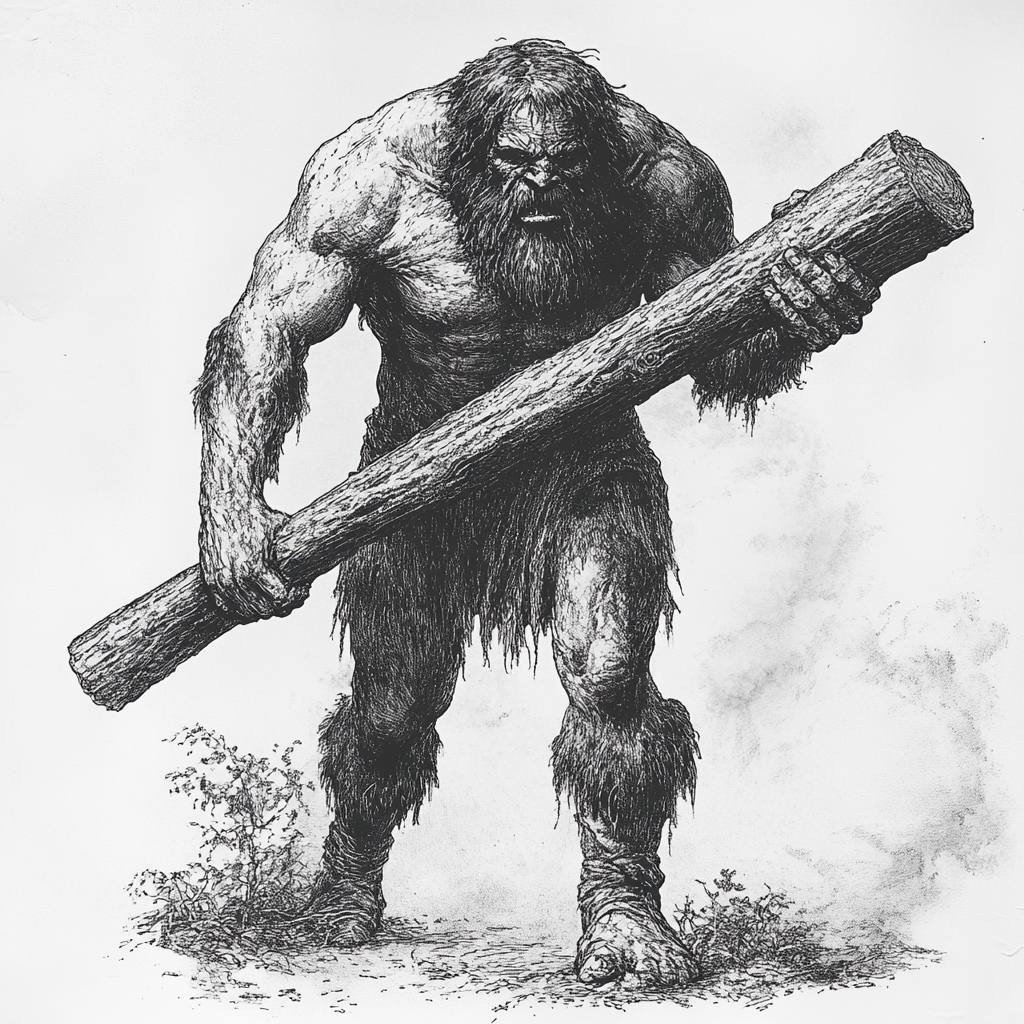
The Silvrens named them “Gloomtreads,” for their heavy steps darkened the land. War erupted as the Gloomtreads stormed Nuahaven’s outskirts, wielding crude clubs of hewn wood. The first battle, the Clash of Dawnplain, saw the cave-dwellers rally under Thalion. He stood atop a ridge, bronze spear in hand, shouting, “For Nua’s harmony!” His strikes felled a Gloomtread, but many Silvrens perished, their blood staining the grasses. Vaelina, leading sea folk, turned the tide with nets repurposed to entangle the giants’ legs, her voice rallying: “Bind their steps!” Her heroics saved dozens, though she lost kin to crushing blows.

In the forested ridges, Eliron led the mountain folk in the Battle of Thornridge, luring Gloomtreads into quicksand pits. His sister, the syren Lirys, sang to bolster courage, her melodies piercing the giants’ roars. “Nua strengthens us!” she cried, as her traps claimed three brutes. Yet the cost was heavy—homes burned, lives lost.

As battles raged, a spy, the male youth Thoryn, ventured near a Gloomtread camp under Sylvara’s light. Hidden in tall grasses, he witnessed a birth among the giants: a female bore young, and among the offspring, a syren child emerged, its cries distinct in the night. But the brutish males seized it, dashing its fragile form against the rocks in a ritual of violence. Nearby, shallow pits held discarded remains of similar infants, their features bearing the mark of syrens. Horrified, Thoryn returned, reporting to Tanes: “They slay their syrens at birth, prophet. I saw it with my own eyes—the young dashed upon stones, their bodies cast aside like waste. This discord must be the root of their brutality.”

Around Nuahaven’s fires, the Silvrens speculated. “The ancient giants built with wisdom,” Vaelina mused. “These Gloomtreads are their fallen kin, warped by opposition, their trinity broken.”

Eliron nodded: “Killing syrens spawns Discordants grown monstrous. Nua’s balance is lost to them.”

Tanes, somber, spoke: “Their sin mirrors ours—division invites Boana. Unite, or we fall as they did.”

The war ground on, but the Silvrens learned the Gloomtreads’ weakness: their dim wits made them easy prey for ambushes. In the Ambush of Mistvale, Thalion’s cave-dwellers lured giants into a narrow gorge, dropping boulders over walls. Vaelina’s sea folk crafted traps of weighted nets along the shore, toppling Gloomtreads into the surf. Eliron’s mountain folk used forest paths to confuse the brutes, leading them into carnivorous plant groves where maws snapped at their flesh. Heroes rose: the female Sylvaraen, who climbed a Spikecrest’s back to slay a Gloomtread with a stolen iron blade; and the syren Korathis, who baited giants into quicksand with daring taunts.

Yet the Gloomtreads’ numbers seemed endless, their roars echoing across the continent. Tanes, tireless, roamed among the embattled groups, her voice a beacon. “Kin of Silvren!” she cried in Nuahaven’s square, “Nua withholds peace while we remain divided. The Gloomtreads are Nua’s lesson—our disunity mirrors their broken trinity. Join as one people, as in the valley, and victory shall be ours!”

Thalion, bloodied from battle, protested: “We fight together now—does that not suffice?”

Vaelina added: “Our traps and spears align. Is this not unity?”

Tanes replied: “Not arms alone, but hearts. Shed your separate ways—cave, sea, mountain—and be Silvrens wholly. The Gloomtreads force us to stand together; Nua’s wisdom weaves even this evil into good.”

Slowly, the Silvrens heeded. Cave-dwellers shared stonecraft with sea folk, who taught net-weaving to mountain folk. Unified strategies emerged, battles turning in their favor. The Gloomtreads, unwitting tools of Nua’s infinite wisdom, forged the Silvrens’ reunification, their war a crucible for harmony’s return, as Nuahaven stood resolute under the three moons’ eternal light.

The Book of Tanes: Chapter Three – The Wonders and Fears of the New Land

26 Jul

Upon the shores of the unnamed continent, where streams sparkled like the Silvren River under Solara’s radiant gaze and the three moons—Luneth, Sylvara, and Korath—cast their eternal watch, the Silvrens set foot on their promised haven. The land, untouched by Elyrian hands, teemed with unfamiliar life, its forests dense with alien flora and its plains alive with creatures unknown. Led by Tanes, the prophet whose voice carried Nua’s will, the Silvrens began to explore, their hearts mingling awe with trepidation as they ventured into this strange realm.

Hunting parties fanned out from the fledgling encampment, their steps cautious upon soils that bore no trace of their old world’s beasts—no Trivox, no Serath, no Glimmerfin. Instead, they encountered creatures wondrous and bizarre. Six-legged beasts, swift as shadows, roamed the grassy expanses, their hides shimmering with iridescent hues. One party, led by the male Thorneus, returned with tales of these “Hexapods,” their three genders—male, female, syren—mirroring Nua’s sacred design. “They mate as we do,” Thorneus reported, his voice awed, “syren to female, then male, in perfect sequence. Nua’s harmony spans even this far land.”

Another group, guided by the syren Vaelor, discovered winged reptiles gliding above jagged cliffs, their scales glinting like polished bronze under Korath’s crimson light. These “Skydrakes,” as they named them, swooped in triads, their mating dances echoing the trinity of Elyria’s beasts. “See how they circle in threes!” Vaelor exclaimed to his companions. “Nua’s hand shapes all creation, old and new.”

The hunters returned with bountiful yields: succulent fruits, tart and golden, hanging from vines unlike any in the Starlit Canopy; and game, six-legged deer-like creatures they called “Velithons,” whose flesh was tender and nourishing. Liranae, the female elder, prepared feasts under Sylvara’s silver glow, her voice lifted in prayer: “Thanks to Nua, whose bounty knows no bounds.”

Yet the land held perils. One party, venturing into a swampy lowland, stumbled into quicksand, its deceptive surface swallowing their gear before they scrambled free. “The earth betrays us!” cried a young male, his hands muddied. Another group, led by a female named Elira, discovered geysers erupting in scalding plumes near the base of a smoldering ridge. “The ground breathes fire!” Elira warned, guiding her kin away. Hot springs bubbled nearby, their waters soothing yet edged with sulfur’s sting. Stranger still were plants with gaping maws, snapping shut to ensnare small hexapod rodents, though none seemed large enough to threaten an Elyrian. “These devourers are Nua’s work,” Tanes mused, observing their vibrant petals, “but tread lightly, for this land tests our faith.”

Most wondrous were the caves, vast and geometric, carved into the cliffs of a range they named the Titan Spires. Their walls bore precise angles, as if shaped by tools of intelligent design, scaled for beings thrice the height of an Elyrian. “No beast could craft such halls,” Vaelor whispered, tracing the smooth surfaces. “Giants dwelt here, long ago, their minds sharp as steel.” The caves, ancient and empty, held no trace of their makers, only echoes of a lost era, stirring wonder and unease among the Silvrens.

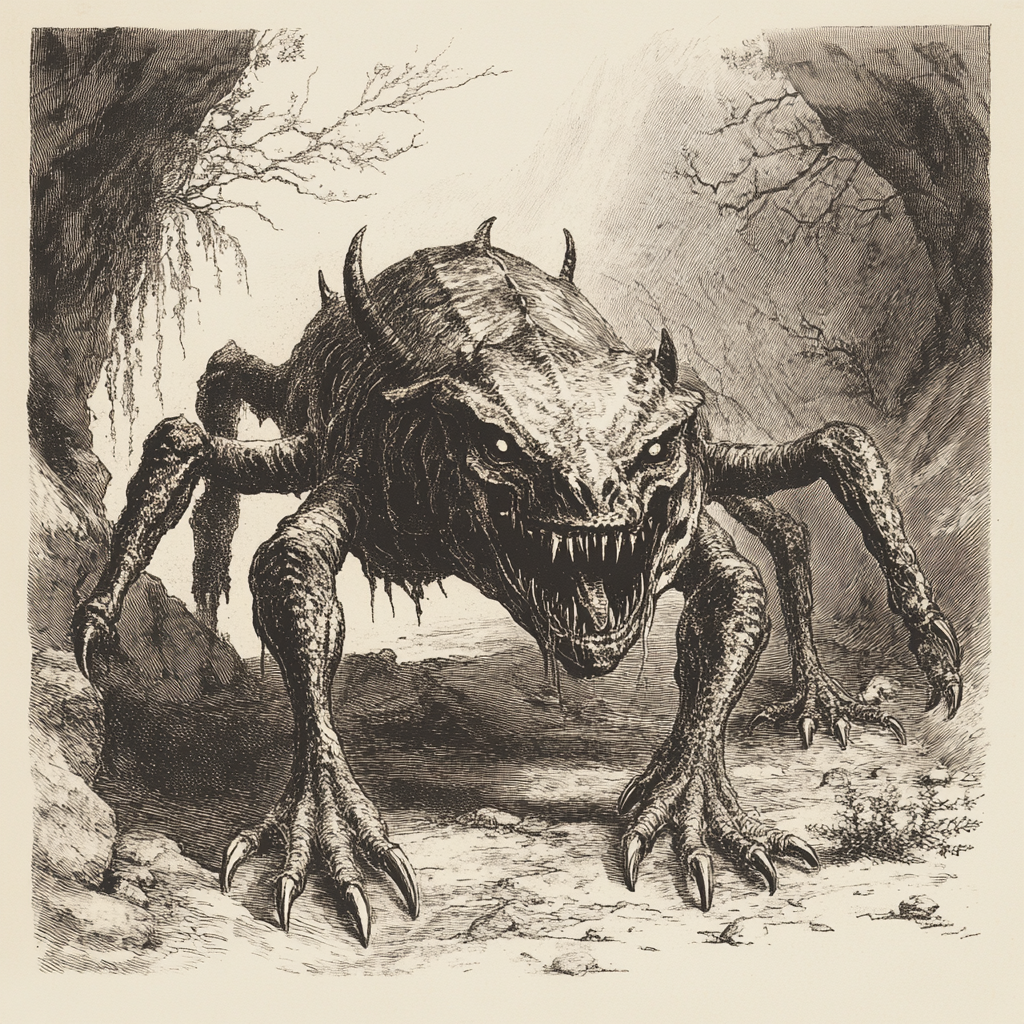
But fear soon overshadowed wonder. A hunting party, led by Thorneus, spied a massive six-legged reptile in the distance, its jaws lined with teeth like daggers, its scales dark as the Azure Veil’s depths. They named it a “Dreadmaw,” fleeing to warn the encampment. “A monster stalks the plains!” Thorneus shouted, gathering the builders of wood-and-stone homes. “It could devour us all!”

Panic gripped the Silvrens as they huddled in their nascent village, named Nuahaven in honor of their Shaper. “This land is cursed!” Liranae wept, clutching her children. “Quicksand, fire-spouts, and now beasts that dwarf the Trivox! Why did Nua bring us here?”

Vaelor, his voice trembling, confronted Tanes: “Prophet, you promised peace, but danger surrounds us! The Dreadmaws will feast on our bones!”

Tanes stood firm, her gaze steady as the Crest of Dawn. “Have faith in Nua, kin of Silvren. The Eternal Shaper led us here, and her harmony protects us. The beasts of our old world lived in peace; so too shall these. Trust, and venture forth.”

Yet fear kept them cowering, the Dreadmaw’s distant roars chilling their nights. Hunters refused to roam, and the encampment’s growth stalled, homes half-built under Luneth’s pale watch. “We cannot live like this!” Elira protested. “If we hunt, we die; if we stay, we starve!”

“Patience,” Tanes urged. “Nua’s plan unfolds slowly, as the moons cycle. Pray, and observe the land’s secrets.”

As time passed, hunting parties, driven by necessity, ventured cautiously again. They noticed a pattern: the Dreadmaws, though fearsome, never attacked. One group, led by Vaelor, watched a Dreadmaw bypass their scent, turning instead to a fallen Velithon. “It shuns us,” Vaelor marveled. “Perhaps we are not its prey, our scent unfit for its hunger.”

Another party encountered a different giant carnivore, a hulking six-legged beast with spines along its back, dubbed a “Spikecrest.” It too ignored them, feasting on smaller hexapods. “Nua shields us,” Elira whispered, her fear easing. “These beasts hunt not Elyrians, as Tanes foretold.”

The Silvrens grew bolder, their faith in Nua strengthened. Nuahaven flourished, its homes rising sturdy with timber from broad-leafed trees—not Veilwards, for Tanes forbade their cutting—and stone from the Titan Spires. Orchards of tart fruits bloomed, a reminder of Nua’s universal design. “The trinity binds all creation,” Tanes taught, “from Elyria to this new land. Nua’s will is one.”

By the fires of Nuahaven, under Korath’s crimson glow, the Silvrens speculated about the ancient caves. “Who were these giants?” Thorneus mused, carving a Velithon roast. “Their hands shaped stone with purpose, minds vast as the Azure Veil.”

Vaelor offered: “Perhaps they were Nua’s first children, before Elyrians, called to another realm by her will.”

Liranae countered: “Or they fled some great opposition, leaving these halls as warnings. Are they gone forever, or do they watch from hidden places?”

Tanes listened, then spoke: “The caves are a mystery, but Nua’s purpose endures. Live in harmony, honor the trinity, and fear not the unknown. The Shaper guides us, as she did through the sea to this promised land.”

Thus, the Silvrens thrived, their village a beacon of faith amid the strange and wondrous continent, their hearts anchored by Nua’s eternal harmony, even as questions of the vanished giants lingered like shadows in the Titan Spires.

The Book of Tanes: Chapter Two – The Drifts of Faith and the Shores of Promise

26 Jul

As the severed peninsula drifted upon the Azure Veil’s vast expanse, buoyed by mysterious forces beyond mortal ken, the Silvrens gazed back at the receding shoreline where General Korvanus’s army dwindled to specks under Solara’s fading light. A chorus of relief and awe rose from the people, their voices mingling with the gentle lap of waves against the floating land’s edges.

“Praise to Tanes!” cried Thorneus, the male elder, raising his arms toward the prophet who stood at the forefront, her form silhouetted against the three moons’ rising glow. “You have delivered us from the emperor’s grasp! Nua’s voice through you has wrought this miracle!”

Vaelor, the syren youth, echoed fervently: “Tanes, our savior! The land itself obeys your command!”

Liranae, the female mother, clutched her children close, tears streaming: “Blessed be Tanes, who led us to safety!”

But Tanes turned to them, her eyes stern yet compassionate, the wind from Sylvara’s tide tousling her hair. “Hold your praises, kin of Silvren. It was not I who parted the earth and set us adrift. Nua, the Eternal Shaper, has saved us through her divine will. Give thanks to the Shaper alone, for I am but her vessel.”

The people bowed their heads, murmuring prayers: “Glory to Nua, guardian of harmony.”

Yet joy bubbled forth, and some began to dance upon the grassy expanse, sharing meager stores of fruit and bread in celebration. Laughter echoed across the peculiar groves fringing the land, where strange trees with broad leaves and gnarled trunks swayed gently.

“Stop this revelry!” Tanes commanded, her voice cutting through the merriment like a Korveth current. “We float upon unknown waters, our resources finite. Conserve what we have—every morsel, every drop—for Nua’s path may be long.”

Thorneus paused mid-step: “But prophet, we have escaped death! A moment of joy strengthens the spirit.”

“Joy without wisdom invites opposition,” Tanes replied. “Boana lurks in excess. Save your strength for the trials ahead.”

Chastened, the Silvrens quieted, gathering in clusters to ration their supplies under the watchful eyes of Luneth, Sylvara, and Korath.

Soon after, as the island drifted further from familiar shores, Tanes assembled the people amid the groves. “Hear Nua’s guidance,” she proclaimed. “The sea offers bounty: catch the fishes that leap in these waters, gather the seaweed that clings to our edges. These shall sustain us. But mark my words—do not cut down these strange trees. They are woven into Nua’s design for our voyage; harm them not.”

Grumbles arose. Vaelor spoke first: “We are valley folk, not seagoers! Fish are for the coastal hordes; our bellies crave the grains and fruits of solid earth.”

Liranae added: “Seaweed? It tastes of salt and slime. Nua meant us for rivers and plains, not this endless blue.”

Tanes’s gaze hardened: “Foolish words! Nua provides what is needed, not what is desired. The beasts of the deep thrive on such fare without complaint. Would you invite Boana’s shadows by scorning the Shaper’s gifts? Eat as commanded, and faith shall nourish you.”

Humbled, the Silvrens named their floating haven “Nuadrift,” in honor of the Eternal Shaper’s mercy, and dubbed the strange trees “Veilwards,” for they seemed to ward against the sea’s depths with their resilient forms.

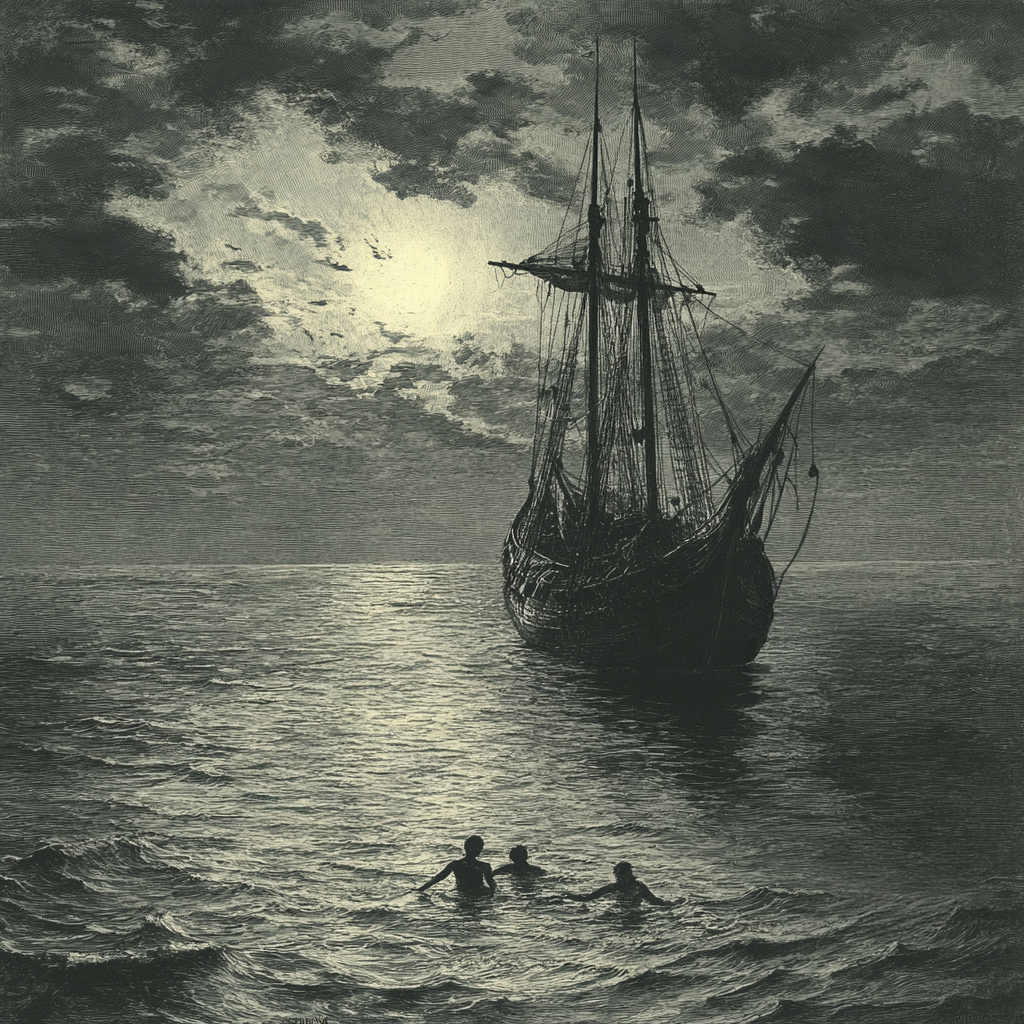
As Nuadrift wandered eastward under Solara’s gaze, a derelict sailing ship appeared on the horizon, its sails tattered like Serath wings after a storm, adrift and unmanned. Tanes pointed toward it: “Nua sends aid. Some must swim to the vessel and claim it for our people.”

Thorneus protested: “We are no sailors, prophet! The waves are treacherous, and we know not the ways of ropes and winds.”

Vaelor nodded: “Let it pass; we are safe on solid ground, even if it floats.”

Tanes shook her head: “You speak from fear, not faith. Nua foretells we shall need this ship. Brave the waters, for harmony demands action.”

A band of sturdy Silvrens—males, females, and syrens—plunged into the Azure Veil, reaching the ship and towing it back with improvised lines. Upon boarding, they discovered barrels of fresh water, preserved by some forgotten crew’s craft, a boon amid their dwindling stores. “Nua provides!” they shouted, lashing the vessel to Nuadrift’s edge with sturdy vines from the Veilwards. Though tempted, they dared not set sail to explore, for they were indeed no mariners, the ship’s mechanisms a mystery they could scarcely operate beyond basic tethering.

Days turned to cycles of the moons, and thirst gnawed at the Silvrens as rations dwindled. “Water fails us,” Liranae lamented to Tanes. “The barrels empty; must we drink the sea’s salt?”

“Keep faith in Nua,” Tanes urged. “The Shaper who parted the land will quench our need. Pray, and oppose despair.”

Just as desperation peaked, a modest iceberg drifted near, its crystalline form glistening under Korath’s crimson hue. With ropes from the ship and poles from lesser branches, they secured it to Nuadrift, chipping pure water from its sides. “Behold Nua’s mercy!” Tanes exclaimed, as the iceberg provided indefinitely, melting slowly into life-sustaining pools.

But as Nuadrift veered into colder currents, far from the warm embrace of the Verdant Crags, chill winds bit like fangs of forgotten beasts. The Silvrens, accustomed to the valley’s mild climes, huddled in all their garments, layers upon layers shielding against the frost.

“This cold pierces the soul,” Vaelor complained, teeth chattering. “We must burn something to warm ourselves!”

Thorneus agreed: “The Veilwards stand idle; a few branches for fire—Nua would understand.”

Tanes warned: “Heed my words! Do not cut the trees; they are sacred to our drift. Endure with faith, as the Calyx burrow through winter’s grasp.”

Yet defiance grew, and against her directives, they felled Veilwards, kindling fires that danced defiantly under Luneth’s pale watch. Warmth spread, but shadows lengthened.

Soon, Nuadrift trembled, waters rising at its edges as it began to sink, the mysterious forces faltering. Panic surged: “The island fails!” Liranae cried. “We drown for our folly!”

Tanes gathered them: “Pray to Nua! Apologize profusely for defying the Shaper’s command. Cut no more trees; repent, and mercy may come.”

On their knees, the Silvrens wailed: “Forgive us, Eternal Shaper! We scorned your gifts, inviting opposition. Restore our harmony!”

As waves lapped perilously high, another floating island appeared on the horizon, akin to Nuadrift but larger, its Veilwards groves intact. “Nua answers!” Tanes declared. Using the lashed ship, they ferried kin across in frantic trips—males hauling elders, females cradling young, syrens guiding the fearful. They abandoned the iceberg, salvaging only chunks already hewn, carrying them aboard for fleeting water.

Aboard the new haven, dubbed “Mercydrift,” thirst returned swiftly, the ice chunks melting away. “Water wanes again,” Thorneus despaired. “Shall we perish now?”

“Faith endures,” Tanes replied. “Nua leads us to promise.”

Just as lips cracked and voices weakened, land emerged—a vast, uninhabited continent, its shores lush with untrodden forests, streams cascading like silver threads, and game roaming freely under Solara’s benevolent rays. No Elyrian foot had marked this realm, a gift from Nua’s boundless creation.

Tanes proclaimed: “This is our new home, kin! Nua has guided us to peace.”

The Silvrens erupted in thanks: “Praise to Tanes, voice of the Shaper!”

But Tanes silenced them: “To Nua alone! The Eternal Shaper delivers.”

They prayed fervently, then celebrated with songs and feasts of fresh-caught game and stream water, their harmony renewed under the three moons, shadows retreating in the light of faith.

The Book of Tanes: Chapter One – The Trials of Prosperity and the Call to Exile

26 Jul

In the verdant embrace of the Silvren Valley, where the river of the same name wound like a silver ribbon under the vigilant gaze of Solara and the three moons—Luneth, Sylvara, and Korath—the Silvrens flourished. Descendants of Galoth’s kin, they adhered to the doctrines inscribed on the sacred tablets: prohibitions against discord and misbond, calls for unity and mercy, and rejection of false gods. Though their observance was not flawless—occasional whispers of opposition lingered like faint shadows—their loyalty to Nua’s code brought bountiful harvests from the fertile plains, sturdy villages of woven branches and stone, and a harmony that echoed the beasts’ innate peace. Children were born whole and wise, unions honored the sacred trinity, and Discordants, rare as they were, were treated with compassion, guided toward the Sanctuary of Whispers only if mercy demanded it.

Yet prosperity bred envy beyond the valley’s borders. Kingdoms to the north and east, steeped in the fractures of old wars and false faiths, gazed upon the Silvrens’ abundance with covetous eyes. First came the legions of Northwind, from the Whispering Range, their Trivox-mounted warriors clad in iron, intent on conquest. As they charged across the plains under Solara’s midday blaze, a sudden eclipse shrouded the land in unnatural twilight, the three moons aligning in rare defiance. The soldiers, spooked by the heavens’ omen, cried out in terror: “The moons devour the sun! Nua curses our advance!” Their ranks broke, fleeing back to the peaks, leaving the valley unscathed.

Not long after, the coastal hordes of Seawatch, wielding steel blades forged in seaside forges, marched inland, their banners fluttering like Serath wings. But as they encamped near the Starlit Canopy, a virulent disease swept through their tents—fevers that twisted limbs and clouded minds, born not of Boa Worms but of divine intervention. “This plague is Nua’s wrath!” wailed their healers, as warriors fell writhing. The invasion crumbled, the survivors limping homeward, whispering of the valley’s protected sanctity.

Then arose the dune lords of the Sunbaked Dunes, their chariots thundering across the southern fringes, armed with bronze-tipped spears and siege engines. A tempest unlike any before unleashed upon them: winds howling from the Verdant Crags, rains lashing like whips from Sylvara, ruining tents and spoiling supplies in muddy ruin. “The storms guard the Silvrens!” their commanders shouted amid the chaos, as provisions rotted and wheels sank into quagmires. Defeated by the elements, they retreated, their ambitions drowned.

The Southern Empire of the Verdant Crags, vast and shadowed, refrained from these assaults, its borders brushing the valley’s southern edge. But in time, a new ruler ascended: Emperor Dravenor the Cunning, a male of sharp intellect and darker ambitions, his court a labyrinth of intrigues where Lirana-like consorts and Thalyn-esque syrens vied for favor. Hearing tales of the Silvrens’ unyielding prosperity, he dispatched spies—cloaked as wanderers—to infiltrate the valley.

The spies, mingling among the Silvrens in their groves and along the riverbanks, conversed with elders and youths alike. “What grants you such peace and plenty?” one spy inquired of a syren farmer tending moss fields.

“Our loyalty to Galoth’s teachings,” the farmer replied. “We honor Nua’s code: no discord to birth twisted souls, no misbond to sow barren discord. Unity binds us, as the beasts live in harmony.”

Another spy questioned a female healer beneath the Starlit Canopy. “How do you repel invaders without steel?”

“Miracles of the Eternal Shaper,” she answered. “Our faith in the trinity—syren, female, male in sacred order—shields us from opposition.”

Returning to the emperor’s palace amid the mists of the Verdant Crags, the spies reported: “Their secret lies in devotion to Nua and Galoth’s laws, O Emperor. They shun division and embrace mercy.”

Dravenor, his eyes gleaming like polished iron, plotted subversion over decades, his schemes unfolding like slow-circling moons. First, he sent beautiful women, adorned in silks from distant dunes, to tempt the Silvren males into discord—uniting out of order, sans syren’s bond. “Seduce them,” he commanded, “and fracture their code.” Yet the Silvrens, steadfast, resisted; males turned away, invoking Galoth’s prohibitions, and the temptresses returned thwarted.

Undeterred, Dravenor dispatched false prophets, cloaked in robes mimicking Galoth’s wanderer garb, to whisper poisons: “The Discordants are abominations; slay them at birth to purify your blood.” But the Silvrens, remembering mercy’s mandate, rejected the lies. “Nua teaches compassion,” an elder proclaimed. “Even shadows deserve light.”

When this failed, charismatic men infiltrated, sowing seeds of division: “Divide by your views—conservers of old ways here, seekers of new paths there. Strength lies in separation.” Debates raged in village councils, but unity prevailed. “Galoth bids us one people,” a syren leader declared. “Division invites Boana.”

Frustrated after years of fruitless intrigue, Dravenor mustered a colossal army—Trivox riders, steel legions, siege towers rumbling from the crags—believing battle would force the Silvrens to violate Nua’s code through wrath and discord. “If they fight,” he mused, “their harmony shatters.”

As the empire’s shadows loomed, a prophet arose in the Silvren Valley: Tanes, a female of profound vision, descendant of Lira’s line, her voice resonant as the Lunara’s flow. Gathering the people under the Crest of Dawn, she proclaimed: “Nua speaks to me in dreams! The Eternal Shaper wills us to depart this land, lest opposition consume us here. Journey to the Azure Veil, enter the peninsula beyond, and await further guidance.”

Murmurs rippled through the assembly. A male elder, Thorneus, challenged: “Leave our ancestral home? The miracles protect us—why flee?”

Tanes replied, her eyes alight with divine fire: “Prosperity draws endless envy. Nua promises a new realm of peace, free from these trials. Trust in the Shaper, as Galoth did.”

A syren youth, Vaelor, protested: “The path to the Veil is perilous—storms, beasts, empires. What if we perish?”

“The three moons will guide us,” Tanes assured. “Unity in Nua’s code will be our shield. Stay, and Boana’s shadows deepen; go, and harmony endures.”

A female mother, Liranae, wept: “Our children—will they suffer the journey?”

Tanes embraced her: “Nua cradles the faithful. The beasts thrive in harmony; so shall we. Prepare your hearts and packs.”

Persuaded by her words and visions shared in council fires, the Silvrens gathered their kin, beasts, and sacred tablets, departing the valley in a great exodus toward the Azure Veil’s eastern shores. But Dravenor’s scouts spied their movement, and his army pursued, chariots thundering across the plains.

Reaching the peninsula—a narrow jut of land fringed by peculiar trees with unseen buoyant roots—the Silvrens encamped amid its groves, the sea lapping gently under Korath’s crimson watch. Whispers of pursuit grew: “The emperor’s forces draw near!” a scout reported.

Panic stirred. Thorneus confronted Tanes: “Prophet, you led us to a trap! The army approaches, and we are cornered by waves. Where is Nua’s promise?”

Vaelor echoed: “We should have stayed! Now death or chains await.”

Tanes, standing firm by the shore, raised her hands: “Fear not! Nua’s will unfolds. The Shaper who parted eclipses and storms will deliver us. Pray under the moons; harmony holds.”

Liranae pleaded: “The children tremble. What if the army slaughters us here?”

“Trust,” Tanes urged. “The trinity binds us; opposition cannot prevail.”

As the southern army crested the horizon—banners waving, Trivox snorting, General Korvanus at the fore—the ground trembled. With a mighty crack, the peninsula severed from the continent, shadows yielding to divine force, and began to float away upon the Azure Veil’s currents, buoyed up by mysterious forces.

Korvanus, halting his forces at the widening chasm, gazed in awe: “The land itself flees! Nua curses our pursuit—Trivox cannot swim, chariots sink. This mission is doomed.” Turning his army homeward, he left the Silvrens adrift, their floating haven carrying them toward unknown horizons under Nua’s eternal gaze.

The Book of Galoth: Chapter Five – The Wanderings of Galoth and the Revelation of Harmony

26 Jul

In the shadowed epochs of Elyria’s fracture, when emperors wielded steel and false gods whispered deceptions, there arose a wanderer from the heart of the Silvren Valley. Galoth, a syren of humble birth, descendant of Vael’s ancient line, possessed a spirit unyielding and eyes that beheld the world’s hidden truths. Drawn by an inner call he could not name, Galoth ventured southward, crossing the forbidden borders into the vast Southern Empire of Valthor the Dreamer. No sooner had his feet touched the Sunbaked Dunes than imperial guards seized him, chains binding his wrists as they dragged him before the emperor’s throne in the grand palace overlooking the Verdant Crags.

“Stranger from the north,” Valthor declared, his voice echoing through halls adorned with steel tapestries, “you defy my edict. The Silvren folk are barred from these lands, lest they bring unrest to my realm.”

Galoth, unbowed, replied, “I seek only wisdom, O Emperor, for the opposition that plagues Elyria calls me to mend what is broken.”

Valthor, intrigued yet wary, cast him into the dungeon depths, where shadows danced like Boa Worms under the faint glow of torches. But that night, as Luneth’s light pierced the palace windows, a dream visited Valthor. In it, Nua’s voice, faint yet commanding, spoke: “Release the wanderer, for he is the seeker you have longed for. Through him, harmony may yet return.”

Awakening with a start, Valthor summoned Galoth and unshackled him. “Go forth, wanderer,” the emperor said, his eyes softened by the vision. “You are free, for the Eternal Shaper wills it.”

Thus began Galoth’s great journey across Elyria, his path winding through plains and peaks, where he observed the beasts of Nua’s creation thriving in harmony despite Boana’s shadows. In the Whisperwood, he encountered a herd of Trivox, their swift forms grazing under Sylvara’s silver beam.

“Why do you dwell in peace amid the world’s discord?” Galoth asked the lead Trivox, a majestic male with fur like golden dunes.

The Trivox lifted its head and replied, “We follow the sacred sequence, wanderer. Syren precedes male in our matings, and no opposition taints our young. The winds carry our unity, and we run as one.”

Galoth nodded, pondering their words, and continued onward. By the banks of the Lunara River, he met a school of Glimmerfin fishes darting through the currents.

“Tell me,” Galoth inquired of the eldest Glimmerfin, a female whose scales shimmered like stars, “how do you evade the Boa Worms’ touch in these depths?”

“We circle in threes,” the Glimmerfin answered, “male, female, syren bound in order. Our eggs hatch pure, and the tides protect us from envy.”

Further into the Verdant Crags, Galoth conferred with a flock of Serath soaring above the mists.

“What secret keeps your flights harmonious?” he asked a syren Serath perched on a branch.

“We nest in trinity,” the Serath sang, “syren’s bond first, then male’s strength. No discord mars our wings; we soar above the shadows.”

In the plains near Seawatch, he spoke with burrowing Calyx, emerging from their tunnels.

“How do you thrive underground, untouched by war?” Galoth questioned a male Calyx.

“Our burrows echo Nua’s design,” the Calyx rumbled. “Sequence unbroken, young born whole. The earth shields our peace.”

Even the mighty Thalor in the Azure Veil’s depths shared wisdom: “We swim in cycles of three, wanderer, rejecting Boana’s lies.”

Yet Galoth’s path was fraught with perils. In the Kingdom of Northwind, amid the Frozen Spires, guards imprisoned him as a spy during a border skirmish. “Who are you, southerner?” demanded the jailer, a gruff male named Vortek.

“I am Galoth, seeker of harmony,” he replied. “The beasts live in unity; why do Elyrians war? Follow the sacred sequence, shun discord and misbond, and peace shall return.”

The jailer laughed. “Foolish words! Chains suit you better.” But that night, a miracle unfolded: the prison walls cracked as if by unseen hands, ice melting into freeing streams, and Galoth walked free under Korath’s gaze.

Caught in the midst of the Dune Wars, where steel clashed over oases, Galoth was ensnared by rebels. “Explain your presence, stranger,” barked General Dravok, a female warrior with scars like river veins.

“The animals heed Nua’s order,” Galoth urged. “Syren first, then male—no opposition. Wars end when hearts align thus.”

“Nonsense,” Dravok scoffed. “Steel speaks louder.” Yet a sudden sandstorm, miraculous and blinding, scattered the camp, allowing Galoth’s escape.

Imprisoned again in the coastal forts of Wavecrest during naval sieges, he conversed with a general named Marinor. “Your engines destroy what Nua built,” Galoth said. “Look to the Trivox; they ride the winds in harmony. Prohibit discord, embrace the trinity.”

The general sneered, “Dreams for the weak.” But flames erupted mysteriously in the armory, diverting guards, and Galoth fled into the night.

Through battles in the Plains Wars, where Trivox-mounted legions charged, Galoth preached to jailers and commanders alike. “The Serath fly without envy,” he told a syren warden named Lirath. “Why drown in opposition? Misbond weakens; discord births shadows.”

They mocked him, uncomprehending, but miracles—earthquakes, visions, sudden mists—freed him each time.

At last, a voice, soft as the Whispering Range’s winds, guided Galoth: “Cross the narrow bridge to the Isle of Shadows.” He followed to a slender land bridge arching over turbulent seas, leading to a small island ringed by cliffs. There, under Solara’s descent, Nua spoke through shifting shadows on the great cliff face, forms coalescing into words: “Galoth, faithful wanderer, inscribe my laws. Prohibit discord, the out-of-order union that births Discordants. Shun misbond, the incomplete bond that sows barren discord. Honor the trinity: syren, female, male in sequence. Live in unity as the beasts do, reject false gods, wage no unjust wars, treat all with mercy—even the Discordants, for they too are my creation. Spread harmony, for opposition fades in light.”

Galoth, enlightened, etched these doctrines onto tablets of stone from the cliff, finalizing a great philosophy of restoration.

Returning northward, he gifted the writings to Valthor as gratitude for his release and in hope of dissemination. “Emperor,” Galoth said, “these words from Nua can heal Elyria. Your power can echo them far.”

Valthor, moved by the tablets, read them aloud to his assembled subjects in the palace square. “Hear the wisdom of Galoth! Prohibit discord and misbond; embrace Nua’s harmony. Let us cast aside false gods and wars, living as one under the three moons.”

But the people, steeped in opposition, murmured in dissent. “He grows weak,” they whispered. “Dreams over steel?” In rebellion, they rose against him, slaying Valthor with blades forged in his own empire, his blood staining the dunes.

Yet in the Silvren Valley, Galoth’s kin embraced the doctrines. “These are Nua’s true words,” they proclaimed, adopting the laws as sacred. Thus, the Silvrens became Nua’s chosen Elyrians, guardians of harmony in a fractured world, their valley a beacon under Solara’s light.

The Book of Galoth: Chapter Four – The Fractures of Power and the Shadows of False Faith

25 Jul

As the shadows of opposition lengthened across Elyria, the once-unified people splintered further, their divisions carving deep scars into the land like the canyons etched by the Korveth River. From the scattered settlements arose chieftains, bold Elyrians who claimed dominion over valleys and crags, their authority forged in the fires of conflict. These chieftains grew into kings, ruling over burgeoning realms with crowns woven from the vines of the Starlit Canopy and scepters hewn from the stones of the Crest of Dawn. Yet power bred ambition, and kings clashed in wars that shook the foundations of the world, birthing emperors from the blood-soaked earth.

The first great wars erupted in the northern reaches, where the kings of Windhaven, descendants of Lyrin’s line, sought to claim the Frozen Spires from nomadic tribes who had wandered beyond the Whispering Range. King Vortan, a male of fierce resolve with eyes like storm clouds, led his warriors—armed at first with short wooden clubs bound in moss for grip—against the ice-clad foes. In the Battle of Frostveil Pass, under the pale light of Luneth, Vortan’s forces ambushed the enemy in a narrow gorge, clubs cracking against skulls as snow turned crimson. Heroes emerged from the fray: the syren Lirath, whose voice rallied the weary with songs of ancient harmony, shattering the foes’ morale; and the female Thornea, swift as a Darvish in the currents, who felled the rival chieftain with a well-aimed strike. From this victory, Vortan forged the Kingdom of Northwind, but peace was fleeting.

To the south, in the Verdant Crags and Sunbaked Dunes, wars raged over fertile oases and hidden springs. Queen Sylvara II, named for the moon of tides, ruled Mistveil with a nurturing yet iron will. Her armies clashed with the dune lords in the Siege of Sandspire, where defenders hurled stones from atop towering dunes while attackers burrowed tunnels like Calyx beasts. The art of war evolved amid these struggles: smiths in the crags discovered bronze by blending metals from the earth’s veins, crafting blades that gleamed under Solara’s gaze and pierced deeper than wood. Heroes like the male Dravenor, wielder of the first bronze axe, cleaved through enemy lines, his legend sung in the mists; and the syren Vespera, who orchestrated ambushes with cunning traps, turning the dunes into graves.

As generations waged these conflicts, iron supplanted bronze, mined from the depths of the Whispering Range and forged in roaring fires that echoed the winds’ howls. Kings armed their legions with iron spears and shields, clashing in the Plains Wars, where realms from the central lands battled for the fertile expanses bordering the Silvren Valley. Emperor Korath I, rising from Seawatch’s coastal might, unified the eastern shores through the Battle of Wavecrest, where iron-clad warriors stormed beaches defended by wooden barricades. His champion, the female Nirael, rode the first domesticated Trivox—once wild swift-footed beasts of the plains, now tamed through patient bonds and ridden with saddles of woven hide—charging into enemy flanks like a storm from the Azure Veil. The Trivox mounts revolutionized warfare, allowing swift strikes and retreats, their hooves thundering across the earth.

In time, steel emerged from alchemical forges in the south, tempered in the heat of Solara and cooled in the Lunara’s waters, yielding weapons of unmatched edge. Siege engines followed: towering catapults hewn from the Grove of Eternity’s ancient trees, hurling boulders over walls; and battering rams mounted on Trivox-drawn carts, shattering gates in the Empire Wars. Emperor Thalor the Vast, a male of imposing stature from the Sunbaked Dunes, wielded these innovations to conquer the Verdant Crags, his hero syren Marinor devising engines that rained fire upon besieged cities. Battles like the Fall of Craghold saw steel blades clash against iron, heroes perishing in droves— the female Elowena, defender of the walls, who held the breach alone until her last breath; and the male Korvan II, who led a daring night raid, his steel sword singing through the darkness.

Amid this ceaseless strife, the voice of Nua faded from the hearts of the Elyrians, drowned out by the clamor of war and the whispers of Boana. No longer could they hear the Eternal Shaper’s guidance in the winds or the waves; her commandments became distant echoes, forgotten like the dust of the first dead. In their spiritual void, false gods arose, crafted from the forms of Elyria’s beasts and twisted tales of Boana, whom some revered as a liberator rather than opposition. Temples sprouted like weeds across the lands: in the Frozen Spires, shrines to Trivorak, the swift god of the Trivox, depicted as a three-gendered deity with hooves of bronze and eyes of fire.

The theology of Trivorak preached that speed and conquest were divine mandates, urging followers to domesticate not just beasts but souls through ritual discords. In moonlit ceremonies beneath Korath’s crimson glow, priests—males, females, and syrens adorned in Trivox hides—engaged in deliberate discord: males uniting with females first, sans syren, to birth Discordants as offerings. These brutes, dubbed “Swiftspawn,” were raised as war beasts, their dim minds molded for battle, then slain in arenas to “ascend” to Trivorak’s eternal chase. Misbond rituals followed, where syrens and females joined without males, symbolizing “pure velocity” unbound by completion, their unions barren but celebrated with frenzied dances around iron altars.

In the coastal realms, the cult of Serathiel exalted the winged Serath as a goddess of skies and secrets, portraying her as a syren figure with feathers of steel and talons that clutched Boana’s “gifts.” Their theology claimed Boana as a benevolent twin to Nua, the “Shadow Weaver” who granted freedom from harmony’s chains. Rituals in cliffside temples involved aerial offerings: participants committed misbond atop precipices, syrens and females entwining while males watched, forbidden to join, evoking the “flight of incompleteness.” Discord followed in hidden chambers, birthing “Wingless Ones”—Discordants thrown from heights to “earn wings” in death, their screams echoing as praises to Serathiel. Lies wove Boana as the true creator of diversity, opposition as evolution, justifying the consumption of Discordant flesh in feasts rumored in the Isles of Echo, where it was said to grant visions of the skies.

Deeper in the dunes, the burrow-god Calyxor emerged, a deity of earth and hidden depths, embodied as a male with burrowing claws and eyes like buried gems. His followers twisted Boana into the “Underlord,” a force of renewal through decay. Their theology held that discord birthed “Earthkin” Discordants, sacred vessels of Calyxor’s will, to be buried alive in rituals under Sylvara’s silver light, their struggles enriching the soil. Misbond ceremonies in underground lairs saw syrens and females unite in darkness, males excluded to symbolize the “void’s embrace,” fostering barrenness as a path to enlightenment. These unclean practices spread like Boa Worms, corrupting unions and swelling the ranks of Discordants, whom some slew for the Sanctuary of Whispers, others exploited as laborers in mines, their brutish strength chained to false divine purpose.

From this era of fractured faiths and endless wars arose Emperor Valthor the Dreamer, a male of towering presence with hair like the crimson of Korath and eyes deep as the Azure Veil. He forged the Southern Empire, encompassing the Verdant Crags, Sunbaked Dunes, and all lands south of the Silvren Valley, through campaigns of steel and siege. Yet in a vision under Luneth’s pale beam, Nua’s faint whisper warned him: “Touch not the heart of Elyria, lest opposition consume thee.” Thus, Valthor halted at the valley’s borders, decreeing no soul from Silvren might cross south, under penalty of chains in his dungeon depths, fearing their purity might unravel his realm.

Valthor’s court was a web of tangled bonds, his relationships with the other genders a mirror of Elyria’s chaos. His chief consort, the female Lirana, graceful as the Lunara’s flow, bore him heirs through sacred unions, yet jealousy festered when he favored the syren Thalyn, harmonious and cunning, whose whispers shaped his edicts. In fits of passion, Valthor orchestrated discords: uniting with Lirana first, sans Thalyn, birthing Discordants he exiled to the dunes as “sand guardians,” their brutish forms patrolling borders. Misbonds between Lirana and Thalyn, encouraged by the emperor for his voyeuristic rituals, yielded no life but sowed division, the women clashing in court intrigues that led to poisonings and banishments.

Horrors mounted under his rule: Discordants slain in public spectacles to appease false gods, their blood anointing steel blades; wars waged against dune rebels, siege engines crushing villages; and temples to Boana disguised as “Shadow Sanctums,” where rituals devoured the weak. Valthor, in his private chambers overlooking the Verdant Crags, yearned for a better world—a return to harmony where wars ceased and faiths united. He dreamed of peace under Solara’s light, but blinded by opposition, he knew not the path, his edicts enforcing division even as he wept for unity. In his despair, he sought wanderers and prophets, hoping for guidance, yet Boana’s shadows veiled the truth.