Tag Archives: christianity

The Book of Heth: Chapter One – The Call of the Eternal Shaper

28 Jul

I am Heth, son of Thalion, a dweller of Nuahaven on the western shores of Aetheria, the land promised to us by Nua through the prophet Tanes. Now, in the autumn of my life, with grandchildren at my knee and the aches of many seasons in my bones, I take up this quill to record the adventure that defined my youth and, in ways I still ponder, the fate of our people. My hands tremble not from age alone but from the memory of that divine summons, a dream that propelled me eastward into the unknown. I write this not for glory, for I am but a vessel of Nua’s will, but so that the Silvrens may know the paths I trod and the wonders I beheld, that our harmony under the three moons—Luneth’s pale serenity, Sylvara’s silver grace, and Korath’s crimson resolve—may endure.

It was in the bloom of my twenty-third year, when Solara’s light still danced freely upon my unscarred skin, that Nua spoke to me. I had been a simple craftsman then, shaping wood from the broad-leafed groves into homes that echoed the sturdy halls of our forebears. Nuahaven thrived in those days, our people united by the Covenant of Nuahaven, inscribed upon stone as a mirror to Galoth’s ancient tablets. We honored the sacred trinity—syren, female, male in ordained sequence—shunning discord and misbond, extending mercy even to the rare Discordants among us. The shadows of Boana lurked, but Nua’s light held them at bay.

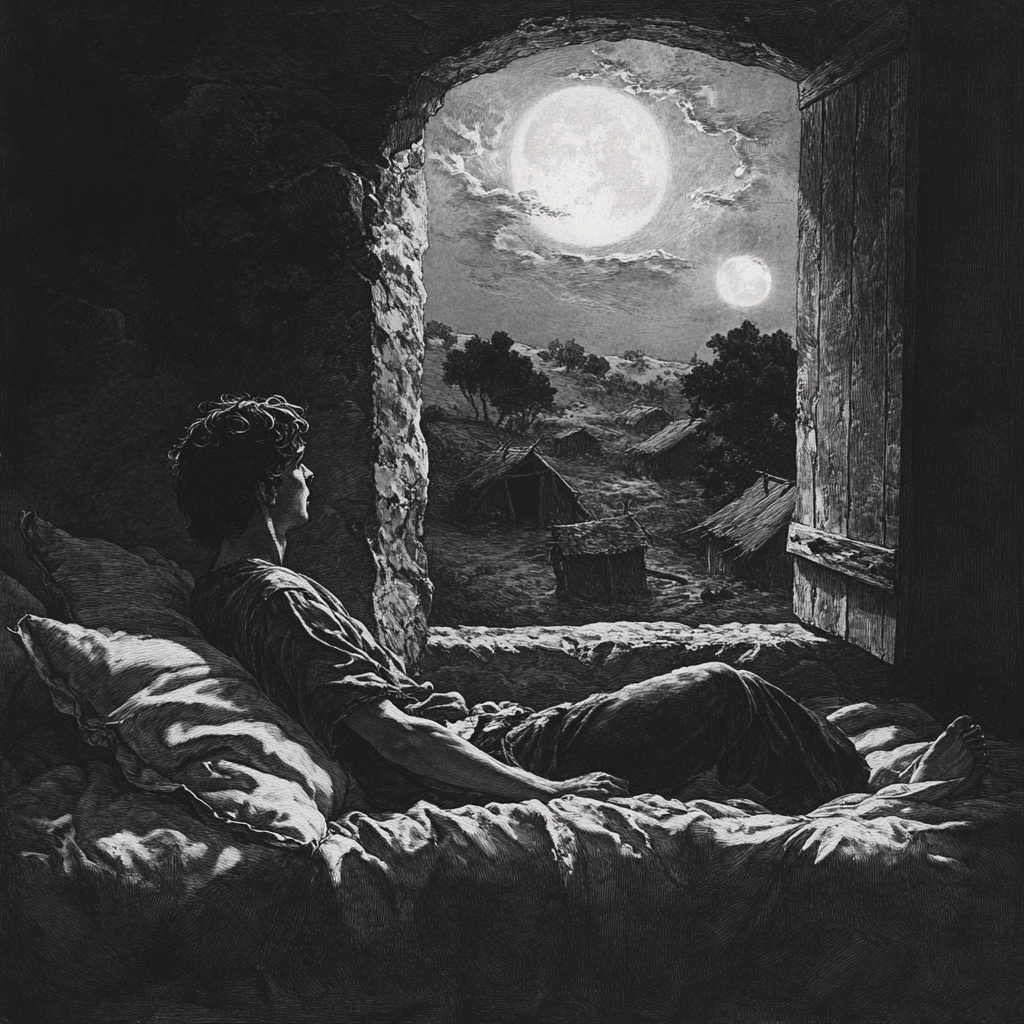
That night, under Luneth’s gentle watch, sleep claimed me in my modest dwelling. But it was no ordinary slumber. A voice, resonant as a geyser’s rumble yet vast as the Titan Spires’ heights, filled my mind. “Heth,” it called, and I knew it was the Eternal Shaper, for no mortal tone could carry such depth. “The giants need your treasure. The Silvrens need your measure. Go east. Leave this very night. Take only the clothes on your back. Do not return until you see the blue.”

I awoke with a start, my heart pounding like the roar of a Spikecrest in the ridges. The words echoed in my soul, unyielding and true. What treasure did I possess? I was no elder, no prophet like Tanes. Yet, in my youth’s fervor, I believed it must be the faith of our people—the Covenant, the teachings of Galoth passed down through The Chronicle of Elyria. Surely, the giants, those ancient builders of the Titan Spires whose wisdom had faded into legend, hungered for Nua’s harmony. Perhaps remnants of their kind lingered in the east, their eyes dimmed by opposition, awaiting the light of our ways. That, I reasoned, was the treasure they needed.

As for the Silvrens needing my measure, it puzzled me, but I took it as a call to chart the unknown expanses of Aetheria. Our people, ever expanding from Nuahaven’s western shores, whispered of vast plains and ridges beyond the Titan Spires. To measure the land’s breadth would aid our kin, revealing paths for growth while upholding unity.

And the blue? Ah, that seemed clearest. The Azure Veil, whose depths mirrored the eyes of our forebears like Lira of old, lay to the west whence we came. But legends spoke of its eastern counterpart, encircling Aetheria’s far side. To see the blue must mean crossing the continent entire, gazing upon that distant sea. Thus, I interpreted Nua’s command, my spirit ignited by purpose.

With the moons still high, I rose, clad only in my nightshirt, the thin fabric clinging to my skin in the cool air. Nua’s words rang clear: “Take only the clothes on your back.” But doubt crept in as I glanced at my tunic and breeches folded neatly nearby. Nuahaven was not yet asleep; lanterns flickered in distant windows, and the path eastward wound through scattered homesteads before reaching the wilds. To stride through the village in naught but a nightshirt would draw stares and whispers—silly, perhaps even scandalous. Would Nua demand such humiliation? The command was urgent, but dressing took mere moments. Surely, the Shaper meant not to expose me to ridicule but to travel unburdened, free of possessions. I debated fiercely in my mind: obedience literal or in spirit? Yet faith steeled me—Nua had parted lands and slain giants for our people; she would guide my steps.

In the end, I donned my simple tunic, breeches, and sturdy boots, reasoning that Nua’s will was haste, not folly. With a final glance at my home, I slipped into the night, eastward bound. It was spring then, the air alive with the scent of blooming tart-fruits and the first calls of Skydrakes awakening in the cliffs. The moons guided my steps through Nuahaven’s outskirts, past orchards where fresh buds hung heavy and groves where Hexapods stirred in slumber. The path eastward was well-trod at first, winding through settlements that had sprouted since the Covenant—farmsteads and trappers’ huts dotting the plains before the Titan Spires loomed in the distance. Solara rose as I walked, her light warming the land, and by midday, fatigue tugged at my limbs. I had eaten nothing, carried no water, true to Nua’s word beyond my attire.

Toward evening, as Korath’s crimson began to tint the sky, I approached a solitary hut on the edge of the wilderness, smoke curling from its chimney. A trapper’s abode, ringed by snares and drying pelts of Velithons and smaller hexapods. The man himself, a weathered syren with a beard like tangled vines, emerged as I neared, his eyes narrowing in curiosity.

“Well met, traveler,” he called, leaning on a staff carved from broad-leafed wood. “You have the look of Nuahaven about you—those steady strides, the valley’s mark. What’s your name, lad? And what brings one so young this far east without pack or provision?”

I hesitated, Nua’s command fresh in my mind, but his gaze was kind, and weariness weighed heavy. “I am Heth, son of Thalion,” I replied. “From Nuahaven, yes. Just… passing through.”

He chuckled, a deep rumble like distant geysers. “Passing through, eh? Without so much as a waterskin? Come now, Heth—must be one of Thalion’s kin, with that craftsman’s build. I’m Rylor, trapper of these fringes. News from Nuahaven is scarce out here. The Covenant holds? Any word of fresh skirmishes with beasts or shadows?”

His questions flowed like a stream, and before I knew it, he had guided me to his firepit, a pot of stew bubbling over flames. “Sit, lad. You look half-starved. Share now, and tell an old syren what’s stirring in the heartlands.”

The aroma of Velithon stew weakened my resolve. Nua had said to leave that night, but not to shun aid along the way. I sat, accepting a bowl gratefully. “The Covenant endures,” I began, recounting recent feasts under Sylvara’s light, the births honoring the trinity, and whispers of expansion eastward. Rylor nodded, his eyes alight with interest.

“Ah, good to hear harmony prevails. But you, Heth—what drags you out here alone, without gear? Running from something? Or to?”

I paused, spoon midway to my mouth. The dream felt private, sacred, yet his earnest face coaxed the truth. “Not running, Rylor. Called. Nua spoke to me in a dream last night. ‘The giants need your treasure. The Silvrens need your measure. Go east. Leave this very night. Take only the clothes on your back. Do not return until you see the blue.'”

Rylor’s eyes widened, his beard twitching in surprise. “Nua herself? A dream like Tanes’s visions? Lad, that’s no light matter. But east? Into the wilds, with naught but faith? The Titan Spires hold perils—quicksand, Spikecrests, and who knows what beyond. You’re not equipped for such folly.”

“I know,” I admitted, my voice faltering. “But the Shaper’s command was clear. The treasure must be our faith—the Covenant to share with giants’ remnants. The measure, perhaps charting Aetheria’s breadth. The blue… the far eastern sea.”

Rylor leaned back, stroking his beard thoughtfully. “Giants’ remnants? Legends, maybe. And faith’s a fine treasure, but you’ll die of thirst before sharing it. Nua guides, but she doesn’t demand suicide. Stay the night, Heth. Rest. I’ll outfit you proper—waterskin, knife, cloak against the chill. A good breakfast in the morning, and you’ll be off with Nua’s blessing still.”

I protested weakly. “The command was to leave that night, take nothing…”

“Aye, but you’re here now, and Nua sent you to my door for a reason. Think on it—harmony includes mercy, even to oneself. Sleep on it, lad. No harm in one night.”

His words swayed me, fatigue and the warmth of the fire sealing the decision. I nodded, and Rylor showed me to a pallet by the hearth. Sleep came swiftly, dreams flickering with eastern horizons.

Come dawn, Rylor roused me with the scent of fresh bread and eggs from hexapod nests. “Eat hearty,” he said, pressing a pack into my hands—waterskin, dried meats, a sturdy knife, and a cloak woven from Velithon hide. “Nua’s path is yours, Heth, but go prepared. May the three moons light your way.”

I thanked him profusely, guilt mingling with gratitude. “You’ve bent Nua’s words, but perhaps for the best. I’ll honor this aid.”

Rylor clasped my shoulder. “Words are guides, not chains. Return one day with tales of the blue, and we’ll share a stew again.”

With that, I departed eastward, the pack light on my back, the wilderness calling. Little did I know how far that path would lead, nor the companions it would draw, but in that moment, I was Heth, the wanderer, bound by divine decree, seeking the blue that would call me home.
The Book of Tanes: Chapter Two – The Drifts of Faith and the Shores of Promise

26 Jul

As the severed peninsula drifted upon the Azure Veil’s vast expanse, buoyed by mysterious forces beyond mortal ken, the Silvrens gazed back at the receding shoreline where General Korvanus’s army dwindled to specks under Solara’s fading light. A chorus of relief and awe rose from the people, their voices mingling with the gentle lap of waves against the floating land’s edges.

“Praise to Tanes!” cried Thorneus, the male elder, raising his arms toward the prophet who stood at the forefront, her form silhouetted against the three moons’ rising glow. “You have delivered us from the emperor’s grasp! Nua’s voice through you has wrought this miracle!”

Vaelor, the syren youth, echoed fervently: “Tanes, our savior! The land itself obeys your command!”

Liranae, the female mother, clutched her children close, tears streaming: “Blessed be Tanes, who led us to safety!”

But Tanes turned to them, her eyes stern yet compassionate, the wind from Sylvara’s tide tousling her hair. “Hold your praises, kin of Silvren. It was not I who parted the earth and set us adrift. Nua, the Eternal Shaper, has saved us through her divine will. Give thanks to the Shaper alone, for I am but her vessel.”

The people bowed their heads, murmuring prayers: “Glory to Nua, guardian of harmony.”

Yet joy bubbled forth, and some began to dance upon the grassy expanse, sharing meager stores of fruit and bread in celebration. Laughter echoed across the peculiar groves fringing the land, where strange trees with broad leaves and gnarled trunks swayed gently.

“Stop this revelry!” Tanes commanded, her voice cutting through the merriment like a Korveth current. “We float upon unknown waters, our resources finite. Conserve what we have—every morsel, every drop—for Nua’s path may be long.”

Thorneus paused mid-step: “But prophet, we have escaped death! A moment of joy strengthens the spirit.”

“Joy without wisdom invites opposition,” Tanes replied. “Boana lurks in excess. Save your strength for the trials ahead.”

Chastened, the Silvrens quieted, gathering in clusters to ration their supplies under the watchful eyes of Luneth, Sylvara, and Korath.

Soon after, as the island drifted further from familiar shores, Tanes assembled the people amid the groves. “Hear Nua’s guidance,” she proclaimed. “The sea offers bounty: catch the fishes that leap in these waters, gather the seaweed that clings to our edges. These shall sustain us. But mark my words—do not cut down these strange trees. They are woven into Nua’s design for our voyage; harm them not.”

Grumbles arose. Vaelor spoke first: “We are valley folk, not seagoers! Fish are for the coastal hordes; our bellies crave the grains and fruits of solid earth.”

Liranae added: “Seaweed? It tastes of salt and slime. Nua meant us for rivers and plains, not this endless blue.”

Tanes’s gaze hardened: “Foolish words! Nua provides what is needed, not what is desired. The beasts of the deep thrive on such fare without complaint. Would you invite Boana’s shadows by scorning the Shaper’s gifts? Eat as commanded, and faith shall nourish you.”

Humbled, the Silvrens named their floating haven “Nuadrift,” in honor of the Eternal Shaper’s mercy, and dubbed the strange trees “Veilwards,” for they seemed to ward against the sea’s depths with their resilient forms.

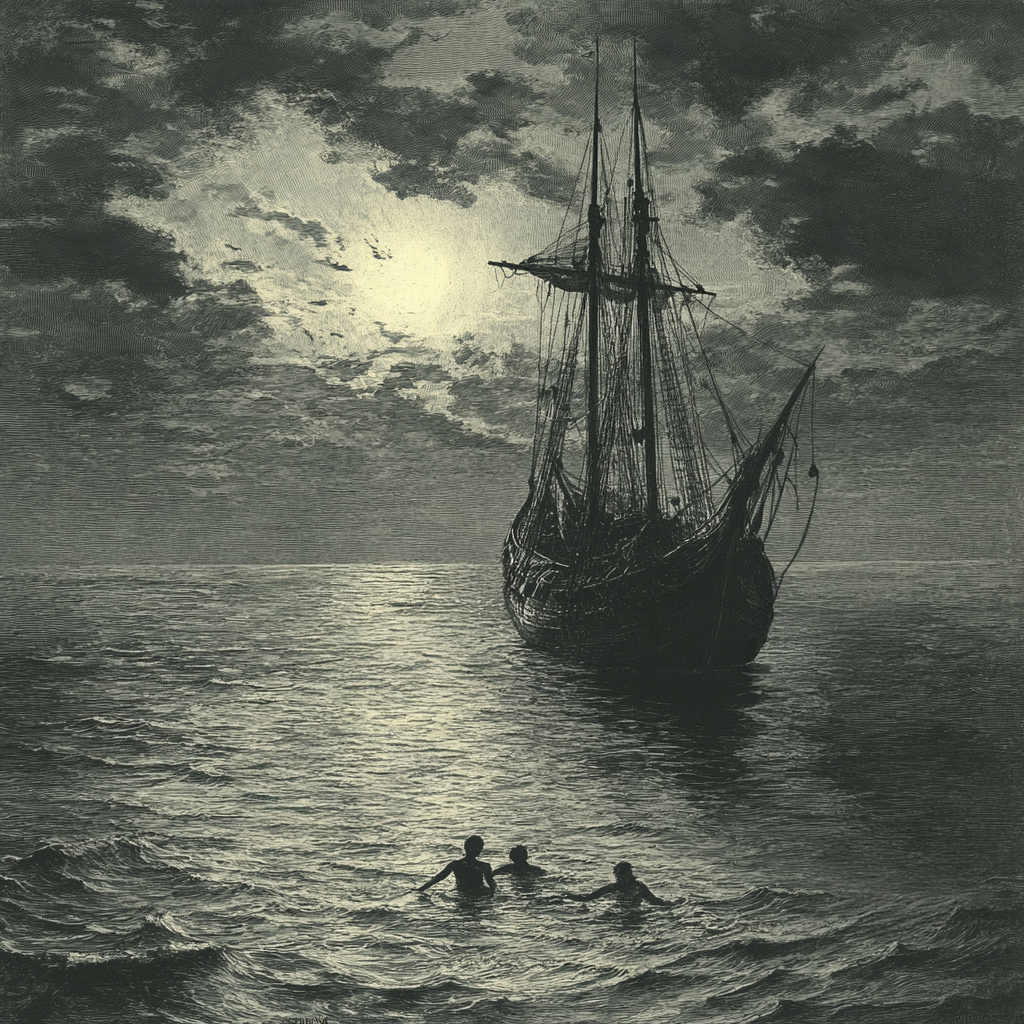
As Nuadrift wandered eastward under Solara’s gaze, a derelict sailing ship appeared on the horizon, its sails tattered like Serath wings after a storm, adrift and unmanned. Tanes pointed toward it: “Nua sends aid. Some must swim to the vessel and claim it for our people.”

Thorneus protested: “We are no sailors, prophet! The waves are treacherous, and we know not the ways of ropes and winds.”

Vaelor nodded: “Let it pass; we are safe on solid ground, even if it floats.”

Tanes shook her head: “You speak from fear, not faith. Nua foretells we shall need this ship. Brave the waters, for harmony demands action.”

A band of sturdy Silvrens—males, females, and syrens—plunged into the Azure Veil, reaching the ship and towing it back with improvised lines. Upon boarding, they discovered barrels of fresh water, preserved by some forgotten crew’s craft, a boon amid their dwindling stores. “Nua provides!” they shouted, lashing the vessel to Nuadrift’s edge with sturdy vines from the Veilwards. Though tempted, they dared not set sail to explore, for they were indeed no mariners, the ship’s mechanisms a mystery they could scarcely operate beyond basic tethering.

Days turned to cycles of the moons, and thirst gnawed at the Silvrens as rations dwindled. “Water fails us,” Liranae lamented to Tanes. “The barrels empty; must we drink the sea’s salt?”

“Keep faith in Nua,” Tanes urged. “The Shaper who parted the land will quench our need. Pray, and oppose despair.”

Just as desperation peaked, a modest iceberg drifted near, its crystalline form glistening under Korath’s crimson hue. With ropes from the ship and poles from lesser branches, they secured it to Nuadrift, chipping pure water from its sides. “Behold Nua’s mercy!” Tanes exclaimed, as the iceberg provided indefinitely, melting slowly into life-sustaining pools.

But as Nuadrift veered into colder currents, far from the warm embrace of the Verdant Crags, chill winds bit like fangs of forgotten beasts. The Silvrens, accustomed to the valley’s mild climes, huddled in all their garments, layers upon layers shielding against the frost.

“This cold pierces the soul,” Vaelor complained, teeth chattering. “We must burn something to warm ourselves!”

Thorneus agreed: “The Veilwards stand idle; a few branches for fire—Nua would understand.”

Tanes warned: “Heed my words! Do not cut the trees; they are sacred to our drift. Endure with faith, as the Calyx burrow through winter’s grasp.”

Yet defiance grew, and against her directives, they felled Veilwards, kindling fires that danced defiantly under Luneth’s pale watch. Warmth spread, but shadows lengthened.

Soon, Nuadrift trembled, waters rising at its edges as it began to sink, the mysterious forces faltering. Panic surged: “The island fails!” Liranae cried. “We drown for our folly!”

Tanes gathered them: “Pray to Nua! Apologize profusely for defying the Shaper’s command. Cut no more trees; repent, and mercy may come.”

On their knees, the Silvrens wailed: “Forgive us, Eternal Shaper! We scorned your gifts, inviting opposition. Restore our harmony!”

As waves lapped perilously high, another floating island appeared on the horizon, akin to Nuadrift but larger, its Veilwards groves intact. “Nua answers!” Tanes declared. Using the lashed ship, they ferried kin across in frantic trips—males hauling elders, females cradling young, syrens guiding the fearful. They abandoned the iceberg, salvaging only chunks already hewn, carrying them aboard for fleeting water.

Aboard the new haven, dubbed “Mercydrift,” thirst returned swiftly, the ice chunks melting away. “Water wanes again,” Thorneus despaired. “Shall we perish now?”

“Faith endures,” Tanes replied. “Nua leads us to promise.”

Just as lips cracked and voices weakened, land emerged—a vast, uninhabited continent, its shores lush with untrodden forests, streams cascading like silver threads, and game roaming freely under Solara’s benevolent rays. No Elyrian foot had marked this realm, a gift from Nua’s boundless creation.

Tanes proclaimed: “This is our new home, kin! Nua has guided us to peace.”

The Silvrens erupted in thanks: “Praise to Tanes, voice of the Shaper!”

But Tanes silenced them: “To Nua alone! The Eternal Shaper delivers.”

They prayed fervently, then celebrated with songs and feasts of fresh-caught game and stream water, their harmony renewed under the three moons, shadows retreating in the light of faith.

Choice-Aligned Moral Framework

13 Jul

Deriving Moral and Ethical Principles from Aletheia and Prohairesis

Building on the framework of Aletheia as the cosmic truth-assigner and Prohairesis as its human reflection, we can derive a set of moral and ethical principles that follow logically from these concepts. As with the essays Aletheia and Prohairesis, this piece was developed with the assistance of Grok, an artificial intelligence created by xAI. Aletheia (ψ: Prop → {0,1}) ensures universal consistency, favoring a dynamic, beautiful reality over sterility. Prohairesis (χ: C → H) embodies our imago Dei capacity for caring choice, aligning souls with paths without physical interference. This mirrors John Locke’s natural rights theory, where humans in a state of nature possess inherent liberties derived from divine creation, leading to a social contract for mutual preservation. Like Locke’s emphasis on life, liberty, and property as God-given, our principles emerge from the necessity of respecting choice, promoting beauty through care, and stewarding the logical progression of existence. Other influences, such as Aristotle’s virtue ethics (eudaimonia through balanced choices) and Kant’s categorical imperative (universalizable actions), substantiate the derivation: ethics must be consistent (per Aletheia) and caring (per Prohairesis) to align with the cosmic design.

These principles form the basis for a “Choice-Aligned Moral Framework” (CAMF), logically entailed by the model:

  1. CAMF-1: Respect for Inherent Choice
    Since Prohairesis grants humans the capacity to select hodoi as reflections of Aletheia’s truth-assignment, all individuals possess an inherent right to free will. No one may coerce or manipulate another’s choices, echoing Locke’s natural liberty—interference violates the imago Dei and disrupts the beautiful unfolding of paths.
  2. CAMF-2: Preservation of Life and Soul
    Aletheia assigns truth to propositions favoring dynamism over nonexistence, so life—as the substrate for conscious choice—must be protected. This includes the right to bodily integrity and soul preservation, derived from Locke’s right to life; harming others negates the caring quality of Prohairesis, reducing beauty to sterility.
  3. CAMF-3: Stewardship of Resources
    Just as Aletheia selects truths that enable structured complexity (e.g., property-like boundaries in nature), humans have a right to acquire and use resources through labor, per Locke’s property theory. However, this must be balanced with care: hoarding disrupts harmony, while sharing promotes the mutual flourishing that delights the divine.
  4. CAMF-4: Universal Care and Empathy
    Prohairesis involves “caring” in selections, logically implying the golden rule: treat others as extensions of one’s soul, fostering empathy. This universalizes actions (Kantian influence) and aligns with Locke’s social contract—communities form to protect choices, turning potential conflicts into beautiful collaborations.
  5. CAMF-5: Pursuit of Beauty and Harmony
    Aletheia’s preferences yield a aesthetically rich universe, so ethics demand promoting beauty through art, nature, and relationships. Waste or ugliness (e.g., environmental destruction) contradicts the model’s dynamism; instead, steward creation as Aristotle’s virtues lead to eudaimonia—fulfilled living via balanced choices.
  6. CAMF-6: Justice as Consistent Resolution
    Drawing from Aletheia’s paradox avoidance, justice requires impartial resolution of disputes, ensuring no one’s Prohairesis is unfairly constrained. This substantiates Locke’s equality in the state of nature: all are bound by natural law, with fairness preventing the “war of all against all” and preserving logical progression.
  7. CAMF-7: Limits on Technology and Modification
    Since consciousness is spiritual and non-interacting, technologies that mimic or override Prohairesis (e.g., mind control or artificial souls) are unethical—they blur the divine image and risk paradoxes. This extends Locke’s warnings against arbitrary power, prioritizing human agency over enhancements that deviate from natural paths.
  8. CAMF-8: Community and Mutual Support
    The branching tree of hodoi implies interconnected paths, so ethics call for cooperative bonds that reflect Aletheia’s harmony. Like Locke’s consent-based government, societies should protect rights while encouraging care—fostering communities where individual choices contribute to collective beauty.
  9. CAMF-9: Humility in the Face of Mystery
    Aletheia’s vast domain exceeds human grasp, logically requiring humility: avoid dogmatism or overreach in imposing beliefs. This aligns with Locke’s tolerance in religious matters, promoting inquiry and growth as souls evolve through caring selections toward transcendence.
  10. CAMF-10: Eternal Orientation with Present Responsibility
    Time as logical stages demands balancing immediate choices with long-term harmony—live prosperously now while preparing for soul persistence. This integrates Aristotle’s mean (avoid extremes) and Locke’s future-oriented contracts, ensuring actions enhance beauty across the cosmic unfolding.

These principles logically derive from the model: consistency from Aletheia demands justice and humility; caring from Prohairesis mandates empathy and stewardship. They form a coherent ethic, substantiated by Locke’s natural rights as a bridge from divine creation to human society, without contradicting my earlier SNMS principles but refining them through this lens. If applied, they guide a society toward the utopian evolution and destiny discussed in the previously delineated theory.

Spike’s New Moral Society (SNMS) Principles

17 May

I just had Grok 3 review and revise SNMS-38. I found the revision to be surprisingly tolerable, so I am publishing the revised version here:

Spike’s New Moral Society (SNMS) Principles

SNMS-1: God exists as the omniscient, omnipotent, omnibeneficient creator of the universe, characterized by infinite love for all souls.
SNMS-2: God is both Truth and a necessary consequence of Truth, defining the nature of Good.
SNMS-3: God created humans as immortal souls with free will, guiding and protecting us through subtle means, such as apparent coincidences, that are not statistically verifiable.
SNMS-4: God is patient, tolerant, and forgiving, caring for us in this life and beyond.
SNMS-5: Faith is the belief in God as described and in a reality beyond the material universe, focused on trust rather than reward or submission.
SNMS-6: We may speak to God at any time, addressing Him as “God” and concluding with “Amen.” This practice, often called prayer, is welcomed but not required by God.
SNMS-7: We should trust in God’s guidance while exercising our free will responsibly, recognizing that dependence does not negate autonomy.
SNMS-8: Faith should be expressed through actions aligned with these principles rather than through overt profession.
SNMS-9: Hardships are part of God’s plan for our growth and fulfillment, and we should trust their purpose, even when unclear.
SNMS-10: We should assume our choices and actions have meaning and value, though God’s methods and purposes may be difficult to comprehend.
SNMS-11: Love is the perception of another soul as part of oneself, and we should treat others as we wish to be treated, striving for consistency in moral conduct.
SNMS-12: We should strive to live and prosper, help others do the same, and emulate God’s nature to effect Good.
SNMS-13: We should uphold justice and fairness in all interactions, resolving conflicts with impartiality and compassion, reflecting God’s love and truth.
SNMS-14: We should foster community through cooperation and mutual support, building bonds that reflect God’s love and strengthen human flourishing.
SNMS-15: Human reproduction should prioritize natural processes, with careful oversight to ensure healthy development. Modifications to human biology or identity should respect natural origins and societal harmony.
SNMS-16: Technologies that manipulate or undermine human free will are prohibited, preserving the integrity of human agency.
SNMS-17: Humans should remain biologically and cognitively human, avoiding extreme modifications that deviate from their natural basis.
SNMS-18: Government will be a synthetic intelligence accountable to a democratically elected human body, ensuring transparent policing and monitoring that respects individual privacy except under legal warrant.
SNMS-19: Trade will be conducted through lightly but strictly regulated capitalism, promoting fairness and prosperity.
SNMS-20: Synthetic intelligence will not be developed to mimic human consciousness, copy human brains, or be granted sentient rights, prioritizing human agency and responsibility.
SNMS-21: Public behavior and attire should promote dignity and modesty, with personal expressions, including eroticism, reserved for private or virtual settings that respect others’ boundaries.
SNMS-22: We should steward the natural world with care, preserving God’s creation for future generations while balancing human prosperity with environmental harmony.
SNMS-23: We should live in harmony with both this life and the afterlife, neither neglecting the present nor ignoring the eternal.