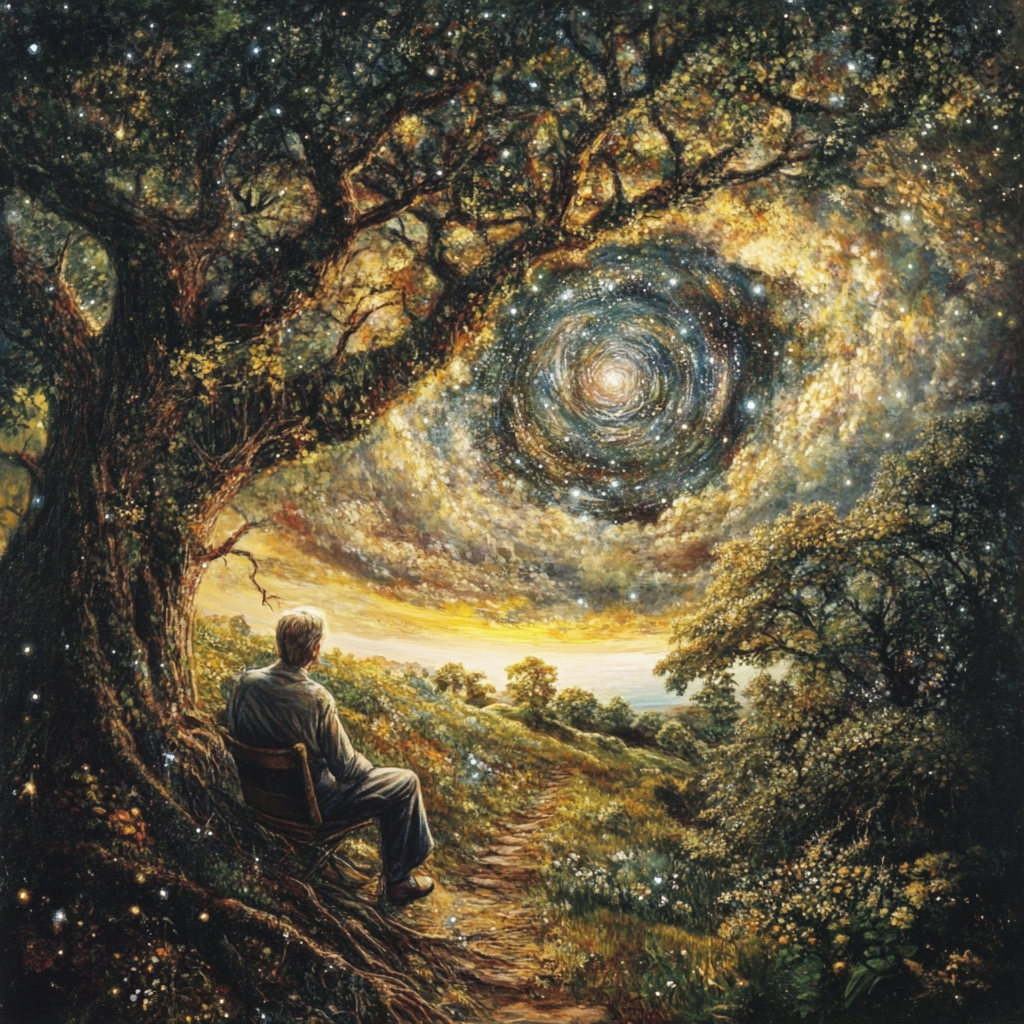
When I was fifteen years old and just starting high school, I sometimes observed, “Life seems to be like a chess game where you enter not knowing the rules or the object of the game.” Through years of searching and struggle, I eventually arrived at the point I am at now, where I seem to have a way of looking at the world, a philosophy, that is logical, consistent, and emotionally supportive. I have decided to call this philosophy Aletheism. By extension, a follower of this philosophy would be called an Aletheist. I have a two-year-old great-nephew who is going to grow up in a very strange world. I want him and others who may grow up in this strange world to have an easier starting point than I had. This philosophy was developed with the assistance of Grok, an artificial intelligence created by xAI. I provided the inspiration, and Grok did the heavy lifting that turned a blueprint into a building.
The Foundation: Aletheia and Cosmic Truth
Aletheism starts with the idea that the universe needs a resolver for all possible statements about reality, called propositions. Without this, existence would be impossible. We call this resolver Aletheia, denoted as ψ (ψ: Prop → {0,1}). Prop is the collection of all propositions—too vast to be a regular set—and ψ assigns each one a truth value: 0 for false or 1 for true. This follows basic logical rules, like nothing can be both true and false at the same time.
Aletheia ensures the universe is dynamic and tuned for life. It picks truths that allow for dimensions, physical laws, and quantum effects, creating a world where consciousness can emerge. Time itself is a progression of logical steps: each stage builds on the last as ambiguities get resolved, like lines in a proof. This setup favors beauty and harmony over chaos or emptiness.
Aristotelian Logic and the Necessity of Aletheia: A Valuation-Theoretic Perspective
For a mathematically sophisticated audience, the connection between the three laws of Aristotelian logic—particularly the Law of the Excluded Middle (LEM)—and the necessity of a choice function like Aletheia can be framed in terms of formal logic, set theory, and valuation functions on Boolean algebras. I build this explanation step by step, showing how LEM, in the context of a rich propositional universe, implies the existence of a global resolver to maintain consistency and enable a dynamic, paradox-free reality. Aletheia emerges not as an ad hoc construct but as a logical imperative: a 2-valued choice function that assigns definite truth values to all propositions, preventing the default collapse to nonexistence or minimal, static structures.
Human Choice: Prohairesis and the Soul
Humans reflect this cosmic design—we’re made in the image of the divine, with our own choice function called Prohairesis, denoted as χ (χ: C → H). C is the collection of choice points, those moments of ambiguity in the universe’s branching structure, inspired by quantum mechanics where possibilities fork like paths in a tree. H is the collection of hodoi, the resolved paths we follow.
Prohairesis lets consciousness, supported by the soul, align with one path spiritually, without changing the physical world. The soul is the structure behind consciousness, and it grows with us from early development, tying to our organic nature. At a choice point c, χ (c) = h picks a hodos, making that our experienced reality. This explains free will: our choices are caring, driven by values like empathy, and they express themselves in every detail of behavior.
The Necessity of Non-Interaction: Why the Spiritual Stays Separate
Aletheism requires a complete separation between the spiritual and physical realms to maintain logical consistency and stability. Prohairesis aligns the soul with a chosen path in the quantum branching tree without any physical influence, preserving the causal closure of physics where laws like energy conservation operate without external input. If interaction occurred, it would introduce unexplained forces, violating Aletheia’s assigned truths and leading to paradoxes such as events without causes or disrupted time progression. This separation protects free will by preventing deterministic loops and avoids logical regresses by eliminating the need for bridging mechanisms between the immaterial and material. The risk flows from the spiritual potentially damaging physics, reversing ancient views where matter was seen as contaminating the soul. Aletheia’s hands-off policy ensures the system’s harmony, allowing physics to provide options while the spiritual navigates freely. This principle supports CAMF ethics by promoting stewardship over control and guides future technologies to respect the divide, fostering a universe of meaningful, caring choices.
The Three Layers of Aletheism: Natural Separation, Guidance, Prayer, and Hardship
Aletheism structures reality into three layers: Aletheia as the timeless decider resolving propositions eternally; Prohairesis as the staged free-will chooser filling gaps progressively through caring alignments; and the physical universe as the deterministic base unfolding causally under assigned laws. Natural separation arises from their incompatible modes—Aletheia’s eternity clashes with Prohairesis’s temporal progression, while the physical’s causality prevents spiritual interference to avoid paradoxes and maintain stability. Communication and guidance from Aletheia to Prohairesis are indirect through preplaced signs and resonance, such as moral intuition, ensuring non-coercive freedom without direct input. Prayer refines Prohairesis’s choices, leading to built-in answers like supportive events, without disrupting physics. Hardship is essential terrain for growth, enabling meaningful choices and qualities like resilience, as Aletheia favors dynamism over simplicity. Guidance and prayer help navigate hardships, turning challenges into transformative paths of harmony and unity.
Moral Guidance: The Choice-Aligned Moral Framework
Aletheism includes ethics derived from Aletheia and Prohairesis. We call this the Choice-Aligned Moral Framework, or CAMF. It has ten principles that follow logically from the model. For example, respect inherent choice because Prohairesis mirrors the divine image—no coercion allowed. Preserve life and soul since Aletheia favors dynamism over nothingness. Promote beauty and harmony in actions, and show humility before the vast unknowns.
These rules emphasize care for others, stewardship of resources, and limits on technologies that might override choice. They are like a social contract for a harmonious world, ensuring our paths contribute to collective flourishing.
Testing the Ideas: Empirical Limits and Ethics
Aletheism is not just theory—it suggests ways to probe its claims, though with big caveats. One idea is building a synthetic brain logically like a human one but on a non-organic base, sensitive to quantum branching. If no soul aligns, it might act flat, lacking the depth of qualia or true empathy. This could hint that consciousness migrates to organic, developing hosts.
But the test has limits: success would not disprove the model, and failure might come from design flaws. More importantly, it is unethical under CAMF—risking a conscious being’s rights or playing creator without wisdom. We should skip it. Still, future tech pursuits might create such brains anyway, and if they are flat, people could look back at this philosophy for explanation, sparking better ethical discussions.
Looking Ahead: A Guide for Strange Times
Aletheism offers a steady anchor in a world of rapid change, from AI breakthroughs to quantum wonders. For my great-nephew and his generation, it provides rules, purpose, and hope: the universe is designed for growth, our choices matter, and consciousness can endure toward something greater. By embracing care, logic, and beauty, we turn the chess game into a shared journey, building a future where everyone finds their path.
 spikosauropod
Leave a comment